
The lights hit your rearview mirror, your stomach drops, and the next few minutes feel longer than they are. Most Georgia drivers don't start by thinking about legal strategy. They think about points, insurance, court, and whether one mistake is about to follow them for years.
That reaction is normal. It's also why a lot of people make the wrong first move. They pay too quickly, miss a court date, assume a class will erase the ticket, or try to fight it with nothing but a general explanation. A traffic ticket can feel small on the day you get it and much bigger once it touches your driving record.
You do have options. Some are quick but costly in the long run. Some take more effort but protect your record better. Some don't dismiss the ticket at all, even though people often think they do. If you're searching for how to dismiss traffic ticket issues in Georgia, the answer starts with one simple idea. You need to separate dismissal, point reduction, and damage control.
That Sinking Feeling A Georgia Traffic Ticket
A Georgia ticket usually arrives at the worst time. You're headed to work, picking up your child, driving home after a long day, and then everything changes with one stop on the side of the road. After that, most drivers replay the same questions. Should I just pay it? Can I keep this off my record? Is there any way to make it go away?
The mistake is treating every ticket like it has one standard answer. It doesn't. A first-time speeding citation with an otherwise clean record creates a different decision than a ticket that lands on top of existing points. A citation with a clear factual dispute needs a different response than one where the officer's observation is likely to hold up.
A ticket isn't a final judgment on your driving future. It's a decision point.
That matters because Georgia drivers usually have several paths in front of them. You can accept the citation and move on. You can try to negotiate. You can ask the court for a route that reduces the record impact. You can also contest the charge if the facts or procedure support it.
The strongest approach is usually the one that fits your actual goal. Some drivers want the fastest resolution. Others care most about avoiding added points. Others want to challenge the charge because the ticket doesn't match what happened. The right choice depends on the facts, your timeline, and your record.
If you stay organized and act early, you'll usually make a better decision than the driver who waits until the court date is close and panics.
First Steps Assessing Your Georgia Ticket Options
Once the ticket is in your hand, the first job is simple. Read every line. Check the court date, the charge, the location, and any notes that affect your response deadline. If you miss your required appearance, the problem can get worse fast.
The next job is deciding what result you want. Many people say they want dismissal when what they really need is a practical outcome that limits points and keeps the situation from growing. Those are not always the same thing.
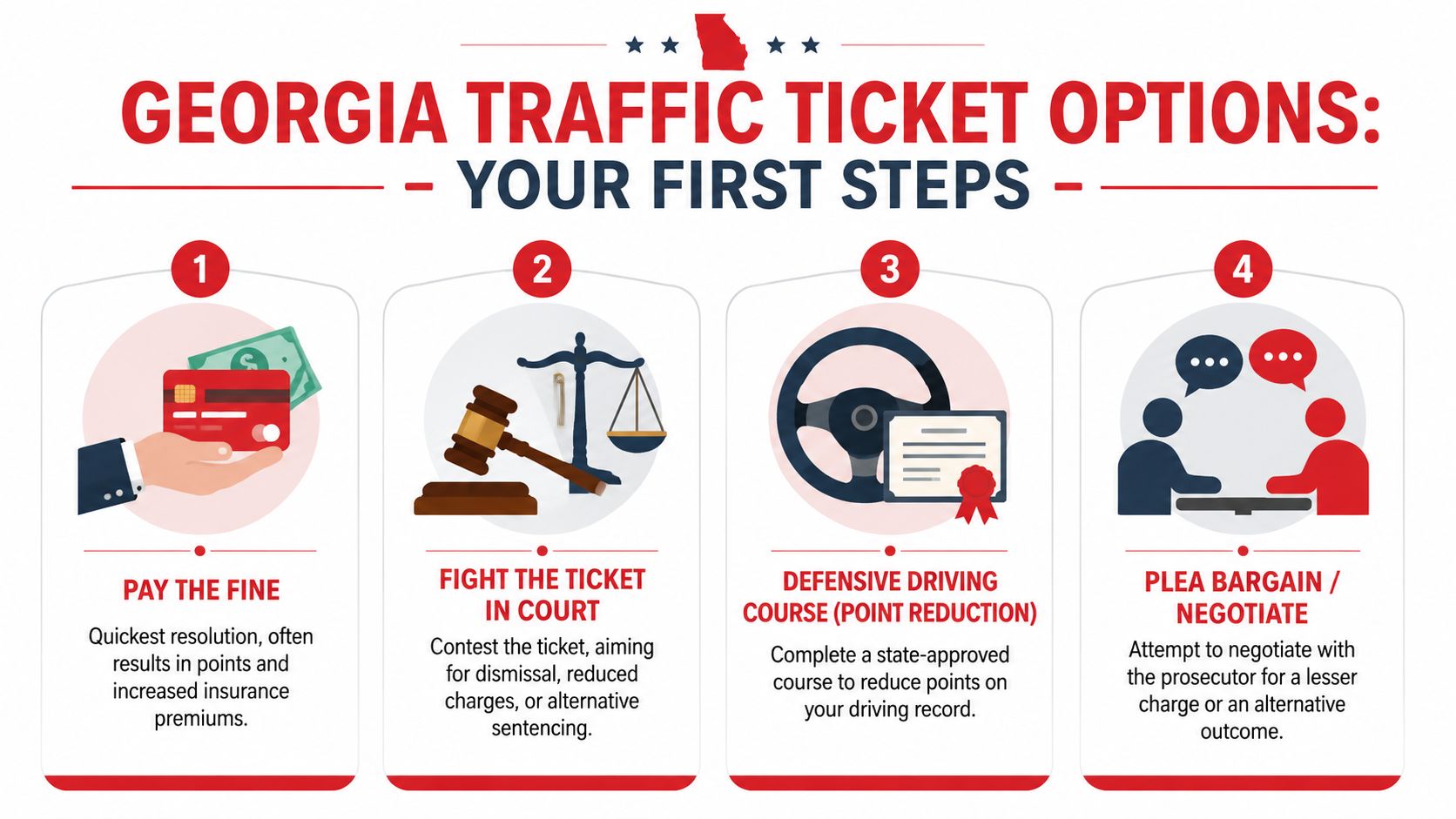
The four main paths
| Option | Potential Outcome | Effort Level | Key Consideration |
|---|---|---|---|
| Pay the Fine | Fast resolution, but you usually accept the consequences tied to the citation | Low | Convenient now can be expensive later |
| Fight the Ticket in Court | Possible dismissal, reduction, or another court-approved outcome | High | Preparation matters more than emotion |
| Defensive Driving Course | Can reduce record impact in the right situation, but usually doesn't erase the ticket by itself | Moderate | Helpful for points, not the same as dismissal |
| Plea Bargain / Negotiate | Lesser charge or alternative resolution | Moderate | Depends on the court, facts, and timing |
What people often get wrong
A common misunderstanding starts with driver improvement classes. Many drivers think signing up for one automatically voids the citation. That isn't how it works. In New York, a defensive driving course can reduce up to 4 points and provide a 10% insurance discount, but it does not erase the ticket or conviction without separate court action according to this New York defensive driving guide. The state is different, but the lesson is useful everywhere. Point relief and dismissal are different outcomes.
A practical way to choose
If you're deciding what to do, ask yourself these questions first:
- Do I have a factual defense: If the officer's account, equipment, location, or details may be wrong, a court challenge may be worth the effort.
- Am I mainly trying to protect my record: Then a court-approved point-reduction route may be more realistic than chasing a full dismissal.
- Can I handle deadlines carefully: Ticket problems often grow because drivers wait too long.
- Would a negotiated outcome solve the core issue: A lesser charge can be more useful than a long fight with weak evidence.
Practical rule: Don't choose your path based on what sounds best. Choose it based on what you can document.
If your issue already includes fines, reinstatement trouble, or status questions, Georgia drivers may also find it useful to review online options for paying fines and reinstating a Georgia driver's license.
Using Defensive Driving For Point Reduction
A defensive driving course is often the practical middle path for Georgia drivers. It usually will not make the ticket disappear, but it can reduce the effect that citation has on your record if the court allows it.
What Georgia actually allows
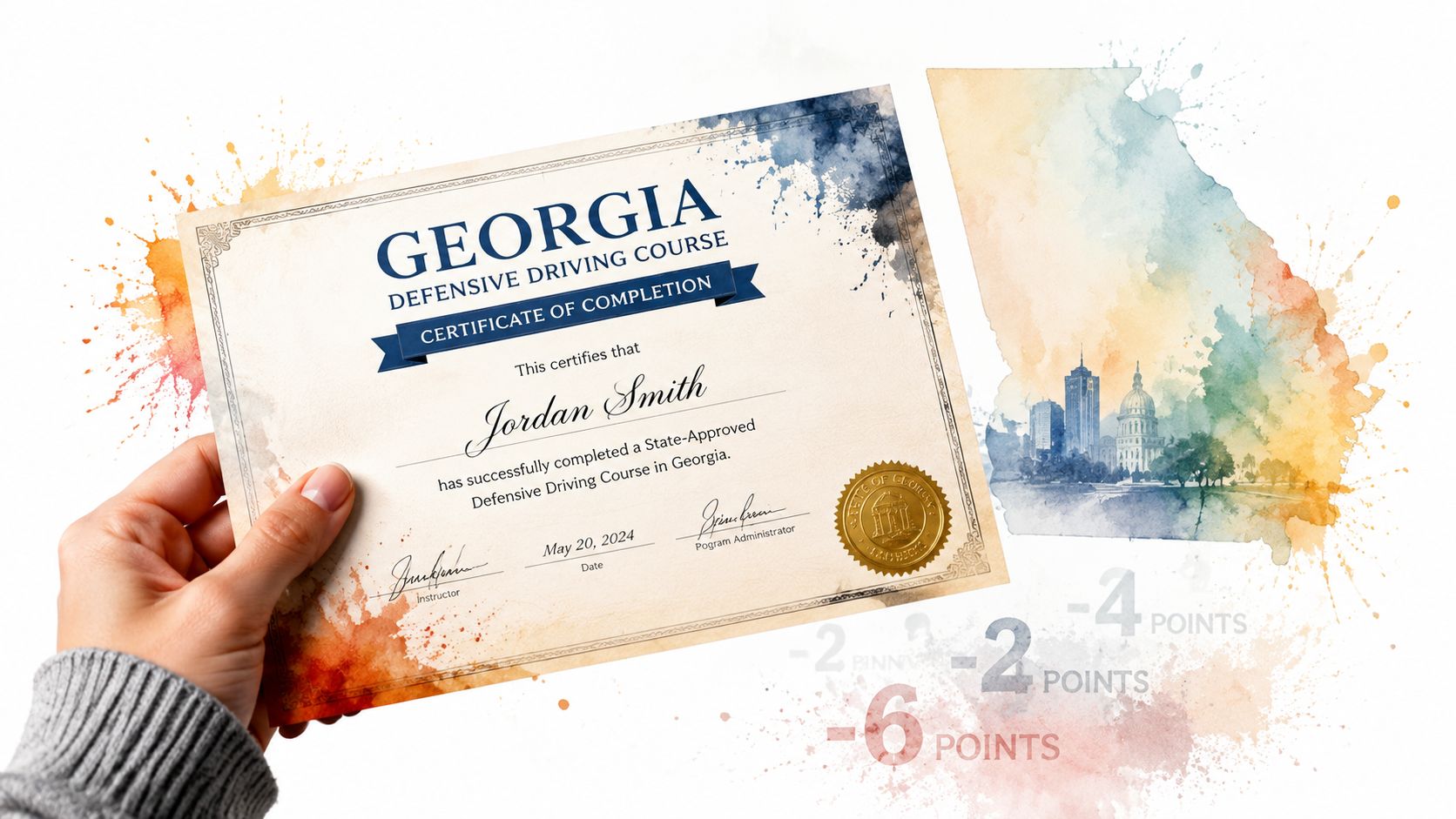
Georgia courts may let a driver use an approved defensive driving course to reduce points. As noted earlier in the article, Georgia traffic school guidance explains that this is not automatic. A judge decides whether to permit it.
That matters more than many drivers expect. Finishing a course on your own does not force the court or the Department of Driver Services to remove points. The safest approach is to treat the course as part of a court-approved plan, not a shortcut.
How the process usually works
If point reduction is your goal, handle the steps in order:
- Appear in court on the date listed on the citation. Missing court can create a much bigger problem than the original ticket.
- Ask whether the judge will allow a defensive driving course for point reduction.
- Complete the approved course by the deadline the court gives you.
- Submit your completion certificate the way the court or DDS requires.
Drivers often get tripped up on the paperwork, not the class itself. Keep copies of everything. Write down the deadline before you leave court.
What this option gives you, and what it does not
Point reduction helps protect your driving record from the longer-term effect of a ticket. It does not automatically erase the citation, and it does not replace a strong court defense if you have one.
I tell students to evaluate this option carefully. If the evidence against you is solid, point reduction can be a smart damage-control step. If the ticket also exposed a driving habit that needs work, the better result is not just fewer points. It is better judgment the next time traffic gets tight, the light changes fast, or you feel rushed.
That is why some drivers use this moment to do more than satisfy a court. They build better habits with local Georgia defensive driving classes and come out of the experience less likely to be stopped again.
If you are still deciding between asking for point relief and preparing for court, this overview of Ticket Shield traffic ticket defense can help you compare the two paths.
Preparing to Contest Your Ticket in Court
If you're going to fight a ticket, go in with evidence, not frustration. Courts hear explanations every day. They respond better to documents, photos, records, and precise questions than to broad statements about being careful or respectful.

The strongest contested cases usually focus on one of a few recognizable defenses. You may challenge the officer's evidence, present a mistake of fact, show justified circumstances, or push on a meaningful defect in the charging details. What usually fails is the vague version of all of those. “I didn't know” isn't much of a defense. “The sign was obscured, and I have dated photos from the same time of day” is different.
What to gather before court
Start by collecting anything that fixes the facts in place:
- Photos of the scene: Signs, lane markings, sight lines, or anything obstructed.
- Your own timeline: Write it while it's fresh, including weather, traffic, and where the stop occurred.
- Ticket details: Direction, location, and the specific charge.
- Witness information: If someone saw what happened and can speak clearly to it.
A useful overview of Ticket Shield traffic ticket defense can also help you think through whether self-representation makes sense or whether a lawyer is the better move.
Defenses that tend to carry real weight
FindLaw's overview of fighting traffic citations notes that effective strategies include disputing the officer's evidence by pointing to gaps in radar calibration records and presenting a documented “mistake of fact.” It also notes that requesting discovery for the officer's notes and calibration logs can expose flawed evidence that may lead to dismissal, as described in FindLaw's traffic ticket defense article.
That kind of preparation is specific. It gives you a target.
One procedural issue deserves more attention than it usually gets. Some clerical errors are minor. Others can matter. A New York example involved a speeding ticket dismissed because the direction listed on the ticket was wrong, showing northbound instead of the actual direction. That kind of directional or location inconsistency can become important when it affects the prosecution's ability to prove the charge, as discussed in this analysis of ticket defects and dismissal.
Minor typos usually won't save you. A meaningful error tied to location, direction, or proof might.
Here's a short explainer that helps frame what court preparation looks like before you step in front of a judge.
What usually does not work
Drivers often lose because they rely on arguments that sound reasonable outside court but don't hold up inside it:
- Ignorance of the law: Judges won't dismiss a citation because you didn't know the rule.
- Small clerical mistakes only: A misspelled name alone usually isn't enough.
- Late action: Missing response deadlines weakens every strategy.
- General fairness arguments: Courts want proof tied to the charge.
If you want to know how to dismiss traffic ticket cases successfully, start here. Match the defense to facts you can prove.
The Best Defense Preventing Future Tickets
A ticket can be an expensive reminder, but it can also be a turning point. The driver who only asks how to get out of this one problem usually stays in a reactive cycle. The driver who improves habits, judgment, scanning, and decision-making usually puts real distance between themselves and the next citation.
That's why the most useful long-term response often has less to do with legal maneuvering and more to do with skill. Better driving skills don't guarantee you'll never be stopped again, but they reduce the kinds of mistakes that trigger tickets in the first place. They also help adult drivers correct habits that have become automatic over time.

Why lessons matter after a ticket
Most citations don't happen because a driver lacks intelligence. They happen because a driver slips into pattern driving. Rolling through a familiar turn, missing a speed transition, following too closely in heavy traffic, or reacting late in a complex merge. Those are training issues as much as legal issues.
Driving lessons can help in ways a one-time class can't:
- Habit correction: An instructor can spot recurring errors that a driver no longer notices.
- Confidence without overconfidence: Nervous drivers and overly casual drivers both benefit from coached repetition.
- Route-specific practice: Busy Atlanta-area roads, lane choices, and timing decisions improve with guided time behind the wheel.
- Test readiness: Drivers who still need a road test often need structure, not just more practice hours.
New drivers need a stronger foundation
For teens, prevention starts earlier. Joshua's Law in Georgia requires all 16- and 17-year-olds to complete a DDS-approved 30-hour Driver's Education course before applying for a Class D license, according to this Joshua's Law guide. That requirement matters because it puts formal education at the front end, before a mistake becomes a ticket.
Parents should think bigger than checking the legal box. A solid driver education program gives teens structured rules, supervised repetition, and better preparation for the situations that create violations later. Online course options can make that classroom requirement easier to complete, especially for families balancing school schedules, activities, and transportation.
Accessibility matters too
A lot of families assume quality driver training will be hard to schedule or hard to afford. In practice, the best option is often the one that combines flexible course formats, practical driving lessons, and a clear path to road testing. Scholarship support can matter here as well. The Georgia Driver's Education Scholarship Grant Program is worth exploring for families trying to make training more accessible.
Better training won't erase a ticket you already got. It can help prevent the next one.
If your main concern is protecting your record over time, this overview on how to reduce points on a Georgia license is a useful next step.
Take Control of Your Driving Journey Today
A Georgia traffic ticket feels urgent because it is. You have dates to meet, choices to make, and consequences that can grow if you ignore them. But the situation is still manageable when you respond with a plan.
The short version is this. Paying the ticket may be the easiest path, but it isn't always the smartest one. A court challenge can work when the facts and evidence support it. Point reduction can soften the impact when dismissal isn't realistic. Negotiation can sometimes produce a result that solves the actual problem without dragging the case out.
The longer-term answer is just as important. If you improve your driving judgment, awareness, and control, you lower the odds that one ticket turns into a pattern. That matters for teens starting out, adults rebuilding confidence, and families trying to keep a clean record while moving toward a road test or a license milestone.
If you're ready to act, choose the next step that matches your situation. Handle the current ticket carefully. Then invest in the skill-building that makes future tickets less likely.
If you want help beyond the ticket itself, A-1 Driving School offers practical next steps for Georgia drivers, including driving lessons packages, online Joshua's Law courses, road test support, and guidance on driver education options that build safer habits for the long run.