You may have searched for local defensive driving classes because you got a ticket, want to reduce points, or you're checking whether a course could help with insurance. That's a common starting point.
But in Georgia, that search often lands people in the wrong program.
A teen trying to earn a first license usually needs Driver's Education, not defensive driving. An adult who already has a license but feels rusty may need driving lessons, not a classroom-only course. And someone who needs to finish a court or record-related requirement may need a Driver Improvement Program, which is Georgia's defensive driving course.
I've seen this confusion for years. Parents call asking for “defensive driving” when they really mean Joshua's Law. Adults ask for “driver's ed” when what they need is one-on-one practice with parking, lane changes, and road test prep. The names sound similar, but the purpose is different.
Navigating Georgia's Driver Training Options
Defensive driving has been around a long time. The National Safety Council says it pioneered the nation's first Defensive Driving Course and has trained over 80 million drivers through its programs, which shows how widely this type of training has spread over time (National Safety Council defensive driving courses).
That history matters, but it doesn't mean every driver needs the same class.
Start with your real goal
Ask yourself one question first. What are you trying to accomplish right now?
- First license: You're probably looking for Driver's Education, and for many teens that includes Joshua's Law requirements.
- More confidence behind the wheel: You likely need driving lessons with an instructor.
- Road test help: You may need practice sessions plus a clear path to testing.
- Ticket, points, or compliance issue: You may be looking for a defensive driving class.
Most confusion comes from treating all driver training as one category. It isn't.
Practical rule: If you already have a license and need a court, points, or record-related class, think defensive driving. If you're learning to drive for the first time, think Driver's Education. If you need real-world skill building, think driving lessons.
Why local options matter
Those seeking local defensive driving classes often desire something nearby, approved, and easy to schedule. That same logic applies to every other driver training need too.
A local school can help with practical questions such as:
- Which course fits your situation
- Whether the class is online, in person, or both
- Whether the program is accepted for Georgia requirements
- What to do after the classroom portion ends
That last point gets overlooked. A classroom course can teach rules, risk awareness, and decision-making. It can't replace time in the car with an instructor who helps you turn, merge, park, and manage traffic calmly.
What Is a Defensive Driving Class
A common Georgia scenario goes like this. You already have a license, something happened on your record, and now you are searching for a class that will count for your situation. In that case, a defensive driving class usually means a Driver Improvement Program, not beginner training and not private driving practice.
What it does in Georgia
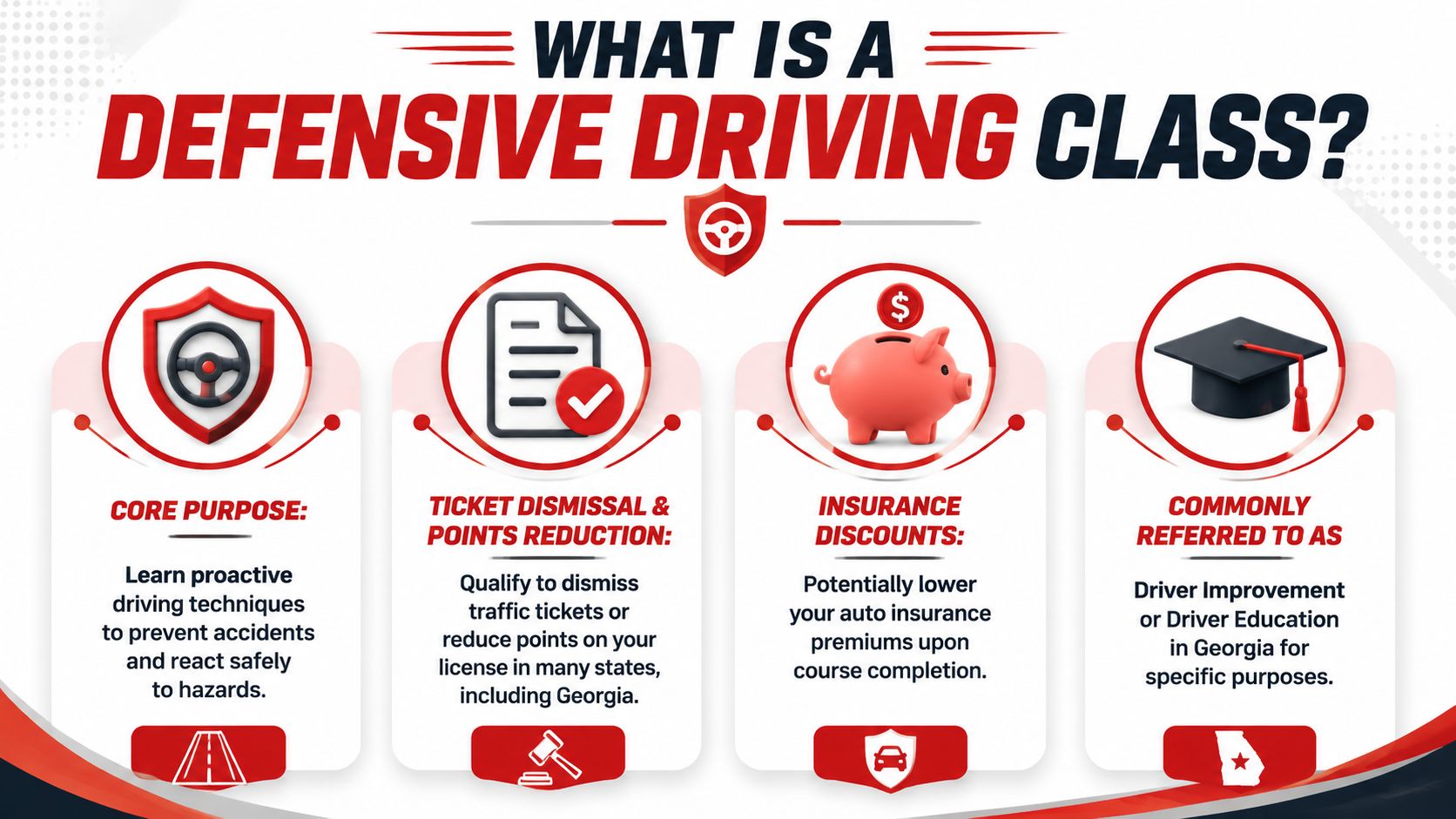
In practical terms, this course is for drivers who need a classroom-based program focused on safer choices, hazard awareness, and responsible decision-making after they are already licensed. It often comes up after a ticket, for point reduction, or because a court or employer wants proof that the driver completed an approved course.
Georgia treats defensive driving as a set course with specific rules. The class is 6 hours, and A-1 explains that eligible drivers may take it once every 5 years to remove up to 7 points from a driving record on its online Georgia defensive driving course.
A simple way to sort it out is this: defensive driving helps licensed drivers correct, refresh, or document safe driving behavior. It does not teach a brand-new driver how to start from scratch, and it does not replace time in the car with an instructor.
Who usually takes it
The right fit is often a driver in one of these situations:
- Court or citation needs: You were told to complete a driver improvement course.
- Point reduction: You want to reduce points on an eligible Georgia driving record.
- Safety refresher: You have driving experience but want a structured review of risk awareness and decision-making.
- Insurance questions: You want to ask your insurer whether course completion qualifies for any discount or benefit.
A good analogy is a tune-up. Defensive driving helps sharpen judgment and reinforce safer habits for someone who already knows how to operate a vehicle. If your need is steering control, parking practice, lane changes, or road test preparation, that points to driving lessons instead.
Defensive Driving Versus Driver's Education
A parent calls because their 16-year-old needs help getting licensed. A different caller already has a license and wants to deal with points after a ticket. Both ask for a "driving class." In Georgia, those are usually two different needs.
That confusion happens all the time because the names sound similar. The purpose is what separates them.
Defensive driving helps an experienced driver review judgment and meet a specific requirement
A defensive driving class fits someone who already knows how to drive and already holds a license. The goal is usually to complete a court-accepted course, address a point-related issue, or get a structured safety refresher.
Driver's Education serves a different job. It teaches a new driver the rules of the road, basic risk awareness, and the foundation needed before independent driving starts to feel natural. For Georgia teens, that often connects to Joshua's Law requirements and the process of earning a first license.
One way to keep it straight is to compare it to sports. Defensive driving is film study and strategy review for someone already in the game. Driver's Education is the beginner program that teaches the rules, positions, and basic mechanics.
That distinction matters because enrolling in the wrong course wastes time and does not solve the actual problem.
The easiest way to separate the three programs
| Program | Best for | Main outcome |
|---|---|---|
| Defensive Driving | Licensed drivers | Documentation, record-related needs, and a structured safety review |
| Driver's Education | New drivers | Preparation for a permit, supervised practice, and a first license |
| Driving Lessons | Teens or adults who need hands-on practice | Better vehicle control, more confidence, and road test readiness |
Driving lessons belong in this comparison because families often mix them up with both classroom options. A student can finish an education course and still need help with turns, parking, lane changes, or traffic timing. That is a practice problem, not a defensive driving problem.
A good example is hazard recognition. A student may learn the IPDE process for safe driving decisions in training, but knowing the steps on paper is different from using them calmly in busy traffic. Driver's Education introduces that thinking. Defensive driving reviews it for licensed drivers. Driving lessons let an instructor watch how the student applies it in real time.
This short video helps illustrate the difference between learning about driving and developing safer driving habits in practice.
If your teenager is working toward a first Georgia license, start by matching the program to that goal. Driver's Education covers the beginner requirements. Driving lessons build the skill. Defensive driving is usually the right fit later, after a person is already licensed.
The A-1 Advantage Professional Driving Lessons
A student can understand the rule for a four-way stop and still hesitate when four cars arrive at once. That gap matters. It is the difference between knowing the material and using it under pressure.
Driving lessons help close that gap. Lessons and lesson packages are where many students improve the fastest. A teen may complete an online course and still feel tense in traffic. An adult may remember the rules but struggle with left turns, highway merging, backing, or parallel parking. In-car practice gives those drivers a place to repeat the skill, get feedback, and try again while an instructor is watching.
Why behind-the-wheel training matters
Behind-the-wheel instruction works like supervised practice in a real lab. The road provides the situation. The instructor helps the student read it, respond to it, and correct mistakes before those mistakes turn into habits.
That kind of coaching is useful because driving problems are often specific. One student brakes too late. Another checks mirrors but forgets blind spots. Another slows down well but turns too wide. A classroom course can explain all of those topics. A road lesson shows which problem is holding the driver back.
For many students, lessons help with:
- Starting from zero: learning steering control, braking, lane position, and how traffic flows
- Closing skill gaps: correcting wide turns, late braking, hesitation at stops, or weak mirror habits
- Road test preparation: practicing the driving behaviors the examiner will watch for
- Nervous driving: building confidence in small steps instead of rushing too much at once
Some students need a full beginner plan. Others need a few focused sessions before the road test. The best lesson package fits the driver's current skill level and goal.
Teens and adults usually need different kinds of help
A teen driver often needs structure, repetition, and a clear routine. An adult driver often needs calm coaching and a chance to rebuild confidence.
For teens, the lesson may focus on habits that should become automatic, such as scanning ahead, judging following distance, and setting up turns early. For adults, the issue may be different. They may be returning to driving after years away, feeling anxious after a bad experience, or adjusting to Georgia roads after moving from another state or another country.
That is why professional lessons matter even after coursework is finished. Passing a written course does not always mean a person is ready for busy intersections, fast traffic, or test-day pressure.
“I know the rules” and “I can handle real traffic calmly” are two different stages of learning.
What to look for in lesson packages
When comparing schools, look past the simple question of whether lessons are offered. The better question is how the instruction is organized and whether it matches the student's needs.
Helpful details include:
- Flexible pacing: some students need a slower build, while others are ready to add harder skills sooner
- Clear lesson goals: each session should focus on specific skills instead of repeating the same drive
- Scheduling options: school, work, and family routines affect how practice fits into the week
- Road test focus: training should connect to the skills needed on exam day and in everyday driving
A-1 Driving School offers teen and adult driving lessons, road test preparation, and lesson packages for drivers who need practical, in-car instruction.
Your Complete Path to a Georgia Driver License
For a new driver, the process feels easier when you break it into clear stages. The goal isn't just to finish a requirement. It's to move from permit to real-world independence without skipping the parts that build judgment and confidence.
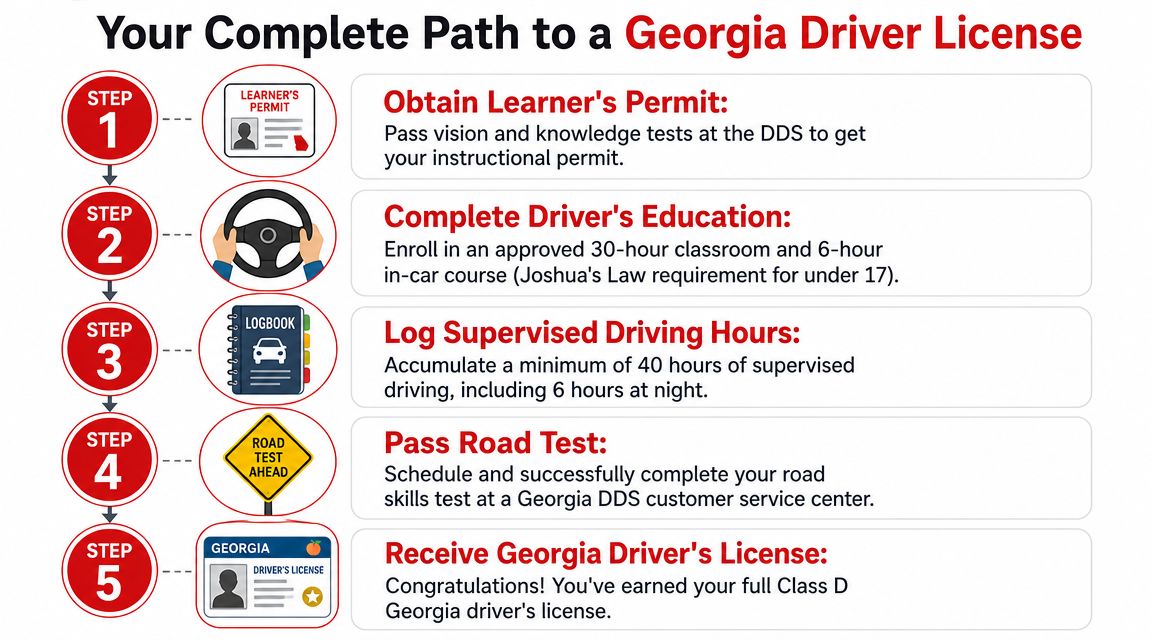
A simple path for teens and families
Many Georgia families are balancing school, sports, work schedules, and permit timelines. That's why flexible course options matter.
Some students do better in a traditional classroom. Others stay on track better with online coursework they can complete from home. If your main need is Joshua's Law, online Driver's Education can make the academic side more manageable while leaving room to schedule in-car lessons separately.
The bigger mistake is thinking the classroom course is the whole process. It isn't. New drivers still need practice, coaching, and a plan for the road test.
How the pieces fit together
A practical path usually looks like this:
Get the permit
The student starts by meeting Georgia permit requirements and learning the rules of the road.Complete Driver's Education
Joshua's Law often applies to eligible teen drivers within this requirement.Add driving lessons
Professional instruction helps students apply what they studied, correct mistakes early, and practice in real traffic.Prepare for the road test
Students should practice test-style maneuvers and common driving situations, not just casual neighborhood driving.Take the test with a plan
Familiarity with the process lowers stress and helps students perform more consistently.
Families who want a broader overview of steps, documents, and timing can review this guide on how to get a driver's license in Georgia.
Online courses, road testing, and scholarship support
Convenience matters. Some local traffic safety programs in other states are still entirely classroom-based. For example, Madison College states its traffic safety education courses are 100% in-person with no online option, and the Wisconsin Technical College System routes those courses through district colleges, which shows how format can vary sharply by market (Wisconsin traffic safety course format overview).
Georgia families often expect more flexibility. That's why online Driver's Education options can be so helpful.
For many students, the most useful combination is:
- Online coursework for schedule flexibility
- Driving lessons for real skill development
- Road test services or prep to reduce last-minute confusion
- Scholarship guidance for families seeking help with training costs
The Georgia Driver's Education Scholarship Grant Program can also be an important option for families trying to make training more affordable. If you qualify, it can make it easier to move from “we need lessons” to “we can start now.”
Find Your Perfect Driving Program Today
By this point, the main question usually becomes clear. You probably don't just need “a driving class.” You need the right kind of training for your exact situation.
If you're a licensed driver handling a ticket or point issue, local defensive driving classes may be the right fit. If you're a parent helping a teen get started, you're probably looking for Driver's Education and Joshua's Law support. If you're a teen or adult who wants to feel steady, safe, and test-ready, driving lessons are often the most useful next step.
Match the program to the problem
Use this quick checklist:
- Need help with a driving record issue? Look at defensive driving.
- Need a first license? Look at Driver's Education and Joshua's Law.
- Need confidence in traffic? Book driving lessons.
- Need to prepare for the exam? Add road test practice and testing support.
That last category is where many students improve the fastest. Lessons and lesson packages give you something a self-study course can't provide. A trained instructor watching your decisions in real time.
Keep it simple
You don't have to guess your way through Georgia driver training. Start with your goal, choose the program that matches it, and make sure the school and course format fit your schedule.
For most families and adult learners, the smartest move is to think beyond the classroom. Online learning can help with convenience. Driving lessons build the skill. Road test prep ties everything together.
If you're ready to choose the right next step, visit A-1 Driving School to compare Driver's Education, Joshua's Law options, driving lessons, lesson packages, road test help, and defensive driving courses in Georgia.