You've done the permit phase. You've sat through class. You've logged practice. Now the road test feels close enough to make every small mistake seem bigger than it is.
That's usually when families start looking at a virtual driving test simulator. The appeal is obvious. You can repeat tricky situations, make mistakes without real-world consequences, and build familiarity before an instructor or examiner is watching. Used the right way, a simulator is helpful. Used the wrong way, it gives people false confidence about what Georgia requires.
The line matters. A simulator can sharpen awareness, expose weak habits, and make your first in-car lesson more productive. It can't replace the legal steps for Joshua's Law, and it can't stand in for real time behind the wheel on Georgia roads.
Your Smart Start to Georgia Road Test Prep
A lot of teens reach the same point with the same question. “I've had my permit, I finished the classwork, and I'm nervous about the road test. What can I do before I get back in the car?” That's where simulator practice makes sense.
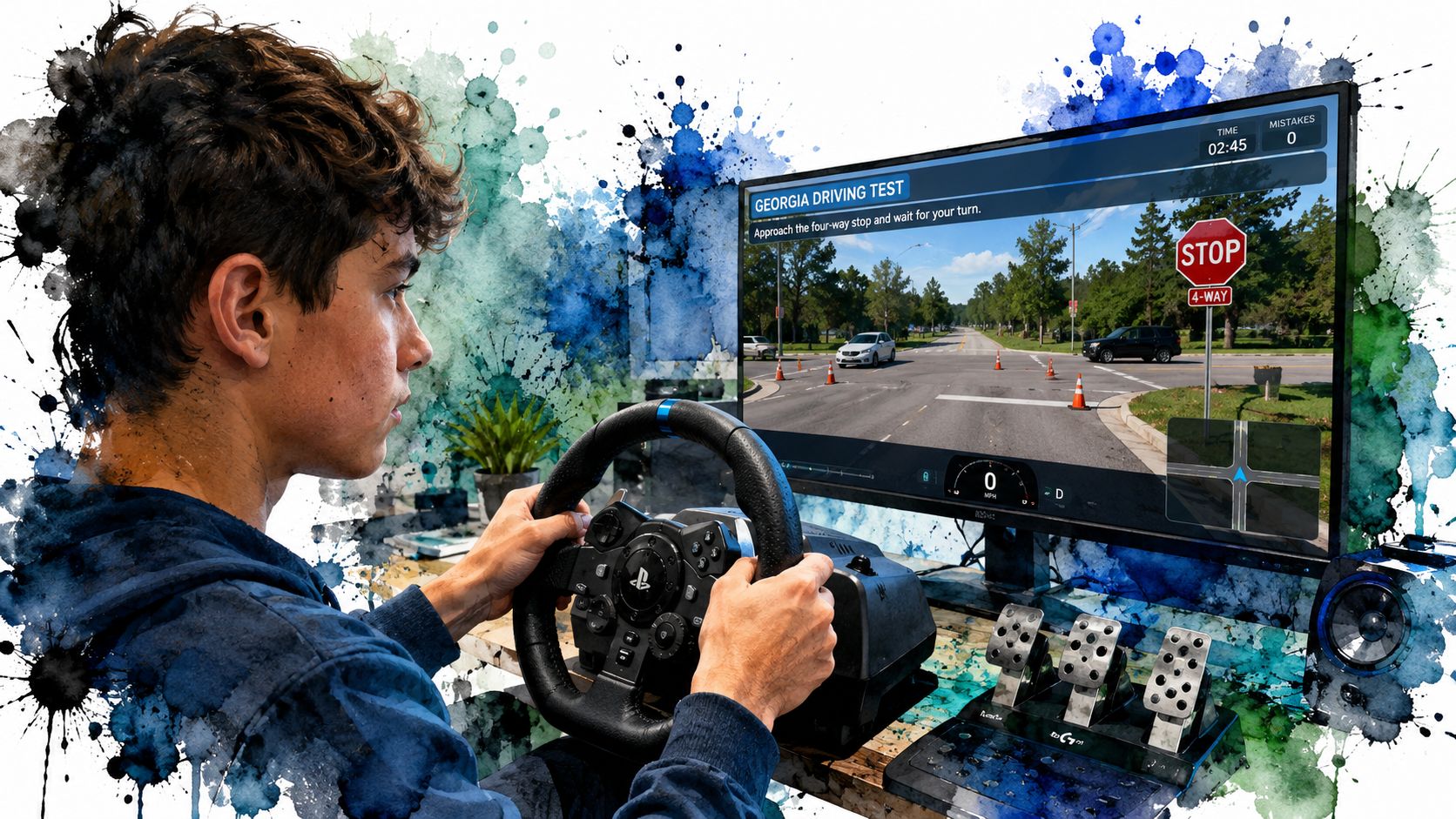
A good virtual driving test simulator works like a rehearsal space. It lets you practice scanning, lane positioning, braking decisions, and reaction timing without traffic pressure or a parent grabbing the armrest. For a new driver, that repetition matters.
There's also real reason to take these tools seriously. A virtual skill-based driving test can identify new drivers who are at higher than average risk for a crash within one year after they receive their licenses, according to NIH-funded research on virtual driving assessment. That doesn't mean a simulator is magic. It means the right virtual exercises can reveal meaningful weaknesses before those weaknesses show up on the road.
What a simulator helps with
A simulator is most useful before or between live lessons when a student needs to slow the process down and repeat the basics.
- Hazard scanning: Looking ahead instead of staring at the bumper in front of you.
- Decision timing: Knowing when to brake, yield, or commit to a turn.
- Lane control: Holding position without drifting.
- Nerve control: Getting used to traffic situations before they happen in a real car.
Practical rule: Use simulator practice to prepare for coaching, not to avoid coaching.
That distinction saves people a lot of frustration. If you treat a simulator as prep, it can lower anxiety and make your on-road lessons more efficient. If you treat it as a substitute for real driving, it won't hold up when the car moves, the road crowns, another driver hesitates, or a pedestrian appears where you didn't expect one.
Where it fits in a Georgia prep plan
For Georgia teens, the strongest sequence is simple. Finish the required coursework, practice the mental side of driving with a simulator, then take those lessons into the car with an instructor who can correct timing, spacing, and judgment in real traffic.
If you're trying to organize that process, A-1's guide on how to prepare for the driving test is a practical place to start. It helps families line up what should happen before test day, instead of guessing.
Choosing and Setting Up Your Simulator
The biggest mistake I see is students practicing on something that behaves more like a game than a car. If the steering is exaggerated, braking feels fake, or the road scenarios are cartoonish, the habits won't transfer well.

You don't need a luxury setup, but you do need one that teaches useful behavior. Research on VDI simulators found statistically significant gains in hazard recognition and steering accuracy, with participants showing up to a 30% improvement in hazard perception scores after completing simulator modules, as noted in the VDI simulator resource summary. That's a good argument for choosing a system designed for skill-building, not entertainment.
What to look for
Some features matter more than others.
| Feature | Why it matters |
|---|---|
| Steering wheel and pedals | They build better hand and foot timing than a keyboard or controller |
| Realistic road environments | Students need intersections, lane changes, signs, and traffic flow |
| Error feedback | You should be able to review braking, lane position, and missed hazards |
| Multiple scenario types | Practice should include turns, parking, merging, and sudden conflicts |
Skip anything that pushes speed, racing lines, or aggressive maneuvering. Georgia road test prep is about control, observation, and judgment.
Setup details people overlook
Placement changes the quality of practice more than is commonly assumed.
- Seat position: Sit upright, with arms slightly bent and both hands able to control the wheel smoothly.
- Screen height: Keep the display close to your natural line of sight so you're not looking down.
- Pedal calibration: Make sure the brake isn't overly sensitive or unrealistically soft.
- Steering response: If the wheel snaps too quickly, you'll build jerky habits.
A simulator should make you calmer and more precise. If it encourages overcorrection, it's teaching the wrong lesson.
One more point. Short sessions are better than marathon sessions. Focused practice on one or two skills usually transfers better than an hour of random driving.
Key Scenarios for Georgia Road Test Practice
When students say they're “practicing everything,” that usually means they're practicing nothing in a focused way. The Georgia road test rewards steady basics. A simulator helps most when you isolate the exact situations that make new drivers tense.
One student might freeze at a four-way stop because they're unsure whose turn it is. Another does fine in traffic but falls apart during backing or parking. The value of a virtual driving test simulator is that you can repeat the same setup until the decision process becomes familiar.
The scenarios worth repeating
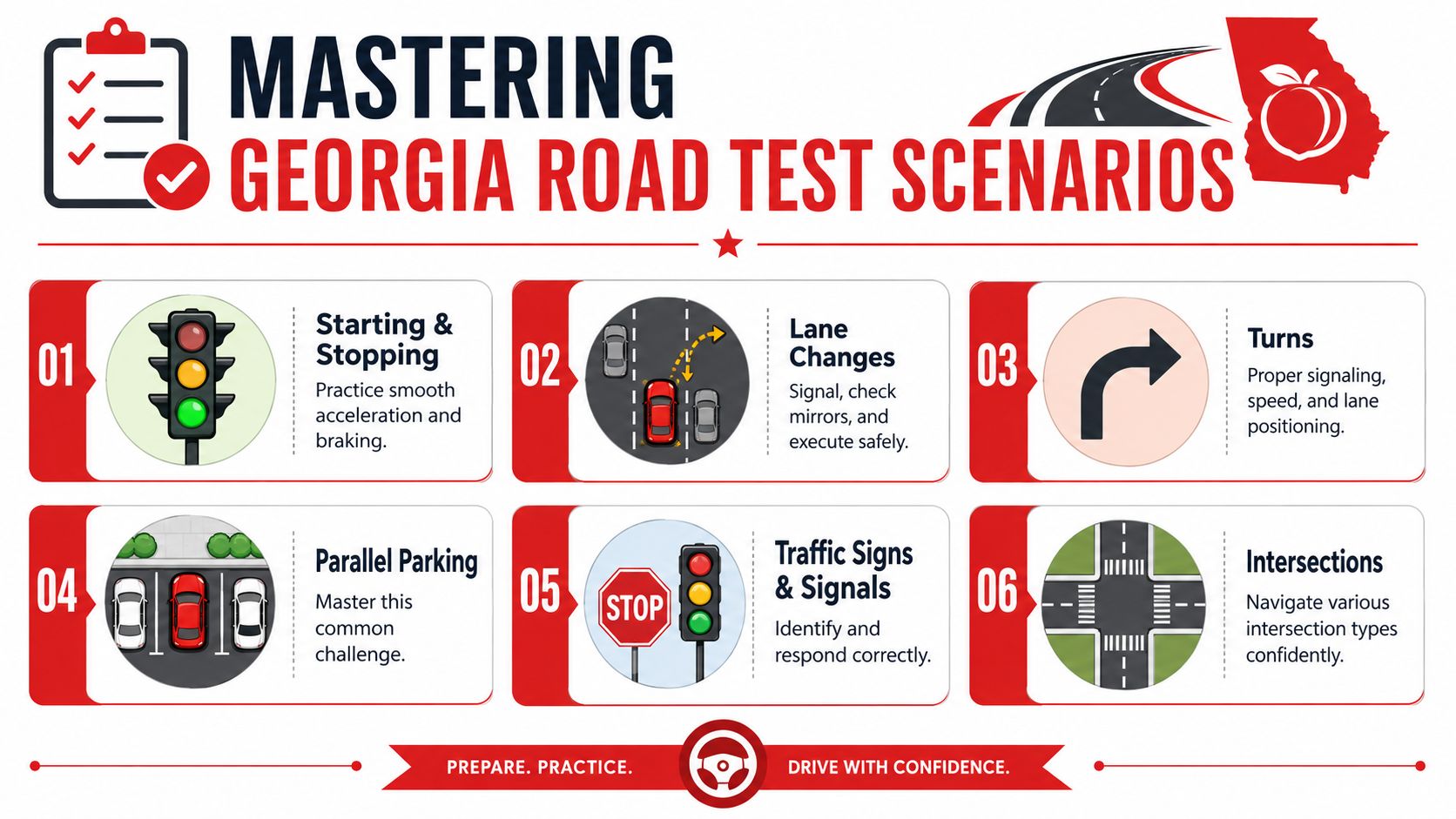
These are the ones I'd prioritize for Georgia road test prep:
Smooth starts and stops
New drivers often brake late or release the brake too quickly from a stop. In a simulator, you can work on gentle pedal control without traffic pressure.Lane changes with full observation
This isn't just about moving over. It's mirror use, signal timing, blind-spot awareness, and maintaining speed.Turns at the right speed
Students commonly enter too fast, drift wide, or cut the wheel too early.Parallel parking and backing control
For parallel parking and backing control, slow steering discipline matters more than confidence. A step-by-step refresher like this parallel parking guide helps when a student keeps rushing the setup.Intersections and right-of-way decisions
This includes stop signs, traffic lights, and moments when other drivers behave unpredictably.Hazard response
A car brakes suddenly. A pedestrian appears near a crosswalk. Someone edges out from a driveway.
Why hazard drills matter so much
Data shows a 20 to 30% improvement in novice drivers' hazard detection after simulator training, according to this summary on driving simulator hazard practice. That matches what instructors care about in real cars. Safe driving isn't just vehicle control. It's noticing trouble early enough to stay out of it.
A student who sees a problem early usually drives better than a student with perfect parking but poor awareness.
That's why I'd rather see a teen practice ten careful intersection decisions than spend the whole session trying to “beat” the simulator. Road test success comes from consistency. Real safety does too.
Understanding Simulator Scores and Feedback
Most students finish a simulator session and look at the score like it's a grade. That's not the best use of it. The report matters more than the final number.

A strong simulator gives the same kind of benefit that a calm instructor gives. It shows patterns. Virtual driving simulators use a standardized, unbiased evaluation methodology, capturing real-time driving errors and detailed progress reports to ensure fair assessment under identical conditions for all drivers, as described in this overview of simulator-based driving evaluation.
What common feedback usually means
Here's how I'd interpret the most common problem flags:
| Feedback item | What it often means on the road |
|---|---|
| Lane deviation | You're steering late, staring too close ahead, or overcorrecting |
| Delayed braking | You're spotting conflicts too late |
| Incomplete stop | You're rolling through because you're thinking ahead too quickly |
| Unsafe following distance | You're not managing space or you're pacing the car ahead |
| Missed mirror check | Your routine isn't consistent before speed or lane changes |
Don't try to fix all of it at once.
Turn feedback into a practice plan
Use a simple review method after each session:
- Pick one recurring error: Repeated lane drift is more important than one awkward turn.
- Match it to a cause: Was it vision, timing, steering input, or rushing?
- Run the same scenario again: Repetition is the point.
- Carry one lesson into the car: If the simulator says you brake late, your next live lesson should focus on looking farther ahead.
Review patterns, not just mistakes. One mistake can be random. A repeated mistake is a habit.
That's where simulator practice starts to become useful instead of just interesting.
From Simulator to Street With A-1 Driving Lessons
This is the line Georgia families need to hear clearly. A simulator can help you practice. It doesn't satisfy the legal driving requirements for a teen license.
For teens under Joshua's Law, the classroom part matters, but so does actual driving. Georgia requires real on-road experience, and no state rule allows a virtual test to substitute for the physical road test or the 40-hour practice requirement, as explained in this discussion of simulator limits and Georgia driving requirements. That's the legal answer.
What simulators can't replace
Let's clear up the common confusion.
- They don't replace Joshua's Law coursework.
- They don't replace behind-the-wheel instruction.
- They don't replace the road test.
- They don't count as the required practice hours on public roads.
That isn't a knock on simulators. It's just the boundary between practice and compliance.
The combination that works better
The smarter approach is to let the simulator expose your weak spots, then work on those weak spots in the car. If a student consistently turns too wide in a simulator, that gives an instructor a starting point. If the student hesitates too long at intersections, that can be coached directly in traffic.
That's where professional lessons matter most. Real roads add variables a simulator can't fully reproduce. Speed judgment feels different in motion. Brake pressure feels different with weight transfer. Intersections feel different when another driver waves you through at the wrong time.
For students who want flexible prep before in-car work, online driving lessons for beginners can help organize the knowledge side of training. For live practice, A-1 Driving School also offers driving lessons, lesson packages, road test preparation, and road testing, which gives families a way to move from virtual rehearsal to actual vehicle coaching in one training plan.
The best use of a simulator is to arrive at your lesson already aware of what needs work.
That cuts wasted time. It also makes students more coachable, because they're not hearing about the problem for the first time while trying to steer, brake, and watch traffic at once.
Georgia Simulator FAQs for Parents and Teens
Parents usually ask the legal questions first. Teens usually ask the practical ones first. Both matter.
Can a virtual driving test simulator count toward Joshua's Law
No. Georgia teens still need the required driver's education steps for a Class D license. Joshua's Law requires 16- and 17-year-olds to complete a DDS-approved 30-hour Driver's Education course before applying for a Class D license, as outlined in this Joshua's Law guide for Georgia families.
A simulator can support learning. It doesn't replace the legal course requirement.
Can a simulator replace the Georgia road test
No. Simulator practice may help a student feel more prepared, but the licensing process still requires the official test environment and actual on-road driving skills.
Is simulator practice still worth it if it doesn't count legally
Yes, if you use it for the right reasons. It's useful for repetition, hazard recognition, parking routines, lane control, and pre-lesson confidence. It's not useful as a shortcut around required training.
Should a teen start with online class, simulator practice, or driving lessons
That depends on where the student is stuck.
- If the issue is legal compliance: Start with a Joshua's Law approved course.
- If the issue is nervousness: Simulator sessions can reduce first-lesson stress.
- If the issue is real vehicle control: Book live driving lessons.
- If the issue is test readiness: Add road test prep and a supervised mock drive.
Are online driver education courses allowed in Georgia
Yes, online options can be a practical fit for many students, as long as the course meets state requirements. Families often choose online learning because it's easier to schedule around school, activities, and transportation.
What about the Georgia Driver's Education Scholarship Grant Program
That program can help qualifying families access driver training. It's worth checking before paying out of pocket, especially if a teen still needs required education and behind-the-wheel instruction.
Should parents buy a simulator instead of lessons
Usually, no. If a family has room in the budget for only one major investment, live instruction has more direct value because it addresses real traffic judgment, vehicle feel, and legal requirements. A simulator makes more sense as an add-on when the student needs extra repetition between lessons.
What's the most effective plan for a nervous teen
Keep it simple. Complete the required course, use a simulator for focused repetition on weak areas, take structured driving lessons, and schedule road test prep before the exam. That sequence gives the student both legal compliance and real skill-building.
If you're getting close to permit-to-license transition and want a plan that matches Georgia requirements, A-1 Driving School offers Joshua's Law driver's education, online course options in Georgia, driving lessons and lesson packages, road test preparation and testing, and information on the Georgia Driver's Education Scholarship Grant Program. For most teens, the biggest improvement comes from combining structured coursework with real behind-the-wheel coaching.