The day you get your Georgia Class D license feels big. You've studied, practiced, passed the road test, and finally have the keys to a little more independence.
Then the critical questions emerge. Can you drive your friends? How late can you be out? What happens if you're coming home from work after midnight? Those are the questions that trip up a lot of teens and parents, especially when online advice is vague or mixed together with rules from other states.
A provisional license is a real license, but it comes with provisional license restrictions that matter every time you drive. If you understand them early, you're much less likely to make a simple mistake that turns into a ticket, a suspension problem, or a stressful conversation at the side of the road.
Your New License Comes with New Rules
A Georgia Class D license gives teens real driving privileges, but it's not the same as a full adult license. The state gives new drivers more freedom in stages, not all at once. That's the point of the provisional period.
Most families focus on the road test, then relax once it's over. That's usually when confusion begins. A teen may assume, “I passed, so I can drive whenever I need to.” A parent may assume, “It's fine if it's just one extra friend for a short trip.” Under Georgia's provisional license restrictions, those small assumptions can create big problems.
Why Georgia treats the first year differently
New drivers are still building judgment. They may know how to steer, brake, park, and follow signs, but they're still learning how to handle pressure, passengers, nighttime visibility, and distractions.
That's why the rules target the situations that tend to be hardest for newer drivers:
- Late-night driving when visibility drops and fatigue becomes a factor
- Teen passengers who can raise the noise level and split the driver's attention
- Phone use and other distractions that pull eyes and hands away from driving
Practical rule: If a situation feels more social than necessary, it's usually worth double-checking whether it fits the law.
What teens and parents should do first
Before the first solo trip, stop and answer three simple questions:
- What time will the trip begin and end?
- Who's riding in the car?
- Is there anything that could distract the driver?
That quick check prevents a lot of accidental violations. It also helps teens build the habit that matters most in the first year. Think before you drive, not while you're already pulling out of the driveway.
What Is a Georgia Provisional License
A Georgia Class D provisional license is the license issued to drivers who are 16 or 17 years old. It sits between the learner stage and a full, unrestricted license. In plain terms, it means the state recognizes that a teen can drive, but still places guardrails around when and how that driving happens.
Georgia uses this step as part of its Graduated Driver Licensing system. The idea is simple. New drivers do better when they gain experience gradually instead of getting unrestricted driving access right away.
What you must complete before applying
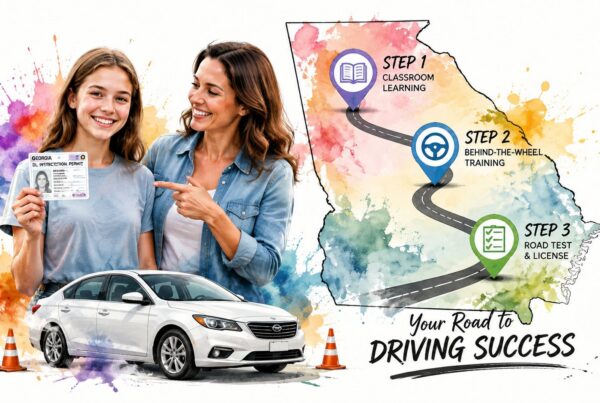
One part of this process is a strict requirement. Joshua's Law in Georgia mandates that all 16- and 17-year-olds must complete a DDS-approved 30-hour Driver's Education course before applying for a Class D license according to this Joshua's Law guide for Georgia teens and parents.
That course requirement is the academic foundation. It gives teen drivers a structured way to learn road rules, risk awareness, and decision-making before they start driving more independently.
There's also practical training. Georgia families often hear about the classroom or online requirement first, but behind-the-wheel work matters just as much.
Why the training requirement matters
A course teaches the rules. Practice teaches what those rules feel like in traffic.
That difference matters because a teen can memorize an answer on a test and still freeze when merging, turning left in traffic, or managing a busy parking lot. Driver education closes that gap by moving from “I know the rule” to “I can use it calmly.”
For a plain-language overview of age-specific Georgia teen rules, this page on Georgia teen driving laws is a useful starting point.
The safest teen drivers usually aren't the ones who rush through licensing. They're the ones who treat the provisional stage as practice with accountability.
How parents should think about the provisional stage
It helps to think of the Class D license as a training year with real consequences. Your teen is licensed, but still learning. That means:
- Freedom is real: They can drive on their own within the law.
- Limits are real: Curfew and passenger rules still control what's allowed.
- Habits matter: The way they drive now shapes whether they keep moving forward smoothly.
If families treat the provisional period as “close enough to a full license,” mistakes happen fast. If they treat it as a supervised transition into adult driving, teens usually make better choices.
The Core Restrictions Curfew and Passenger Limits
The two provisional license restrictions that cause the most confusion are the night driving curfew and the passenger timeline. These aren't side rules. They're the center of Georgia's provisional system.
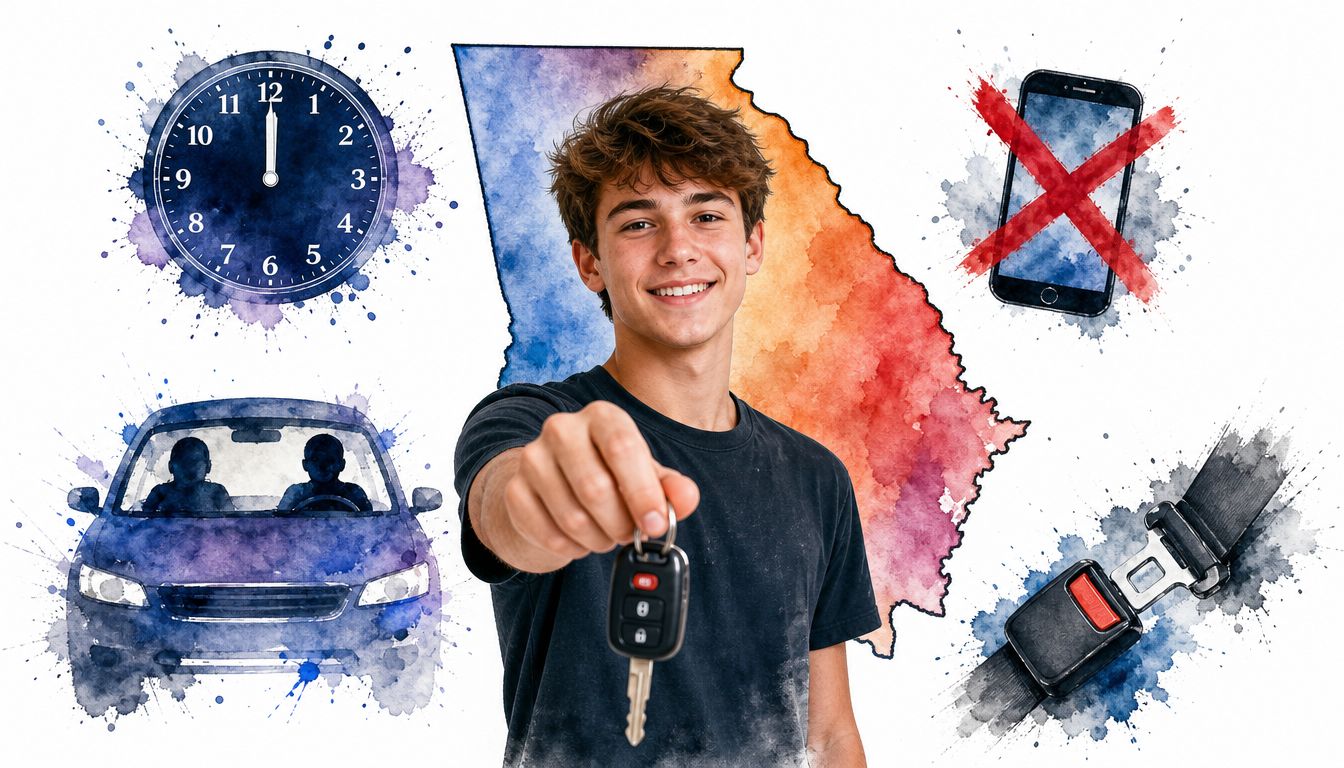
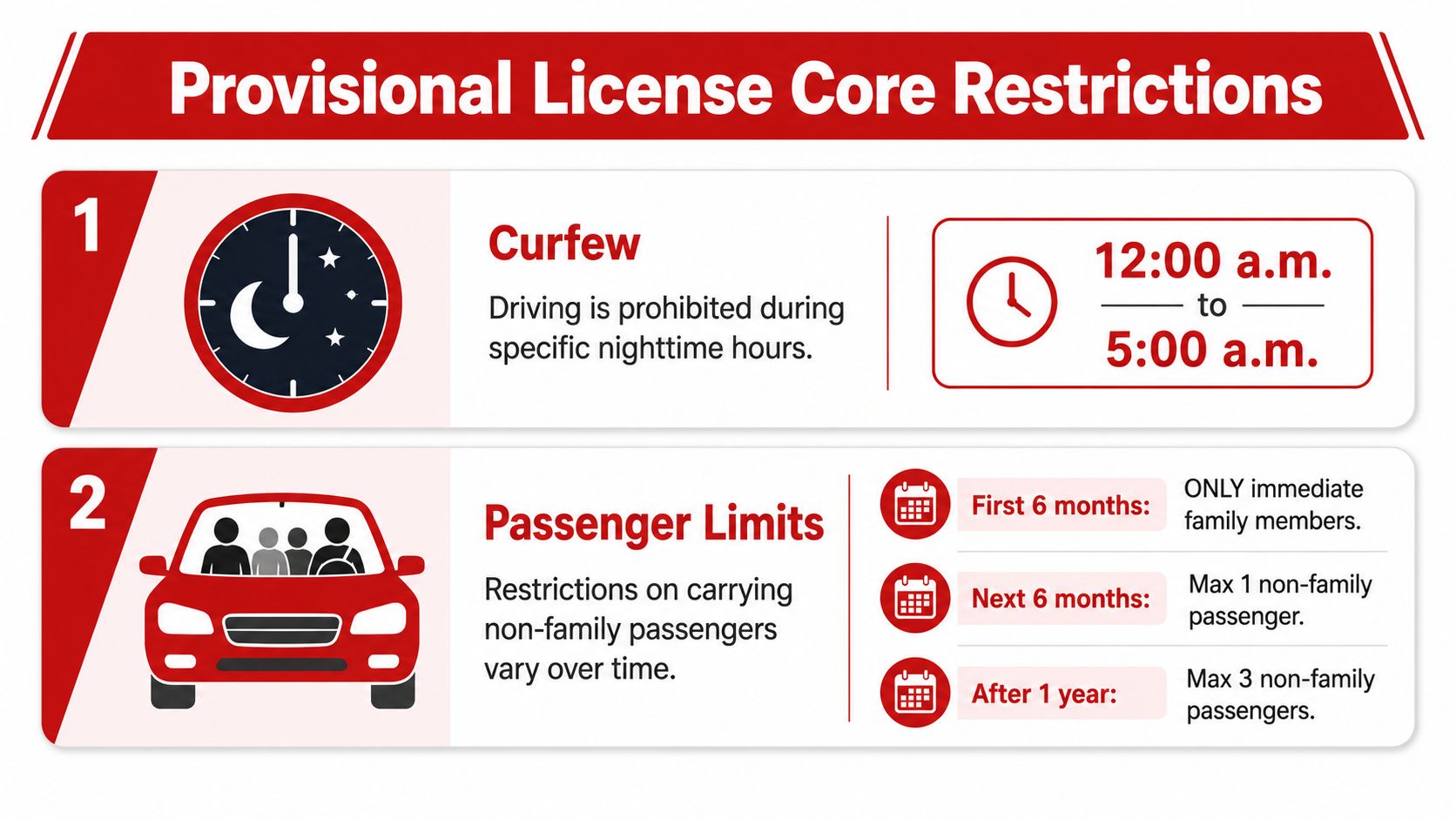
Georgia's Class D Provisional License has a strict driving curfew from 12:00 a.m. to 5:00 a.m. and also limits who may ride in the car based on how long the teen has held the license, as outlined by Georgia provisional license laws.
The midnight to 5 a.m. curfew
For a teen with a Georgia Class D license, the curfew is straightforward. No driving from 12:00 a.m. to 5:00 a.m.
That's the part many teens know. The part they sometimes miss is the reason behind it. The same Georgia provisional licensing information states that this curfew has been credited with a 19% decline in nighttime teen crashes involving passengers in Georgia between 2015 and 2024. That's why the rule is so firm. It targets the hours when low visibility, fatigue, and passenger-related distraction create a riskier mix for new drivers.
The passenger timeline
Passenger limits change over time, which is where many families get mixed up. The rule doesn't stay the same throughout the entire provisional period.
Here's the timeline in a simple format:
| Time Period | Allowed Passengers |
|---|---|
| First 6 months | Only immediate family members |
| Second 6 months | One non-family passenger under 21 |
| After 1 year | Up to three non-family passengers under 21 |
Why these limits exist
A newly licensed teen often feels confident after a few successful solo trips. Then comes the first ride with friends. The energy changes immediately. More talking, more laughing, more requests to change music, more pressure to “just make a quick stop.”
Passenger restrictions exist because the early months of driving should stay as calm and predictable as possible.
A short trip with the wrong passengers can be riskier than a longer trip alone.
Two common mistake patterns
The most common errors aren't dramatic. They're ordinary.
- “It's only one ride home.” In the first 6 months, a non-family passenger under 21 can still be a violation.
- “I'll be home right after midnight.” If the clock crosses into the restricted hours, that can still create a curfew problem.
A simple compliance habit
If you're not sure whether a trip is allowed, check these details before anyone gets in the car:
- Look at the time
- Count the passengers
- Ask whether they're immediate family or not
- Match the trip to the correct point in your license timeline
That routine takes less than a minute. It can save a lot of trouble.
Device Use and Other Critical Safety Rules
The curfew and passenger rules get most of the attention, but they aren't the only rules that matter. Day-to-day safety often comes down to distraction and basic in-car discipline.
Phones need to be out of your hands
For teen drivers, the safest approach is the clearest one. Put the phone away before the car moves.
That means no texting at red lights, no checking notifications in a drive-thru line, no changing a playlist while rolling through a parking lot, and no grabbing the phone because it buzzed. A lot of teens think distraction only counts if they're sending a message. In real driving, distraction starts the second your eyes and attention leave the road.
If your family wants practical habits for preventing distraction before it becomes a pattern, this page on distracted driving prevention gives useful reminders in plain language.
Seat belts are part of the driver's job
A teen driver's responsibility doesn't stop with their own belt. Before moving the car, make sure everyone is buckled.
That can feel awkward with friends at first, especially when someone says, “We're only going a few minutes.” Ignore that pressure. Safe drivers get comfortable saying the same thing every time: buckle up first.
Small habits that prevent bigger mistakes
A safe trip usually starts with a few boring choices that pay off:
- Silence the phone: Use a driving mode or put the device somewhere you can't reach it quickly.
- Set the route early: Don't wait until you're moving to decide where you're going.
- Keep the car calm: Lower the volume, reduce side conversations, and focus on driving.
- Do a belt check: Driver first, then passengers.
The easiest distraction to fix is the one you prevent before the engine starts.
These habits matter because provisional license restrictions are about more than avoiding a ticket. They're there to help a new driver build a pattern of calm, controlled driving. That's what keeps you safe long after the provisional period ends.
Navigating Common Exceptions to the Rules
One of the biggest myths around provisional license restrictions is that they're always absolute in every real-world situation. Families hear “midnight to 5 a.m.” and assume there's no room for work schedules, school obligations, or emergencies.
Many people often get confused on this point. Information from other states shows that waivers can exist for employment or medical emergencies, yet most articles don't explain the practical side of proving that travel is essential, as noted in this discussion of the gap in guidance around night-driving waivers and essential travel.
What counts as essential travel
Good judgment is essential here. A late-night food run isn't the same as a job shift ending late. Driving around because friends want to hang out isn't the same as responding to a medical need.
When a trip is tied to something necessary, families should think ahead about how they'd explain it clearly if asked. The important point isn't to stretch the definition of “essential.” It's to avoid improvising after the fact.
What documentation can help
If a teen may need to be on the road during a restricted time for a necessary reason, it's smart to keep support for that reason easy to show.
Examples of helpful documentation can include:
- Work-related proof: A schedule, shift notice, or signed note from an employer
- School-related proof: A program notice, event message, or school communication
- Medical necessity: Information that helps explain why the trip could not wait
The safest family approach
Don't treat exceptions like loopholes. Treat them like situations that require extra caution and clear records.
If a trip might need an exception, plan it before the keys come out.
That means parents and teens should talk through the route, the reason, the timing, and what proof the teen should keep with them. The goal is simple. If the drive is necessary, be ready to show that it was necessary.
Penalties for Violations and Keeping Your License
A lot of teens hear two versions of the same story. One version says any violation means immediate disaster. The other says police usually don't care about minor provisional license restrictions. Neither view is a good one to rely on.
The smarter view is this. Violations can carry serious consequences, and even when the first contact doesn't lead to the harshest outcome, you shouldn't assume you'll get a pass.
What can happen after a violation
Georgia provisional license guidance warns that breaking curfew or carrying unauthorized passengers can lead to license suspension, points on the driver's record, and higher insurance premiums, as noted earlier in the article.
That matters because the legal penalty is only part of the problem. Once a teen gets a violation, the practical fallout usually spreads to the whole family. Parents may tighten household driving rules. Insurance costs may rise. Trust drops fast.
Why people get confused about first offenses
Some teens hear that the first offense always leads to suspension. Others hear that the first offense is always just a warning. Real life isn't that neat.
A legal discussion cited in the verified data notes that provisional restriction violations can sometimes result in a warning with no penalty for a first offense, which is part of why parents and teens get mixed messages, according to this discussion of warning versus penalty confusion.
The best way to think about enforcement
Don't build your driving habits around the hope of a warning.
Use this rule of thumb instead:
- A warning is possible: Sometimes an officer may handle a minor situation that way.
- A penalty is also possible: You shouldn't expect leniency.
- Repeated mistakes raise the stakes: Patterns are harder to excuse than isolated confusion.
Your license is easier to protect than to win back.
That mindset helps teens make decisions based on safety and compliance, not on guessing what an officer might do.
Your Path from Provisional to Full License
The provisional stage isn't the finish line. It's the bridge to a full license and more freedom, but only if a teen uses that period well.
A lot of new drivers think the goal is just “don't get caught doing anything wrong.” That's too small. The actual goal is to become the kind of driver who doesn't put themselves in avoidable trouble in the first place.
Skill building matters as much as rule following
Rules keep you legal. Skills keep you calm when driving gets complicated.
That's why extra instruction can make such a difference during the provisional stage. Parking lots, neighborhood roads, lane changes, left turns, busy intersections, and road test preparation all build confidence in ways that solo guessing never does.
The practical requirement matters too. As noted in Georgia road test expectations and licensing preparation, to obtain a Georgia license, you also must take 6 hours of driving lessons.
What helps teens move forward smoothly
The teens who transition well usually do a few things consistently:
- They keep practicing: Not just the easy routes they already know
- They get coaching where they're weak: Parking, turns, traffic judgment, and test prep
- They use online learning well: Especially for the Joshua's Law classroom requirement in Georgia
- They take the first year seriously: Not as punishment, but as a skills phase
Georgia families should also look into the Georgia Driver's Education Scholarship Grant Program if cost is part of the decision. It can make professional driver training more accessible for qualified students.
For a straightforward overview of the licensing process itself, this guide on how to get a provisional license in Georgia helps connect the classroom, practice, and testing steps.
Keep the long goal in mind
A full license becomes much easier to earn and keep when the provisional year is handled carefully. Fewer shortcuts. Better habits. More practice in the situations that still feel uncomfortable.
That's what turns a newly licensed teen into a dependable driver.
If you're looking for practical help with the steps that matter most, A-1 Driving School offers Georgia driver's education, Joshua's Law course options, online classes, road test support, and driving lessons built for teens who want more than the minimum. Families can also explore driving lesson packages and learn whether the Georgia Driver's Education Scholarship Grant Program may help with training costs.