

You've just received a Utah traffic ticket, and the obvious question is whether a defensive driving course will help. The answer depends less on which class looks convenient and more on why you're taking it, whether you're eligible, and when the reduction needs to apply. A course can support point reduction through Utah's Driver License Division, and a court may approve a course for a separate ticket-related outcome. Those are different paths, and confusing them is how drivers waste time and money.
Utah also accepts live and online formats through recognized providers. Before you enroll, identify the outcome you need, verify the applicable authority, and protect the timing of your one available point-reduction opportunity.
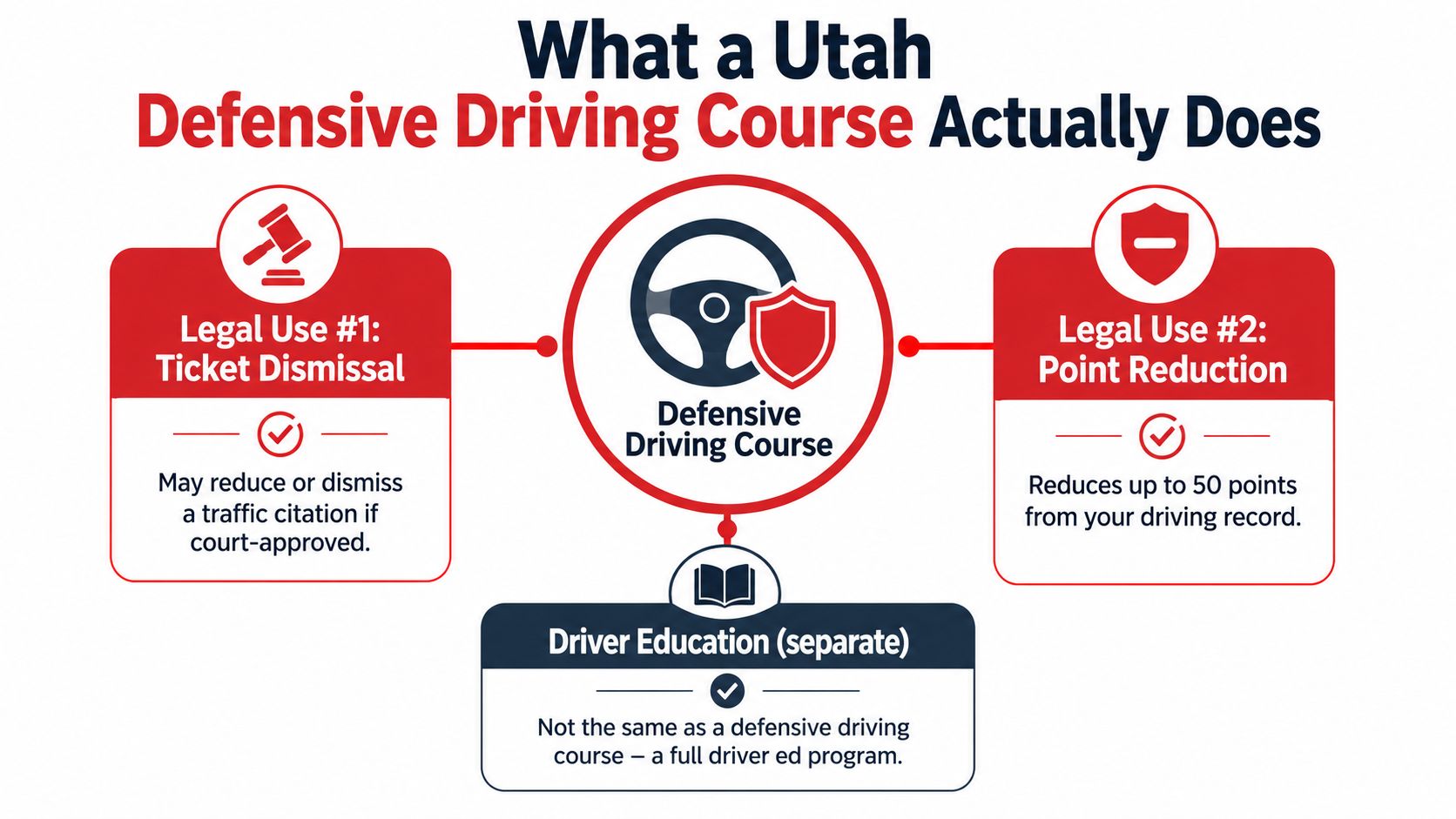
What a Utah Defensive Driving Course Actually Does
A Utah defensive driving course isn't the same thing as driver education. Driver education prepares a new driver to learn traffic laws, vehicle control, and road-test skills. Defensive driving is usually taken by an existing driver who needs a specific administrative, court, or insurance-related result.
Utah's Driver License Division recognizes defensive driving courses through the Utah Safety Council or National Safety Council. For point reduction, the state allows either a live 4-hour course or an approved online course, making the program a formal part of Utah's point system rather than a casual safety seminar. You can review the state's requirements through the Utah Driver License Division point system.
Identify the outcome before choosing the class
Start with the result you need:
- Point reduction: You're trying to lower the points on your Utah driving record through the Driver License Division process.
- Ticket dismissal or mitigation: You're following a court's instructions, and the court decides whether completing the course changes the citation outcome.
- Insurance consideration: You're asking your insurer whether course completion may qualify for a discount. The insurer, not the course provider, makes that decision.
A defensive driving course may help with a court matter, but completing it doesn't automatically dismiss every ticket. Court approval, citation type, and filing instructions control that result. For broader context on traffic-focused driver training and prevention, this motor vehicle accident prevention course resource can help explain why defensive habits matter beyond paperwork.
Treat defensive driving as targeted intervention
The useful mindset is simple: this course is a tool attached to a specific decision. If points are the problem, check your record and eligibility first. If a court gave you a deadline, follow the court's instructions instead of assuming the Driver License Division process will satisfy them.
The course also works best when you connect the material to actual driving habits, especially hazard recognition, space management, and the IPDE process, which means identifying, predicting, deciding, and executing. Review the IPDE process before or during the course so the safety material becomes a driving method, not just a completion screen.
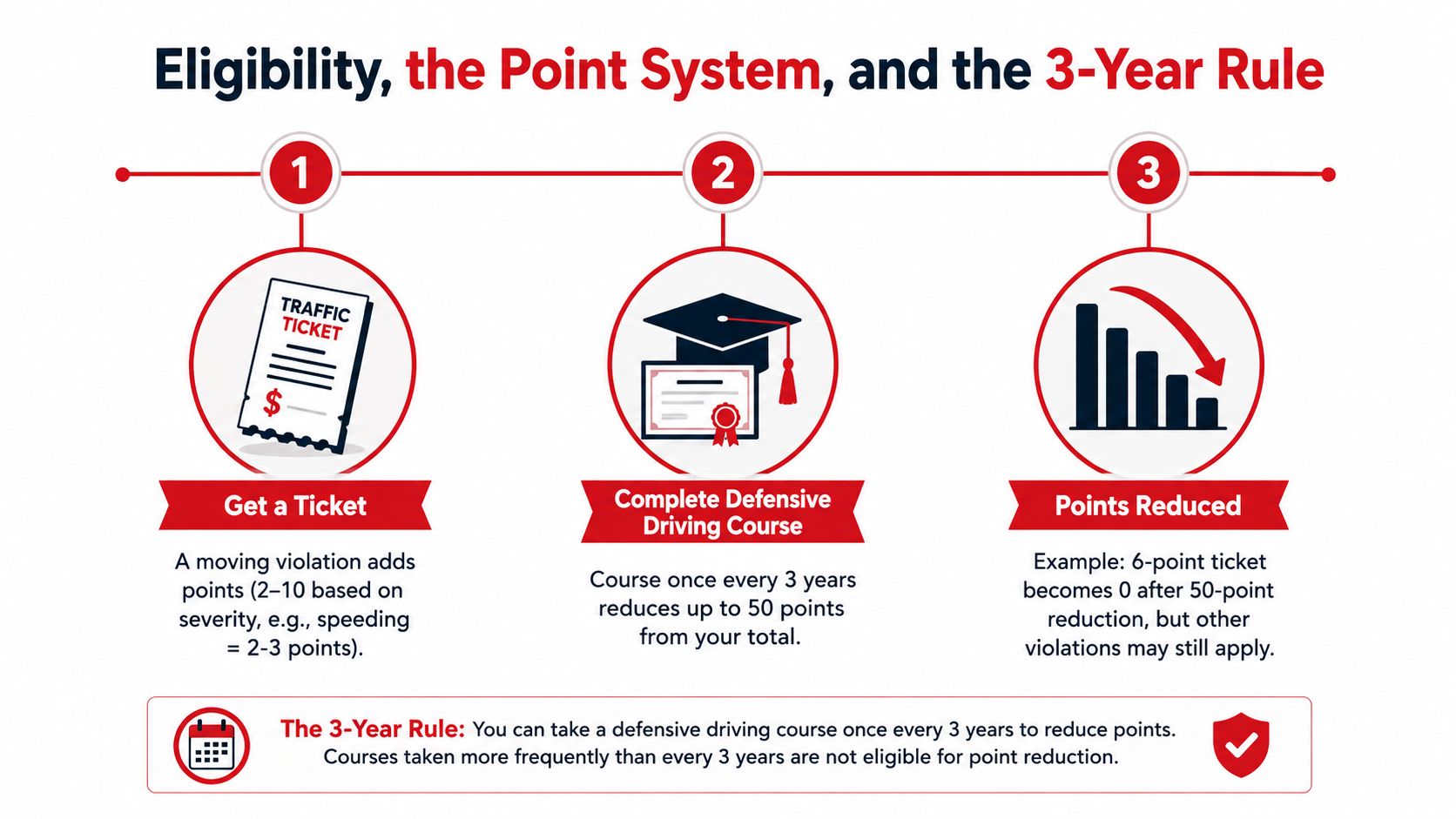
Eligibility, the Point System, and the 3-Year Rule
The most important Utah rule is the clock. A defensive driving course can be used once every 3 years to remove up to 50 points from a driver record, and that limit applies regardless of how many violations accumulate during the interval. The operational details are summarized in Utah traffic school guidance.
That means enrollment timing matters more than course shopping. Taking the course immediately after a minor citation may consume an opportunity you'd need later, while waiting too long can leave points active when a deadline or escalation issue is approaching.
Practical rule: Never enroll based only on the fact that you received a ticket. Enroll after confirming eligibility, point exposure, and the timing of your last reduction.
Use a four-part eligibility check
Confirm the purpose. Decide whether you're pursuing point reduction, a court-approved ticket outcome, or an insurance benefit. These purposes may involve different instructions and different decision-makers.
Check your current record. Obtain the information needed to understand your point balance and the violations contributing to it. Don't guess from memory. A driver may remember the citation but overlook older violations still affecting the record.
Check prior course use. Find out when you last used defensive driving for point reduction. The three-year interval is the limiting factor, not the number of times you're willing to take a class.
Match the completion date to the deadline. If a court or agency requires proof by a certain date, schedule early enough to complete the course and submit documentation. A certificate in your inbox does nothing if the correct office never receives it.
Point reduction also isn't ticket dismissal. The course may reduce points on your record, while a court separately decides whether a citation is dismissed, amended, or left in place. Those outcomes shouldn't be treated as interchangeable.
A common mistake is taking the class too early, then discovering that the three-year window prevents another reduction when a more serious point problem develops. Another is assuming repeated enrollment will keep offsetting every new violation. It won't. The rule rewards planning, not frantic compliance.
For a practical explanation of the record-reduction process, review this guide on how to reduce points on a license, then verify your individual status with the appropriate Utah authority.
Online vs In-Person Defensive Driving in Utah
Utah drivers generally choose between an online course and a classroom format. Neither is automatically superior. The right choice depends on whether you need flexibility, instructor access, or a format that matches a court's instructions.
The Utah Safety Council describes its National Safety Council defensive driving course as a seven-session internet-based program that takes the average student about four hours to complete. Its listings also include live, Zoom, and online versions, so drivers can choose among several delivery formats. The course structure is modular, which is useful for learners who retain more by completing focused sessions than by sitting through one uninterrupted block.
Compare the formats before enrolling
| Feature | Online | In-Person |
|---|---|---|
| Scheduling | Work through the approved sessions around your schedule | Attend a scheduled class or live session |
| Pacing | Complete modular content in the available online format | Follow the instructor's classroom pace |
| Questions | Review course material and provider instructions | Ask an instructor questions during the session |
| Point reduction fit | Practical when online completion is accepted for your purpose | Useful when you prefer direct instruction |
| Court requirements | Confirm the court accepts the online format before enrolling | May fit a court instruction requiring live attendance |
| Completion proof | Follow the provider's certificate process | Obtain proof according to provider instructions |
Online is the practical choice for a driver balancing work, school, or family responsibilities, but convenience can create a trap. Some drivers click through the material without connecting it to the violation that brought them there. Review Utah citation rules, hazard recognition, and your own driving pattern before and after each session.
In-person instruction earns its place when you need live clarification or when a court specifically directs you to attend a classroom course. Don't assume a live class is automatically accepted for every legal purpose, either. Confirm the format and documentation requirements before paying.
If virtual attendance fits your schedule, review the available virtual defensive driving class option and compare its requirements with the instructions attached to your citation.
Finding a State-Approved Provider and Enrolling
Provider verification comes before payment. Start with the Utah Driver License Division's information on accepted defensive driving providers, then check the Utah Safety Council's current course listings. A polished website isn't proof that a course will satisfy your point-reduction or court requirement.
Look for the delivery format, completion process, certificate instructions, and contact information. The provider should state whether the class is live, held through Zoom, or completed online. It should also explain what happens after you finish, including whether the provider reports completion, sends documentation to an agency, or gives you a certificate to submit yourself.
Use this enrollment checklist
- Verify recognition: Confirm the provider and course are accepted for your specific purpose.
- Match the format: Make sure online, Zoom, or live attendance meets the relevant requirement.
- Read the certificate policy: Find out whether completion proof goes to you, the Driver License Division, or a court.
- Check the deadline: Record the required completion and submission dates before registering.
- Save your records: Keep the enrollment confirmation, completion certificate, and submission evidence.
- Ask before paying: If the course page doesn't clearly explain eligibility or reporting, contact the provider first.
Enrollment typically involves creating an account, selecting an available session or online course, paying the stated fee, and completing the assigned material. Don't rely on assumptions about automatic reporting. Even if a provider sends completion information to an agency, you should keep personal proof and confirm that the expected result appears on the correct record.
A short confirmation call can prevent a long administrative problem. Ask exactly which office receives the certificate, whether you must submit anything yourself, and how the provider handles a court-directed completion.
Why Some Drivers Compare Utah Options to Georgia Programs
Some people search for a Utah defensive driving course while solving a different problem. They may be comparing driver education for a teenager, looking for lessons for an adult family member, or researching a Georgia license pathway from another state. That comparison matters because defensive driving and driver education serve different drivers at different stages.
Georgia's Joshua's Law pathway requires 16- and 17-year-olds seeking a Class D license to complete driver education and 40 hours of supervised driving, including 6 hours at night. The standard course structure includes 30 hours of classroom instruction plus 6 hours of behind-the-wheel instruction, or approved parent-taught training under the applicable rules. The requirements are outlined by Georgia DDS.
Georgia DDS also recognizes a virtual 30-hour instruction option paired with behind-the-wheel training. That creates a useful contrast with Utah's defensive driving model. A Utah point-reduction course addresses an existing driver record, while a Georgia Joshua's Law program builds the classroom and supervised-driving foundation required for a young driver.

Choose training based on the driver's actual need
A new teen driver needs education and practice. Classroom content alone isn't enough. The student needs supervised road time, coaching, and preparation for the road test.
A licensed driver with points needs a timing decision. That driver should verify eligibility and the point-reduction window before taking a defensive driving course.
A busy Georgia learner may need online instruction. Virtual classroom delivery can handle the knowledge component, while behind-the-wheel lessons provide direct performance coaching.
A road-test candidate needs focused preparation. Before a Georgia road test, DDS requires a valid Georgia Non-Commercial Learner's Permit and an affidavit confirming the supervised-driving requirement, including nighttime practice. Review the Georgia road test requirements before booking preparation or testing services.
A-1 Driving School provides Georgia-focused driver education, Joshua's Law courses, driving lessons, packages, and road-test services for teens and adults. Families comparing training options may also want a practical multi-policy discount guide for Duluth when reviewing the broader cost of new-driver ownership and insurance.
Scheduling, Costs, and Submitting Your Certificate
The cost question is only useful if you first confirm what you're buying. Utah course fees vary by provider and format, so don't rely on a generic price expectation. Compare the stated fee, delivery method, certificate process, and any separate court or administrative requirements before enrolling.
The time commitment is clearer. Utah recognizes a live 4-hour format and an approved online option, while the Utah Safety Council's internet course is organized into seven sessions with an average completion time of about four hours. Build extra time around that course length if you have a court deadline, technical issue, or certificate-submission requirement.
Keep the paperwork under your control
Use this sequence:
- Book early: Register for a course that finishes before the relevant deadline.
- Complete correctly: Attend the full live session or finish every required online module.
- Request proof: Follow the provider's certificate instructions immediately after completion.
- Send it to the right authority: A point-reduction matter may involve the Driver License Division, while a ticket matter may require submission to the court.
- Confirm receipt: Don't assume a sent certificate was processed.
- Keep a copy: Save the certificate, confirmation emails, and any submission record.
The three-year point-reduction interval is tied to use of the benefit, so record the completion and application details for your own files. If a court gave you instructions, those instructions control the ticket outcome. A certificate sent to the wrong office won't satisfy the court because the course itself was approved.
Frequently Asked Questions About Utah Defensive Driving
How often can I use the course for point reduction?
Utah allows the benefit once every 3 years, with up to 50 points removed from the record. Taking another course before the interval expires won't create another point-reduction benefit.
Can the course guarantee an insurance discount?
No. Ask your insurance company directly. A course may be considered, but the insurer decides whether a discount applies.
What if I forget to submit the certificate?
The expected reduction or court result may not process. Contact the provider and the relevant agency or court, then keep proof of every submission.
Do out-of-state courses count in Utah?
Don't assume they do. Utah's Driver License Division identifies accepted providers and formats, so verify approval for your specific purpose before enrolling elsewhere.
The smart Utah decision is timing first, enrollment second. If your actual need is Georgia driver education, Joshua's Law, road-test preparation, or structured driving lessons, choose training that includes real coaching rather than a course that only checks a compliance box.
A-1 Driving School offers Georgia Joshua's Law driver education, online and virtual course options, road-test services, and customized driving lessons with packages for teens and adults. Visit A-1 Driving School to compare the course and lesson options, then choose the path that matches your license goal and current driving experience.