You're merging onto I-285 when a mattress lifts from a pickup ahead and tumbles across your lane. You may have only a moment to decide whether to brake, steer, or hold your line. The safest response won't come from a dramatic reflex. It will come from a practiced sequence that keeps the vehicle balanced and gives other drivers room to react.
Learning how to handle emergency situations starts before the emergency. You need prevention habits, physical responses for mechanical or weather-related problems, and follow-up steps that protect your safety, driving record, and insurance interests. Georgia drivers face sudden summer downpours, dense Atlanta commuter traffic, deer on rural two-lanes, and unpredictable road debris. Teen drivers also have a compliance pathway to complete through Joshua's Law before earning a Class D license.
The central lesson is simple: muscle memory beats panic. Grip the wheel, look where you want to go, brake with control, and steer smoothly. This guide connects those habits with driver education, behind-the-wheel lessons, road-test preparation, and practical training options available to Georgia drivers.
Why Every Georgia Driver Needs an Emergency Game Plan
A driver who has never rehearsed an emergency often makes several decisions at once. They jerk the steering wheel, stomp the brake, look directly at the hazard, and lose track of surrounding traffic. On an Atlanta freeway, that chain reaction can create a second emergency even when the original obstacle has passed.
A reliable game plan has three layers:
- Prevent: Scan farther ahead, maintain space, check tires, reduce speed for weather, and avoid distractions.
- Respond: Use small, deliberate movements. Keep both hands available, look through the escape path, and avoid sudden steering unless a collision is otherwise unavoidable.
- Recover: Secure the vehicle, contact the right authorities, document what happened, and arrange follow-up care or training.
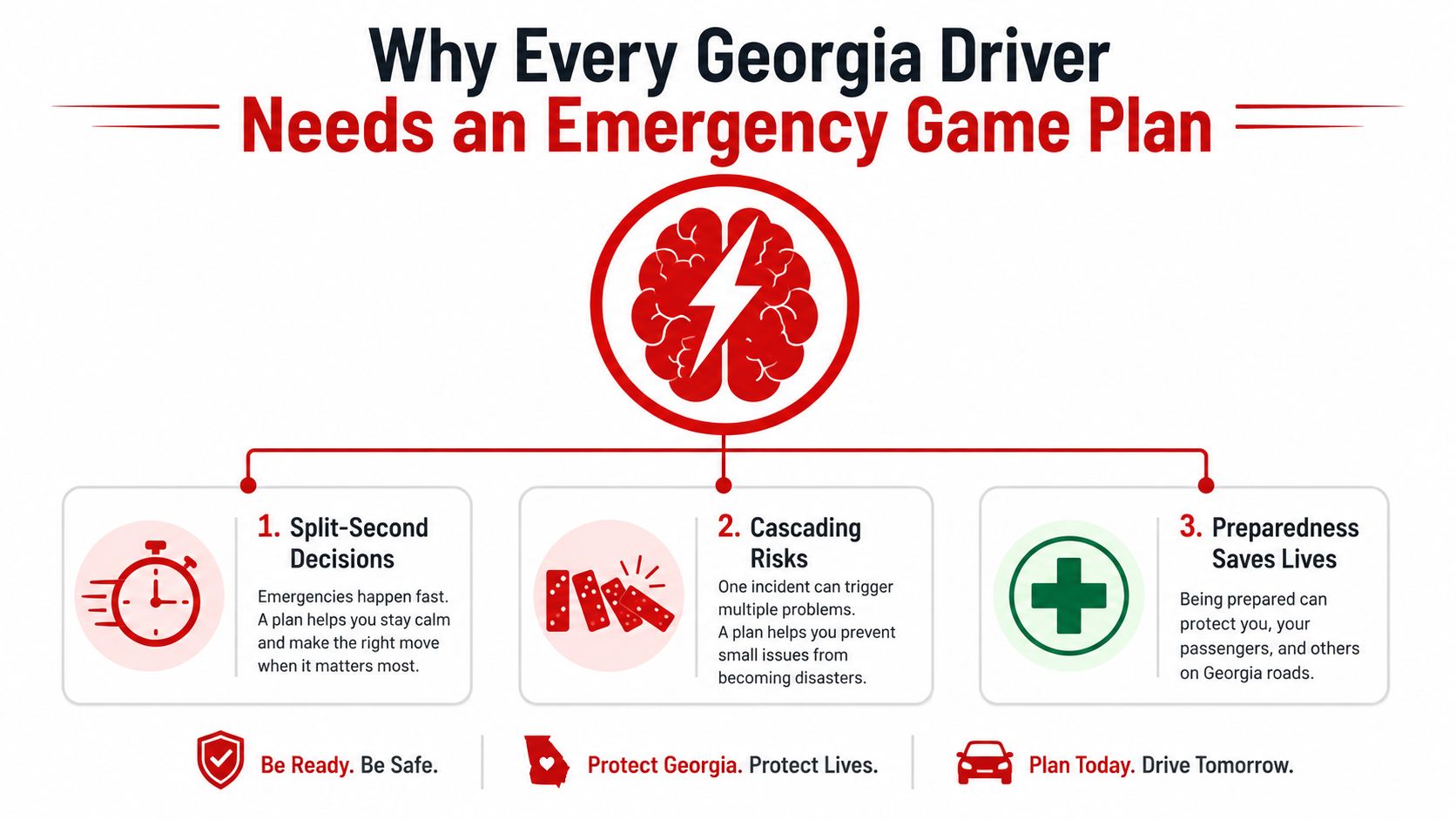
The same structure works whether you're dealing with a mattress on I-285, a deer near a rural curve, or standing water after a thunderstorm. Prevention gives you more time. Controlled physical responses preserve traction. Recovery steps keep a frightening event from becoming a confusing legal or mechanical problem.
Instructor's rule: If you can slow down in a straight line, do that before you make a major steering change.
Timing matters in medical emergencies, too. The American Heart Association reports survival to hospital discharge of 22.4% when CPR began within 1 minute, compared with 10.5% when CPR was delayed 10 minutes or more. Overall survival in the same analysis was 19.2%, and favorable neurological survival was 16.9%. The AHA also notes that bystander CPR approximately doubles survival odds compared with no bystander CPR, based on a meta-analysis of 19 studies involving 232,703 patients. These figures support immediate calling, compressions, and AED use when available. American Heart Association cardiac-arrest analysis
Good driver education doesn't promise that emergencies won't happen. It gives you a repeatable response before your emotions take over. That preparation is especially important for teens completing Georgia's licensing requirements and for adults returning to driving after a long break.
Mechanical Emergencies You Must Handle in the Moment
Mechanical problems feel frightening because the vehicle stops responding normally. Your job is to preserve control long enough to reach a safer stopping place.
Brake failure
Press the brake pedal firmly and pump it several times. If pressure doesn't return, shift into a lower gear to increase engine braking. Apply the parking brake slowly while holding its release button so you can reduce pressure if the rear wheels begin to lock.
Keep the vehicle pointed toward an uphill curb, open shoulder, or other clear area. Don't steer toward moving traffic to find a perfect stopping place. Turn on the hazard lights, sound the horn if needed, and focus on a controlled stop.
Tire blowout
Hold the steering wheel firmly with both hands. Keep the throttle steady for a moment, then ease off it gradually. Avoid braking immediately, because a sudden brake application can transfer weight and make the vehicle harder to control.
As the vehicle slows, guide it toward the shoulder. Once stopped, stay aware of traffic before opening a door. For a refresher on the practical repair side, review these flat-tire repair steps, but don't attempt roadside work in an exposed lane or narrow shoulder.
Engine fire and overheating
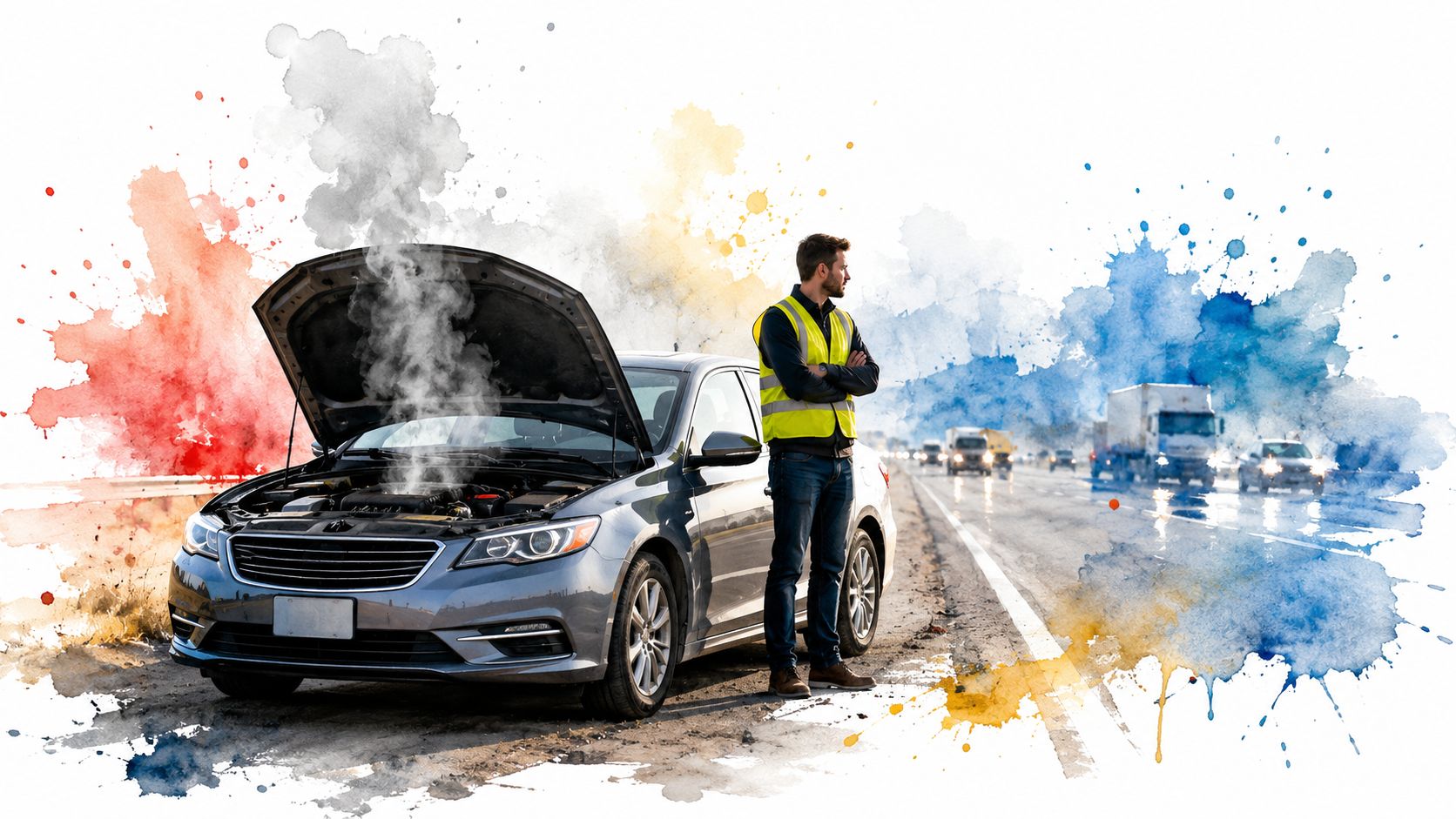
If you see smoke or flames, shut off the ignition and get everyone out. Move at least 100 feet away from the vehicle and stay upwind when possible. Never open the hood during an engine fire, because added oxygen can intensify the flames. Call emergency services from a safe location.
Overheating without visible flames calls for a different response. Turn off the air conditioning, turn on the heater, and pull over when it's safe. Wait for the engine to cool before checking coolant, and never remove a hot radiator cap.
Stuck accelerator
Shift into neutral immediately. Keep the steering controlled, allow the vehicle to roll, and guide it toward the shoulder. Once clear of traffic, shut off the ignition without locking the steering wheel, then call for assistance.
These sequences are easier to perform after quality behind-the-wheel instruction. A good instructor can rehearse emergency braking, controlled stops, gear selection, and shoulder positioning in a quiet area before a teen faces a mechanical problem on a real highway.
The following video can reinforce the visual sequence, but it can't replace supervised practice.
Loss of Control in Skids and Bad Weather
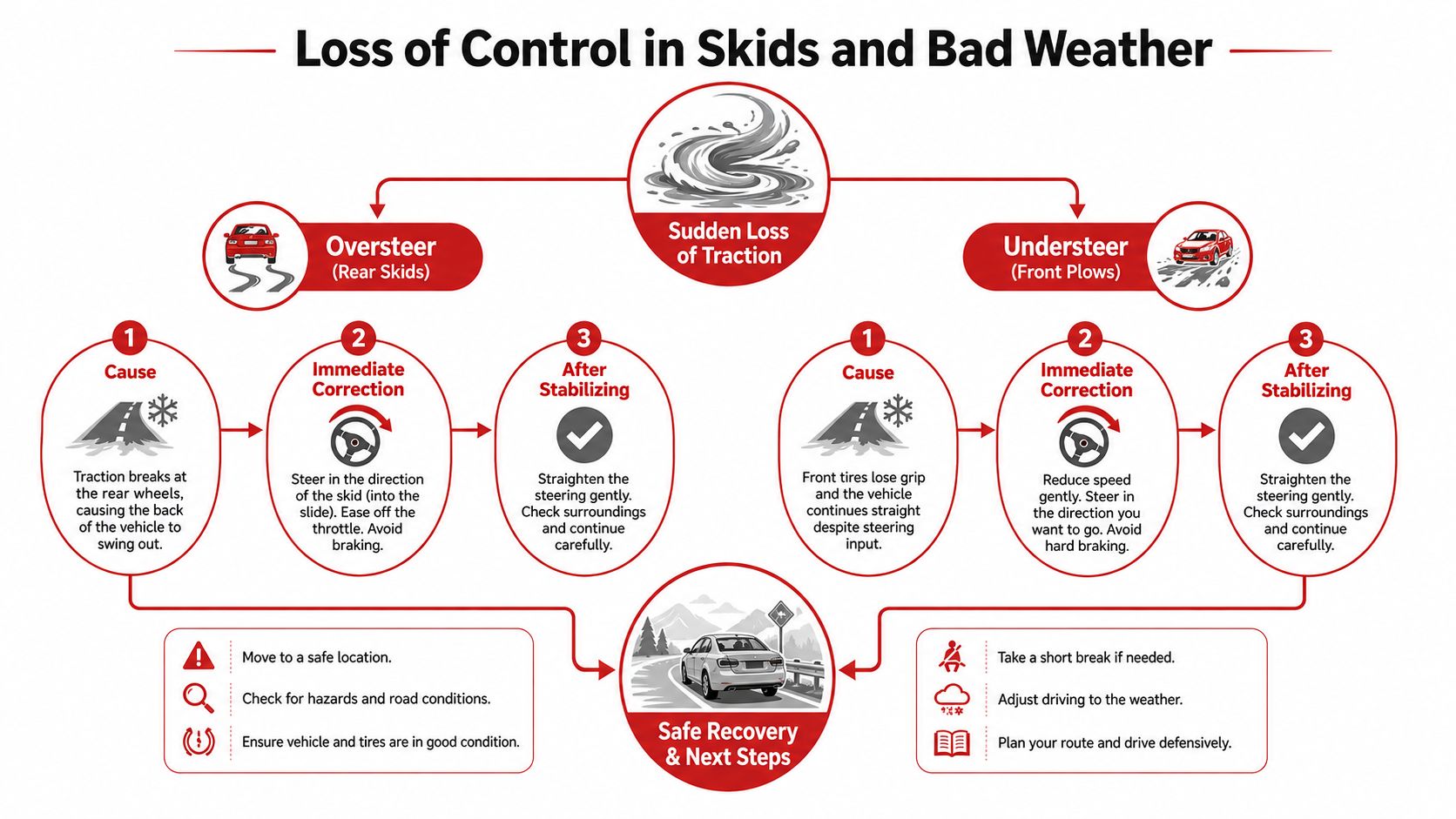
A skid usually begins when your tires lose the ability to follow the direction you've chosen. The correction is rarely a hard counter-move. Look where you want the vehicle to travel, reduce abrupt inputs, and let the tires recover grip.
Rear-wheel skid
If the rear of the vehicle starts moving sideways, look toward the open path. Ease off both pedals and avoid grabbing the brake. Keep your steering hands active but smooth, guiding the front of the vehicle toward the direction you want to travel.
The common mistake is staring at the object or curb that you're trying to avoid. Your hands often follow your eyes, so keep your vision on the escape route.
Front-wheel skid
When the front tires slide straight while you're turning, back off the throttle. Don't add more steering. Wait for the front wheels to begin rolling again, then brake gently and return to a stable path.
Hydroplaning needs the same patience. Ease off the gas, hold the steering straight, avoid sudden braking, and wait for the tread to cut through the water film. If you need a concise refresher, use these hydroplaning recovery techniques.
Georgia's changing surfaces
Wet leaves and painted lines can become unexpectedly slick on Georgia back roads after fall rain. Slow before the surface, not while you're already turning across it. Sudden fog around Lake Sidney Lanier and the Appalachian foothills also reduces your visual margin, so use low-beam headlights, increase following distance, and pull over if you can't identify the lane edges.
After traction returns, find a safe place to stop. Check tire pressure and tread, then dry the brakes by lightly pressing the pedal at low speed. These triggers are worth practicing in an empty lot with an instructor, where you can learn the feel of weight transfer without the danger of freeway traffic.
Collisions, Medical Crises, and Bystander First Aid
A multi-vehicle crash on the Downtown Connector can freeze a capable driver. The first priority isn't deciding who caused the collision. It's preventing another impact and getting accurate information to emergency responders.
If your vehicle can move, pull clear of traffic. Turn on the hazards, place warning devices only when you can do so safely, and exit from the shoulder side away from active lanes. If the vehicle can't move, stay buckled when remaining inside offers more protection, and avoid walking into traffic.
Make the 911 call useful
Tell the dispatcher the roadway, direction of travel, nearest exit or mile marker, number of vehicles, apparent injuries, and hazards such as fuel leaks or fire. Keep answering questions calmly. In the modern emergency system, the FCC and AT&T announced 9-1-1 as the national emergency number in the United States on January 12, 1968. Response time still matters. A JAMA Surgery study found a median county EMS response time of 9 minutes, and crash mortality was higher when response took 12 minutes or more than when it took under 7 minutes, with a mortality rate ratio of 1.46. Emergency communication and response research
Provide only the aid you can perform safely
Check responsiveness and breathing. For an unresponsive person who isn't breathing normally, an untrained bystander can provide compression-only CPR while following dispatcher instructions. Use an AED when one is available and follow its spoken prompts.
Control severe bleeding with direct pressure. Don't move someone with a suspected spinal injury unless fire, traffic, or another immediate danger makes movement necessary. An unconscious person who is breathing may need positioning to keep the airway open, but follow dispatcher guidance and avoid unnecessary movement.
The 2024 American Heart Association and American Red Cross guideline notes that the role of oxygen in general first aid hasn't been established and that direct evidence doesn't support its use for several specific conditions. Don't improvise oxygen treatment when basic assessment, emergency communication, CPR, AED use, or bleeding control is the priority. Guideline discussion of first-aid evidence
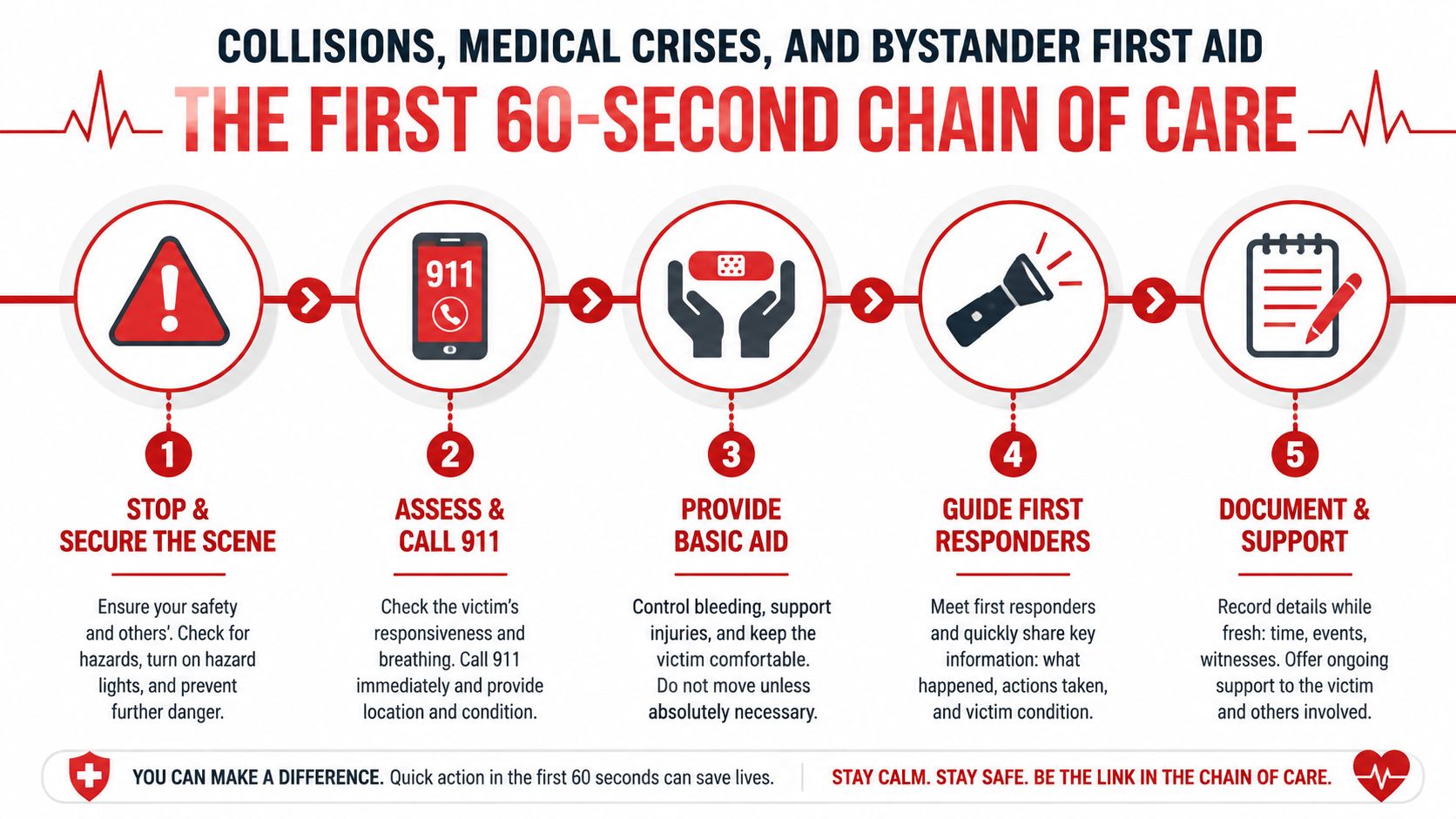
Don't admit fault at the scene. Exchange information after everyone is safe, and remember the location, traffic pattern, weather, signals, and visible hazards for your later report.
What to Do After the Emergency on Georgia Roads
A rear-end collision near the Brookhaven interchange can look minor at first. The vehicles may still roll, nobody may report pain, and both drivers may want to leave. That's exactly when a calm post-crash routine protects you.
Move to safety if the vehicles can be driven without creating another hazard. Photograph vehicle positions, skid marks, license plates, insurance cards, road conditions, signs, and visible damage. Collect witness names and contact details, and don't debate fault with the other driver.
Georgia crashes involving injury, fatality, hit-and-run, or apparent damage over $500 must be reported. Contact the appropriate law-enforcement agency, such as Georgia State Patrol, a county sheriff, or local police, based on the location and circumstances. Ask how to obtain the report and retain the report number.
For repair decisions, especially when damage may make the vehicle uneconomical to restore, a resource covering totalled car repair options can help you understand possible paths before accepting a settlement. Notify your insurer promptly, provide factual information, and avoid guessing about speed, fault, or injury. If an insurer requests a recorded statement and you're uncertain about your rights, consider getting legal advice first.
Georgia drivers should also understand the reporting process through the GDOT crash report system and electronic filing through Georgia DRIVES. Keep copies of the crash report, photographs, medical records, repair estimates, towing receipts, insurer correspondence, and witness information. An accident-response procedure guide can help you organize the sequence before you need it.
| Georgia Post-Crash Documentation Checklist | At the Scene | Within 72 Hours |
|---|---|---|
| Vehicle and road evidence | Photograph positions, damage, plates, skid marks, signs, and weather conditions. | Save photos in more than one location and record any new symptoms. |
| People and reports | Collect witness information and request the law-enforcement report details. | Obtain the report when available and preserve contact records. |
| Insurance and medical care | Exchange insurance information after the scene is secure. | Notify the carrier, keep factual notes, and seek medical evaluation if symptoms appear. |
| Vehicle condition | Arrange safe towing if the vehicle isn't drivable. | Retain estimates, invoices, and documentation about repair or total-loss decisions. |
Pain can surface later, even when adrenaline masks it at the scene. Follow medical guidance, keep appointments, and document changes instead of relying on memory.
Prevention Through Quality Training and Lessons Packages
Most emergency responses improve when the driver has already practiced the physical movement. Training can't remove every hazard, but it can reduce hesitation during emergency braking, evasive steering, wet-weather control, lane changes, and shoulder stops.
For Georgia teens, the compliance path matters. Joshua's Law requires applicants under 18 seeking a Class D license to complete an approved driver education course and 40 hours of supervised driving, including 6 hours at night. Georgia DDS identifies the classroom requirement as 30 hours, available in a classroom or through DDS-approved online courses. Georgia DDS Joshua's Law requirements
A practical training match looks like this:
- New teen driver: Choose the 30-hour Driver's Education classroom component and the required behind-the-wheel instruction, then complete supervised practice with attention to night driving and highway merging.
- Driver with a mechanical-response gap: Book private driving lessons that focus on emergency braking, shoulder positioning, steering control, and safe responses to hazards.
- Driver needing compliance or refresher training: An ADDS-HR certified 6-hour Defensive Driving course may satisfy eligible insurance or court-related needs, subject to the requirements of the insurer or court.
- Family facing cost barriers: Review the Georgia Driver's Education Grant Scholarship Program. It's limited to Georgia residents ages 15 through 17 who are actively enrolled in school and hold a valid Georgia instructional permit or driver's license. The program is intended to cover 30 hours of classroom instruction and 6 hours of behind-the-wheel instruction with an approved instructor. Georgia scholarship program rules
A-1 Driving School offers in-person, online, and virtual learning options, customized teen and adult driving lessons, road-test preparation, and testing assistance across its Atlanta-area locations. Its training can connect classroom knowledge with the physical skills required to manage a blowout, skid, emergency stop, or crowded freeway merge.
Before scheduling a Georgia road test, confirm that you've met all Class D requirements and completed the Joshua's Law and supervised-driving prerequisites tied to eligibility. Georgia DDS road-test requirements The right lessons package should close the gap between knowing the rule and performing it under pressure.
Build Your Own Emergency-Ready Driving Plan
Turn the guide into four habits you can review before a new commute, vehicle, or season.
- Prevent: Check tire pressure and tread regularly, scan ahead, leave space, and slow before heavy rain, fog, leaves, or standing water.
- Respond: Memorize a simple 911 script with your roadway, direction, nearest landmark, vehicle count, injuries, and hazards. Keep both hands ready and favor controlled inputs.
- Recover: Carry a glove-compartment accident kit, save insurance information, secure the scene, document facts, and keep medical or repair records.
- Train: Review Georgia traffic laws, rehearse emergency sequences during supervised practice, and refresh skills instead of trusting one old lesson.
Preparedness awareness doesn't always become preparedness action. In New Zealand's 2025 survey, 91% said being prepared was important, but 40% had taken steps in the prior 12 months. A 2026 U.S. survey found 44% were more concerned about emergencies than the year before, while nearly one in three had taken no action in the previous 12 months and only one in five had practiced household contingency plans. Preparedness survey findings
You can also build emergency contact lists so family members, insurers, medical providers, and roadside contacts are easy to reach.
A-1 Driving School offers Georgia Driver's Education courses, Joshua's Law training, online options, road-test preparation, and driving lessons packages that turn emergency knowledge into practiced control. Visit A-1 Driving School to schedule a free consultation, enroll online, or book lessons for your next step toward safer, more confident driving.