The night before a Georgia road test, the same questions fill driving forums. Did that lane change look late? Will a shaky parallel park sink the score? Can a burned-out bulb end the appointment before you leave the lot? You are probably in that spot now, permit in hand, test date on the calendar, and a thread of driving test tips Reddit open on your phone.
Community posts are a real research habit. In a 2024 analysis drawing on millions of posts and comments plus surveys totaling 11,000 respondents, 74% of respondents said they would use Reddit to investigate a topic, according to Reddit's 2024 recommendation research. I still would not treat a comment as the scoring guide. A tip that works on a quiet street can fail at a multi-lane Atlanta intersection.
This guide turns those recurring worries into seven Georgia-specific fixes. Each one matches a behavior an examiner can see, plus a way to build it in a lesson before test day. Get the car legal, make your checks visible, hold a steady speed, and rehearse the low-speed maneuvers until they feel routine. If you are 16 and aiming for a Class D license, or an adult coming back after years away, that work belongs in lessons, not in the DDS lot on test morning.
1. Practice the Georgia Road Test Route and Maneuvers with a Professional Instructor
Say you test at a Department of Driver Services site north of Atlanta. The examiner will not ask for a scenic drive. You will get turns, lane changes, a speed change, and a few low-speed maneuvers on roads you may have driven once.
Rehearsing those pieces with a licensed instructor, on multi-lane roads and busy intersections near your site, is how the sequence becomes routine. A teen who only loops the neighborhood can freeze when the instruction is "turn left from the second lane." An adult who has not driven in years needs the same reps in real metro traffic.
Georgia also sets the arrival rules before the first turn. Class D applicants need a licensed driver age 21 or older in the car, and Georgia DDS road test guidance says minors, children, and pets may not ride along. Only you and that adult should be in the vehicle. You also need a valid learner's permit or driver's license before a lesson.

Before you book the date:
- Run a full mock: Ask your instructor to score a mock road test at least once, with limited prompts.
- Match the roads: Practice multi-lane streets and busy intersections near the testing location.
- Leave room for reps: Book a lesson package early enough for several sessions, not one cram drive.
Schedule road test preparation once the permit is in hand, so the mock happens before the appointment.
2. Complete a Thorough Vehicle Pre-Check Before the Test Begins
A working turn signal and brake light can keep a simple equipment problem from interrupting test day. Before the drive, Georgia DDS checks that the vehicle is safe and properly equipped. Confirm the requirements in the Georgia DDS road test guidance before the appointment.
What to touch before you roll
Use the same car you plan to bring to the test. In a family sedan, for example, locate the hazard switch and check the lights before test day, rather than searching for controls under pressure.
- Lights: Check the headlights, brake lights, turn signals, and hazard lights.
- Papers: Make sure the registration and insurance are current and accessible.
- Controls: Set the seat and mirrors, then fasten your seat belt.
If you are unsure how to check the brakes, review this brake system inspection guide as part of your preparation. A-1 Driving School lessons give students a chance to practice vehicle setup and test-day routines before the Georgia Road Test.
3. Master Smooth Speed Control and Safe Following Distance
On I-285, traffic can slow sharply while the lane beside you keeps moving. A driver who spots the slowdown early can ease off the accelerator and brake steadily. Examiners look for controlled speed, a safe following gap, and braking that begins in time.
Young drivers are overrepresented in fatal crashes relative to their share of licensed drivers. That makes sound speed and spacing habits important well beyond test day.
A gap you can explain
- Three seconds: When the car ahead passes a sign, count to three before you reach it. Add more space when conditions make it harder to stop.
- Early braking: Ease off before a stop line and apply the brake smoothly. Stabbing the pedal at the last moment makes the stop abrupt.
- Match the flow safely: On Roswell Road, hold a lawful speed that suits traffic and conditions. Driving far below the limit can disrupt traffic; speeding to keep up is not the answer.
A driving lesson gives you a place to practise steady speed and spacing in real traffic. Ask your instructor to call out when your gap shrinks or your braking starts late, then repeat the route until both habits feel consistent.
4. Use Mirrors, Signals, and Head Checks Consistently
A lane change on test day is a communication problem. The examiner cannot score a glance they did not see. Eye flicks at the mirror are not enough if your head never moves.
Say you narrated every mirror check in lessons. On test day the same order stays in your head: mirror, signal, shoulder, go. That narration is what keeps a nervous driver from skipping the blind spot on a lane change along a busy Atlanta arterial. Signaling at every turn in a package is what makes the commuting habit automatic later.
Make the check obvious
- Out loud: Say mirror and signal checks during practice until the order feels dull.
- Both shoulders: Look over the shoulder that matches the move, on every lane change.
- Early signal: Put the blinker on with enough time for the car behind to notice.
- Focused lessons: Spend a session only on lane changes and turns until the order does not wobble.
Our guide on how to check blind spots while driving is the drill to use between lessons, in a parked car first, then in light traffic.
5. Handle Intersections, Right-of-Way, and Roundabouts Confidently
Intersection choices cause clean, avoidable errors. Stop short of the line, roll through, or pick the wrong lane, and the score drops even if the rest of the drive was smooth.
Say you have practiced roundabouts in the Atlanta suburbs, the ones with two approach lanes and a fast exit. Later a test roundabout feels familiar because you already chose the lane before the yield line, not while you were in it. The same idea fixes stop-line stops at a busy signal. You stop fully, look both ways, and go only when the gap is yours.
Come to a complete stop. Check left, right, and left again. Then move. A roll is not a gentle stop. It is a miss.

Review right-of-way in the official driver's handbook before the lesson, so the instructor is correcting your driving, not teaching the rule from zero. Ask for multi-lane intersections and at least one roundabout in the package. Identify the turn lane before you enter it. Metro Atlanta will not give you a long straight road to think it over.
6. Practice Parking, Backing, and Three-Point Turns
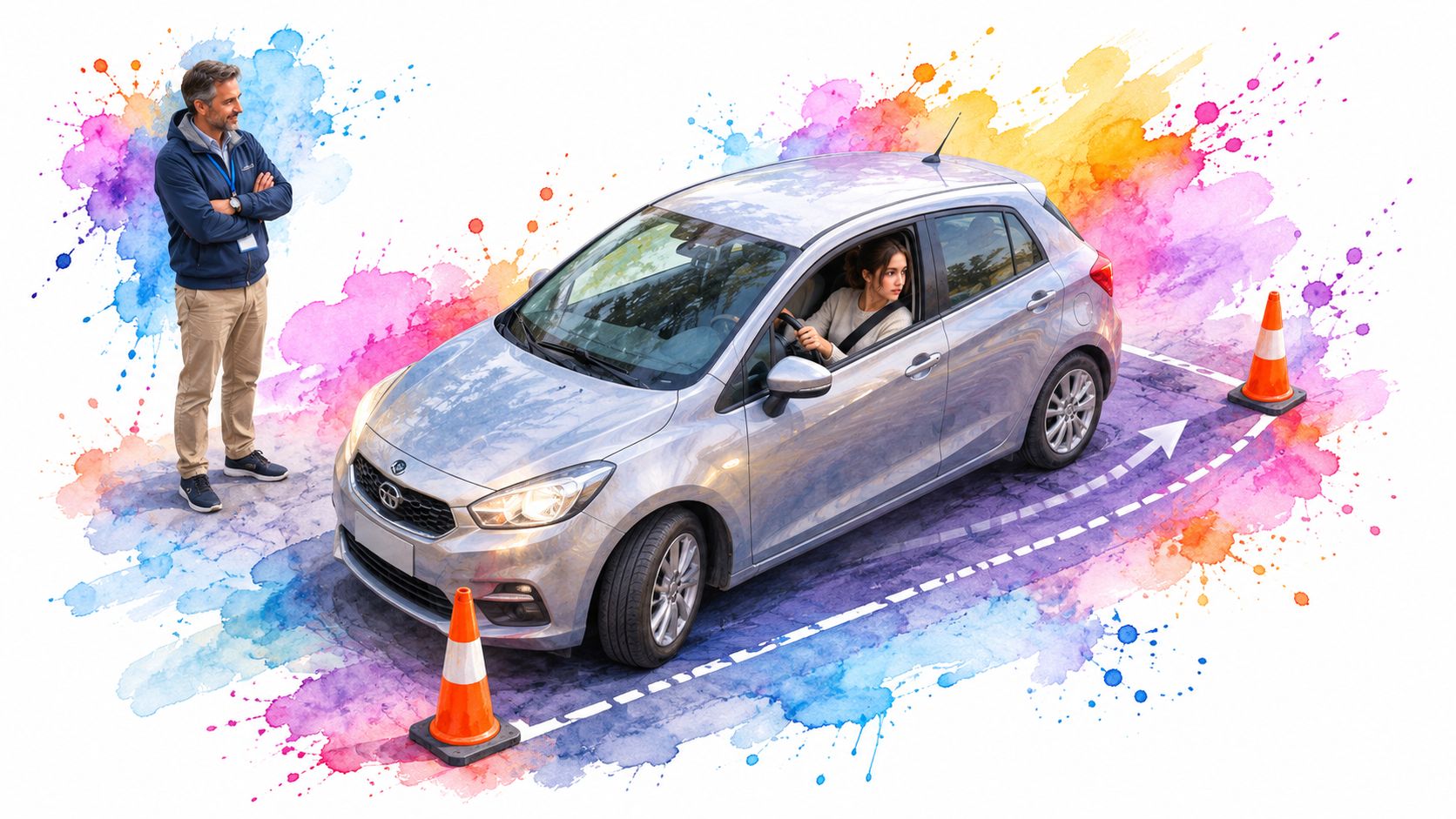
Low-speed work is where prepared drivers still lose points. Parallel parking, a straight back-up, and a three-point turn ask for slow feet and a plan, not courage.
Say the parallel park happened first in a quiet lot during package lessons, with cones standing in for bumpers. On test day the same reference points, a mirror and a marker, put the car in on the first try. An adult who repeats three-point turns on a calm residential street stops dreading the cul-de-sac the examiner picks.
Slow is the technique
Use a reference before you move. Creep, and keep the brake covered. If the angle looks wrong, stop and reset. Rushing a park to get it over with is how a tire meets the curb.
The short clip below shows the kind of controlled parallel park worth copying in a lot before you try it on a test street.
Request extra parking time inside the lesson package. One clean park in an empty lot is not the same as a clean park with the examiner watching and a car waiting behind you.
7. Manage Test-Day Nerves With Mock Tests and Consistent Lesson Routines
Nerves do not fail you. The rushed stop, the missed shoulder check, and the long hesitation do.
Posts on a road-test tips thread stress that examiners need to see head movement for mirror and blind-spot checks, not only eye movement, and that driving substantially below the limit can be viewed negatively. Anxiety makes both mistakes more likely. You stare, or you creep.
A two-second reset
- Shrink the task: Reduce speed early, scan, signal, check the mirror, make the shoulder check, then act.
- No compensation: After a miss, do not stab the brake or freeze. Finish the maneuver smoothly.
- Ask, don't guess: If an instruction is unclear, ask the examiner to repeat it.
- Mock first: Book the DDS test only after a full mock with no major errors.
Breathe once, name the next maneuver, and drive that piece only.
Say you run a mock two days before the DDS test. You walk in calmer because the route style is no longer a surprise. An adult on a weekly lesson rhythm improves in steps instead of a last-weekend cram. Sleep, arrive early, and keep the same pre-drive routine you used in lessons.
If worry is the main problem, read our notes on driving test anxiety, then put a mock inside a lesson package. Day, evening, and online class times keep those reps from piling up on one Saturday.
Georgia Driving Test Tips at a Glance
| Item | Core Skill Tested | Best Practice Format | Common Drawback |
|---|---|---|---|
| Practice the Georgia Road Test Route and Maneuvers with a Professional Instructor | Test maneuvers and route familiarity | Instructor-led lessons with a full mock test | Scheduling and lesson costs |
| Complete a Thorough Vehicle Pre-Check Before the Test Begins | Vehicle safety and readiness checks | Practice a checklist in the test vehicle | A missed equipment issue can delay or fail the test |
| Master Smooth Speed Control and Safe Following Distance | Speed, spacing, and smooth braking | Practice steady driving in varied traffic | Overly cautious driving may be marked down |
| Use Mirrors, Signals, and Head Checks Consistently | Observation and hazard awareness | Repeat and verbalize checks during practice | Test stress can disrupt consistency |
| Handle Intersections, Right-of-Way, and Roundabouts Confidently | Stops, yielding, and lane choice | Practice varied intersections with an instructor | Complex intersections and roundabouts can be intimidating |
| Practice Parking, Backing, and Three-Point Turns | Low-speed vehicle control and maneuvering | Repeated practice in a controlled space | Limited practice space can make rehearsal difficult |
| Manage Test-Day Nerves With Mock Tests and Consistent Lesson Routines | Calm, reliable performance under pressure | Mock tests and regular lessons | Limited time may restrict confidence-building practice |
Turn These Tips Into a Practice Plan That Works
A learner can know every tip from a Reddit thread and still rush a turn when traffic builds on an Atlanta road. Practice needs a routine: check the vehicle, drive through varied traffic, then work on low-speed maneuvers. Finish with a mock test that exposes weak observation, poor speed control, or rushed maneuvers before test day.
For a 16-year-old, Georgia's Joshua's Law pathway includes 30 hours of classroom instruction, 6 hours of behind-the-wheel training with a certified school, and 40 hours of supervised driving with a parent or guardian, including at least 6 nighttime hours. An approved 30-hour online or virtual course can meet the classroom requirement. A 16- or 17-year-old must also hold a learner's permit for 1 year and 1 day before getting a Class D license, and complete the approved education and supervised driving requirements. See the Georgia DDS Joshua's Law requirements and Joshua's Law FAQ from Georgia DDS.
A-1 Driving School offers instructor-led and online Joshua's Law courses, as well as teen and adult driving lessons in Atlanta and Athens. Its locations offer day, evening, and online classes. A-1 also offers a Scholarship Grant Program to help with training costs.
Common test-day errors include weak observation, poor speed control, and rushed low-speed maneuvers. The discussion of why learners fail their driving test points to the same kinds of habits, but practice should reflect Georgia roads and the skills your examiner checks. A lesson package gives you a setting to repeat each skill and get feedback before test day. Explore course options, lesson packages, and online enrollment at A-1 Driving School.
A-1 Driving School has served Georgia drivers since 1987 and offers road testing, Joshua's Law driver education, and teen and adult driving lessons. Put the habits into a consistent lesson routine rather than relying on a late-night search. Visit A-1 Driving School to compare course options and book a session.