Driving after dark feels different because it is different. While only approximately 25% of all driving occurs at night, it accounts for nearly 50% of all traffic fatalities, and the passenger vehicle occupant fatality rate at nighttime is about three times higher than the daytime rate, according to the National Safety Council's night driving overview. That gap catches many new drivers off guard. They assume night driving is just daytime driving with headlights on.
It isn't.
Night driving asks more from your eyes, your judgment, and your timing. Road edges are harder to read. Distance is easier to misjudge. Glare can wipe out your view for a few seconds at the worst possible moment. The good news is that this is a skill you can learn. If you understand what changes at night, and you practice the right habits, you can drive calmly and safely.
The Reality of Night Driving Why It Requires Extra Skill
Most beginners think the main problem at night is darkness. Darkness is part of it, but it's really a chain reaction. Reduced visibility makes it tougher to spot pedestrians, curves, debris, and vehicles entering from side streets. At the same time, other risks tend to rise after dark, including tired and impaired drivers.
That's why night driving deserves respect. It also deserves preparation.
What your eyes struggle with after sunset
In daylight, your eyes gather details quickly. At night, your headlights only reveal part of the road ahead. Everything beyond that becomes less certain. A mailbox can look like a person. A shallow curve can seem straight until you're already in it. A car without bright taillights can blend into the road.
Practical rule: If you feel like the road is shrinking at night, slow down before the situation forces you to.
Glare makes this even harder. One set of bright oncoming headlights can reduce your ability to read lane position, speed, and road texture. New drivers often tense up, stare forward, and stop scanning. That's when small mistakes begin.
Why confidence comes from training, not guessing
A careful driver doesn't try to “wing it” at night. Good habits need to become automatic. You should know where to place your eyes, how much space to leave, when to use high beams, and when tiredness means the trip shouldn't continue.
Fatigue deserves special attention. If you've ever thought, “I'm only a little sleepy,” that's already a warning sign. A short review of why driving drowsy is deadly helps explain why many nighttime mistakes begin before the car even moves.
Night driving can feel intimidating on your first few trips. That's normal. Skill replaces anxiety when you practice the right routines consistently.
Your Pre-Drive Checklist for Nighttime Safety
A safe night drive usually begins before the key turns. Instructors at A-1 Driving School see the same pattern again and again with new drivers in Georgia. Anxiety on the road often starts in the driveway, with a skipped vehicle check, a rushed route choice, or a driver who is more tired than they want to admit.
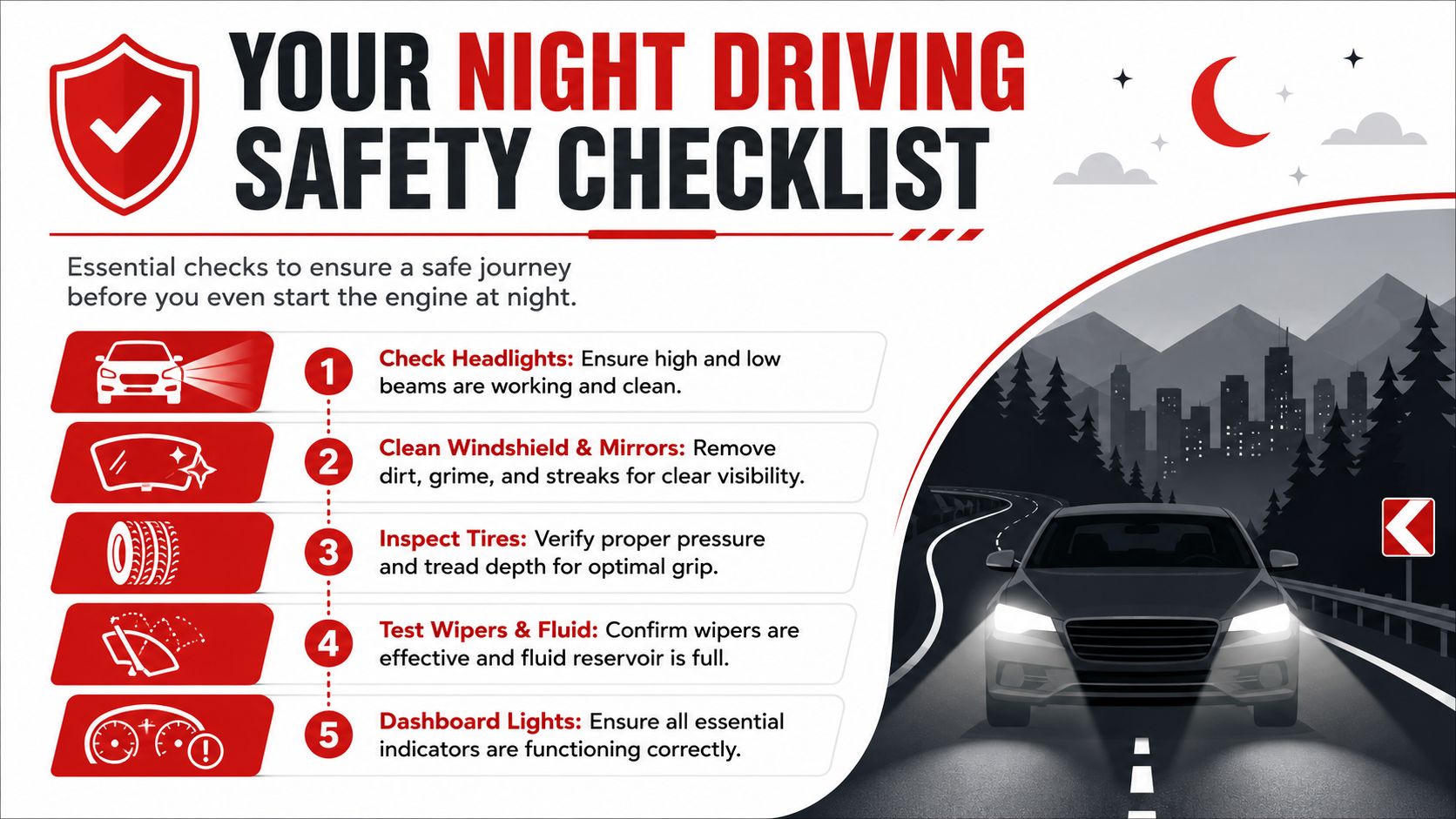
Check the vehicle before you roll
Your car needs to help you see clearly, not make the job harder. A one-minute inspection works like putting on the right glasses before reading small print. You are removing preventable problems before they show up on a dark road.
Start with the parts that affect visibility most:
- Headlights: Check both low beams and high beams. Make sure the lenses are clean, because haze and dirt scatter light and shorten what you can see.
- Windshield and mirrors: Clean the outside and the inside. The thin film on interior glass is easy to miss in daylight, but at night it catches glare from headlights and streetlights.
- Wipers and washer fluid: Test them before you need them. A smeared windshield at night can turn a clear view into a blur in seconds.
- Dashboard brightness: Dim it enough that your eyes stay focused on the road, not the glow inside the cabin.
- Headlight aim: If your headlights point too low, you lose distance. If they point too high, you bother other drivers and increase risk for everyone.
If you want a simple routine to follow, keep a copy of a vehicle inspection checklist in your glove box or on your phone. That is the same kind of repeatable habit we build during behind-the-wheel lessons, because calm drivers rely on routines, not memory.
Prepare yourself, not just the car
The driver is part of the equipment check.
Before a night trip, ask a few honest questions. Am I alert? Do I know where I am going? Have I already been on the road all day? New drivers often assume readiness means feeling "mostly fine." That is risky. Fatigue, stress, and distraction narrow your attention long before you feel completely exhausted.
Use this quick self-check:
| Question | If the answer is no |
|---|---|
| Did you get enough rest to stay alert? | Delay the trip or find another ride |
| Do you know the route well enough to avoid last-second turns? | Preview it before leaving |
| Can you choose roads with better lighting and clearer markings? | Pick the easier route |
| Is your phone set so it will not pull your eyes away? | Silence it and put it out of reach |
A few minutes of preparation can do more for safety than trying to "be careful" once the trip starts. If distraction is part of your normal driving routine, review why preventing distracted driving injuries matters before you make night driving harder on yourself.
Make your route easier
At night, the easiest route is often the smartest route. A slightly longer road with better lighting, wider lanes, and clearer signs can reduce your workload a lot. That matters for new drivers, because confidence grows fastest when the road gives you time to think.
This is also where professional training makes a real difference for Georgia drivers. In lessons, we do not just tell students to "plan ahead." We show them how to choose roads that match their current skill level, how to avoid problem spots, and how to build the judgment they will need for solo driving and Joshua's Law progress.
If you are debating whether you are too tired, too distracted, or too unprepared for a night trip, treat that hesitation as useful information. A careful driver listens to it.
Essential On-the-Road Night Driving Techniques
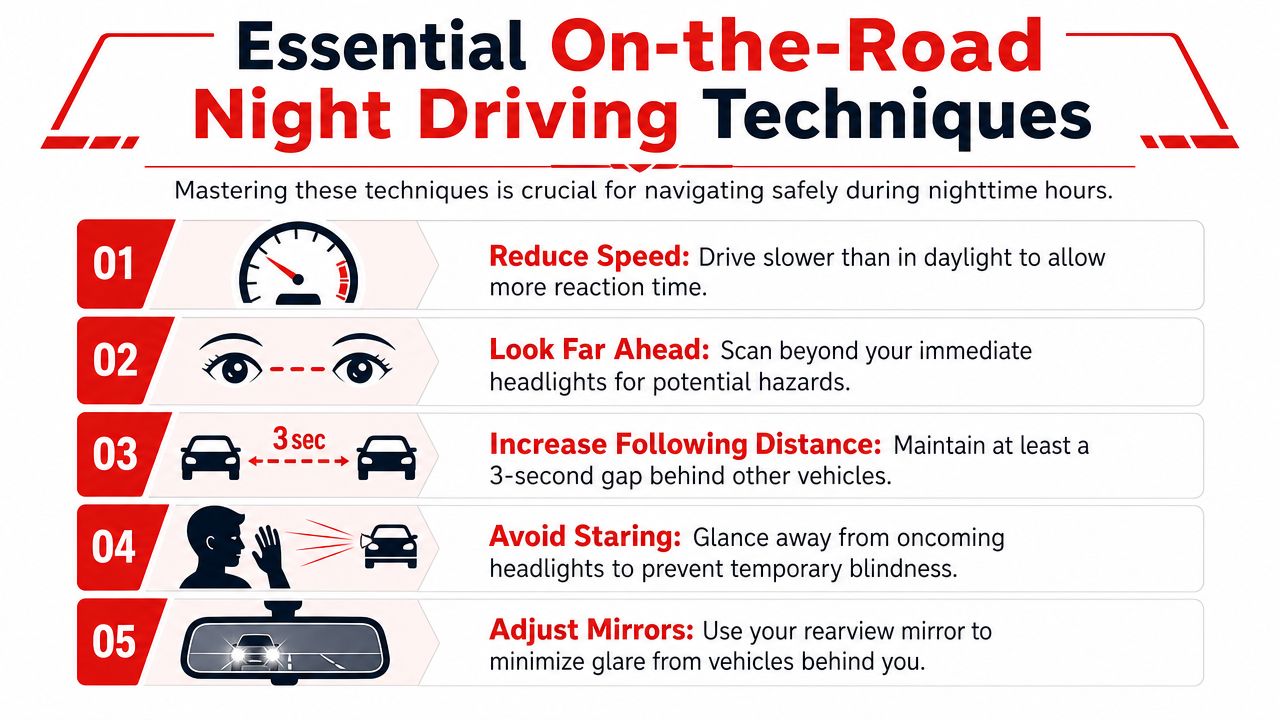
Night driving asks you to do the same job with less information. Your headlights show only part of the road, glare can wash out detail, and hazards often appear later than you expect. A good response is simple. Reduce speed a little, increase space, and make every action smoother.
Increase your following distance
During the day, many drivers use a three-second gap. At night, give yourself more room. Safety guidance from Avatar Fleet's night driving tips recommends a 4-second interval, and that extra time helps because you may spot brake lights, debris, or an animal later than you would in daylight.
Use a fixed object such as a sign or mailbox. When the car ahead passes it, count steadily to four. If you reach the same object before you finish counting, ease off the accelerator and rebuild the gap.
Students at A-1 often notice that this feels “too far” at first. It only feels that way because many drivers follow too closely in the daytime. At night, that extra cushion gives you time to brake firmly without braking suddenly.
Control glare without losing your lane position
Bright headlights can pull your eyes toward them like a flashlight in a dark room. Resist that pull. Shift your focus to the right edge of your lane and use the painted line or road edge as your guide until the vehicle passes.
Keep your steering steady. Keep your speed controlled. Avoid the urge to jerk away from the light.
If your attention is already split, glare gets harder to manage. That is one reason preventing distracted driving injuries matters even more after dark. Night driving leaves less room for a delayed reaction.
Take a moment to watch this demonstration before your next evening drive.
Use high beams with judgment
High beams help on dark, open roads, but only when they do not interfere with another driver's vision. Switch to low beams before oncoming traffic reaches you, and stay on low beams when you are following another car. In fog, rain, or mist, low beams usually work better because high beams can reflect light back at you and make the road harder to read.
A simple rule helps. If your brighter lights could shine directly into someone else's eyes, dim them.
Professional instruction gives new drivers a chance to practice this at the right moment instead of guessing under pressure. Instructors correct timing, mirror use, and visual habits in real traffic, which is one reason the benefits of taking driving lessons from an instructor show up quickly in night driving confidence.
Scan farther ahead, and wider
New drivers often stare at the pavement just beyond the hood because it feels safer. It is not. Looking that close shortens your reaction time.
Lift your eyes farther down the road. Check for taillights, reflections, pedestrians near corners, movement at the shoulder, and places where the road pattern changes. Then bring your eyes back to your lane and mirrors. This rhythm works like reading a sentence instead of focusing on one letter at a time.
That scanning habit is a skill Georgia drivers build best through guided practice. In behind-the-wheel lessons, students learn where to place their eyes, how often to check mirrors, and how to recognize a problem early enough to respond calmly. That kind of repetition supports the same goal behind Joshua's Law training online and in the car. Turning uncertainty into a method you can repeat every night.
Slow down before you fully identify the hazard
At night, uncertainty is a warning sign by itself. If something ahead looks unusual, a shadow near the shoulder, an unclear shape in your lane, brake lights around a bend, reduce speed first. You can identify the hazard as you close distance under control.
That is how experienced drivers stay calm. They do not wait for perfect clarity before acting. They buy themselves time, then make the next decision with better information.
Why Professional Training Is Your Best Night Vision
Reading tips helps. Practicing them with a trained instructor helps more.

Night driving is one of those skills that feels manageable in theory and very different in a real car. A student may understand “don't stare at headlights” when reading an article, then freeze the first time a lifted truck rounds a curve with bright lamps. That's why supervised practice matters. You need to experience the situation, recover correctly, and repeat the response until it feels natural.
Why new drivers need guided repetition
Teen drivers face especially serious risk after dark. The Teen Driver Source at CHOP reports that the fatal crash rate at night for drivers ages 16 to 19 is approximately three times higher than that of adult drivers per mile driven, and the majority of these fatal crashes occur between 9 p.m. and midnight.
That pattern makes sense to any driving instructor. The most demanding time of day meets the least experienced group of drivers. Judgment, speed control, hazard detection, and glare recovery are all still developing.
What an instructor can correct quickly
A trained instructor can spot problems that students usually don't notice in themselves, such as:
- Late scanning: The student waits too long to identify curves or stopped traffic.
- Overdriving the headlights: The car is moving faster than the visible road allows.
- Poor lane position: The student drifts toward glare instead of holding a clean path.
- Tense steering inputs: The hands tighten and small corrections become jerky.
Those are difficult habits to fix alone because the driver often doesn't realize they're happening. Articles can tell you what to do. In-car instruction shows you what you're doing.
Professional lessons turn vague advice into repeatable behavior.
A closer look at the benefits of taking driving lessons from an instructor makes this point clearly. Coaching shortens the learning curve because someone is watching, correcting, and building your confidence trip by trip.
Training builds calm, not just skill
The best result of professional training isn't only technical improvement. It's composure. A driver who has practiced lane discipline, glare response, intersection judgment, and low-light scanning with guidance is less likely to panic when the road gets challenging.
That's what makes night driving safer. Calm decisions, made early.
Meeting Georgia's Night Driving Requirements for Teens
For Georgia families, night driving isn't only about technique. It's also tied to the licensing path. Parents often know Joshua's Law exists, but they aren't always sure what it requires or how to complete each step without confusion.
What Joshua's Law requires
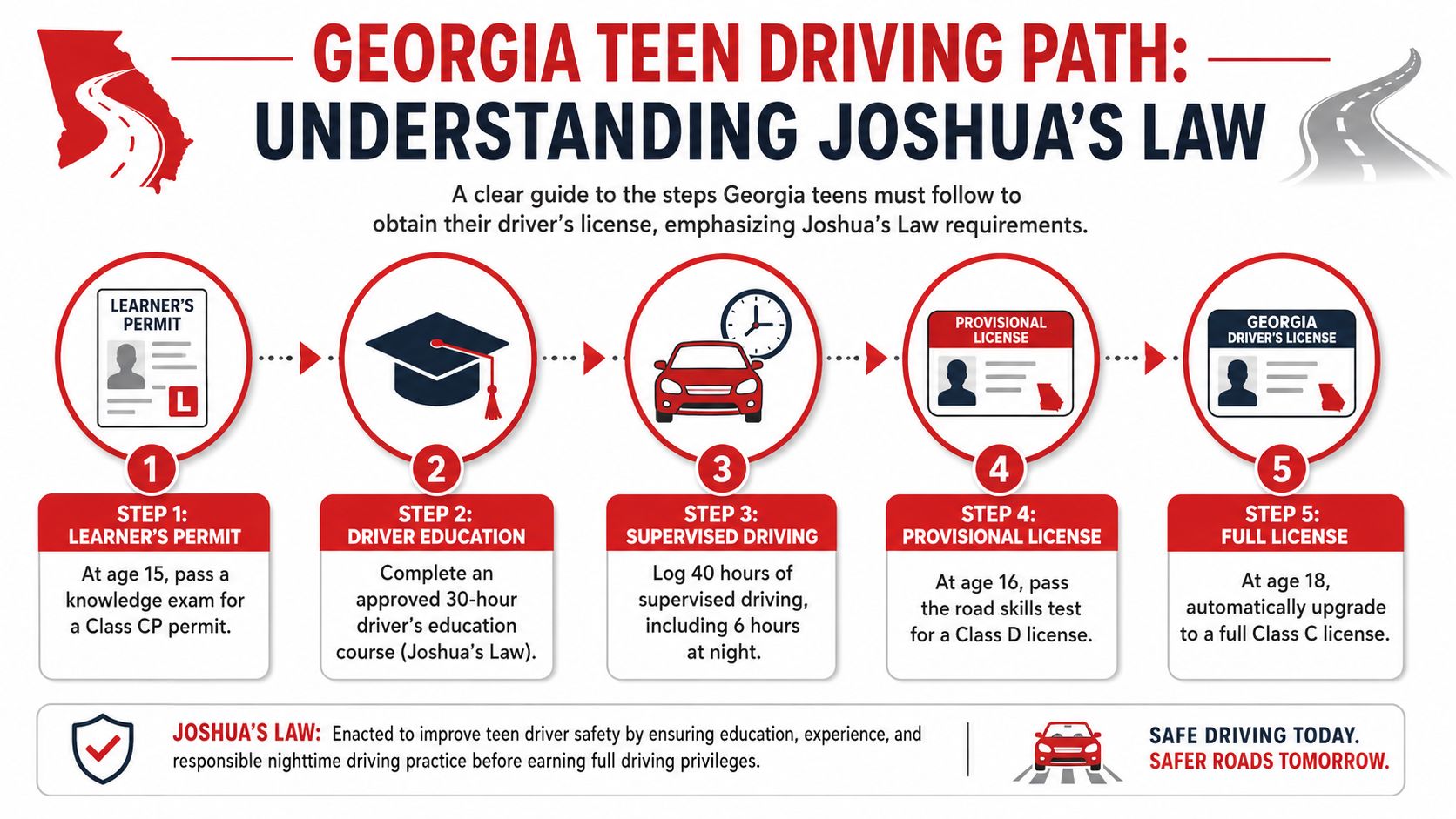
Under Joshua's Law in Georgia, teenagers ages 16 and 17 must complete a DDS-approved 30-hour Driver's Education course to be eligible for a Class D license, and that requirement can be met through either an in-person classroom setting or a flexible online course, according to this Joshua's Law Georgia guide.
That flexibility matters. Some students do better with a live classroom. Others need the convenience of learning online around school, sports, or family schedules. What matters is that the course is DDS-approved and completed correctly.
How parents can think about the full path
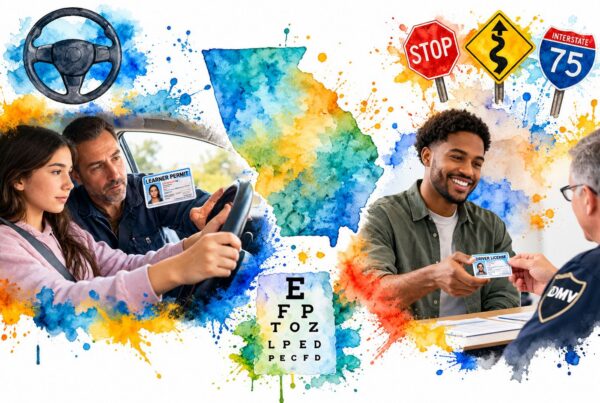
The infographic above lays out the typical path clearly: permit, driver education, supervised driving, road skills testing, then full licensure later. For many families, the most confusing part isn't the rule itself. It's coordinating the classroom requirement, supervised practice, and road test timing without leaving anything until the last minute.
A practical way to stay organized is to track the process in a simple list:
- Course completion: Choose a Joshua's Law option that fits the teen's learning style.
- Supervised practice: Keep a written log and make sure nighttime practice happens intentionally, not as an afterthought.
- Road test preparation: Don't wait until test week to discover weak spots like turns, lane changes, or parking.
- Testing support: Use a school that can help students prepare for the actual road test process.
A teen who only drives in easy daytime conditions may still feel unprepared when the first dark, busy, or unfamiliar trip arrives.
Online options, scholarships, and road testing support
Georgia families often prefer online learning because it makes the classroom portion easier to complete on schedule. That can be especially helpful when a student is balancing school responsibilities and still needs time for practice driving.
Some families also need cost-conscious options. The Georgia Driver's Education Scholarship Grant Program can be an important resource for eligible students who need help accessing training. It's worth exploring early rather than waiting until the permit period is nearly over.
Road testing is the final practical checkpoint. Students who prepare with structured lessons usually arrive more settled because they've already practiced the exact kinds of maneuvers and decisions the examiner will evaluate.
Drive Confidently From Sunset to Sunrise
If you want to know how to drive safely at night, keep it simple. Prepare before the trip. Create more space on the road. Manage glare correctly. Practice until the right responses feel ordinary.
Night driving isn't a talent some people have and others don't. It's a trainable skill. Drivers improve when they stop treating darkness like a minor inconvenience and start treating it like a different driving environment with different demands.
For teens and parents, that means taking the learning process seriously from the start. For adults, it often means rebuilding habits that were never formally taught. If you're also trying to understand the legal side of unsafe behavior behind the wheel, this overview of understanding dangerous driving charges gives useful context on why careful judgment matters long before a citation or crash enters the picture.
The goal isn't to fear night driving. The goal is to respect it, practice it, and get comfortable with it. Once you do, sunset won't feel like a warning. It'll just feel like another part of the day to drive well.
If you're ready to build real confidence behind the wheel, explore A-1 Driving School for driving lessons and driving lesson packages, Joshua's Law courses in Georgia, online course options, road test support, and information about the Georgia Driver's Education Scholarship Grant Program.