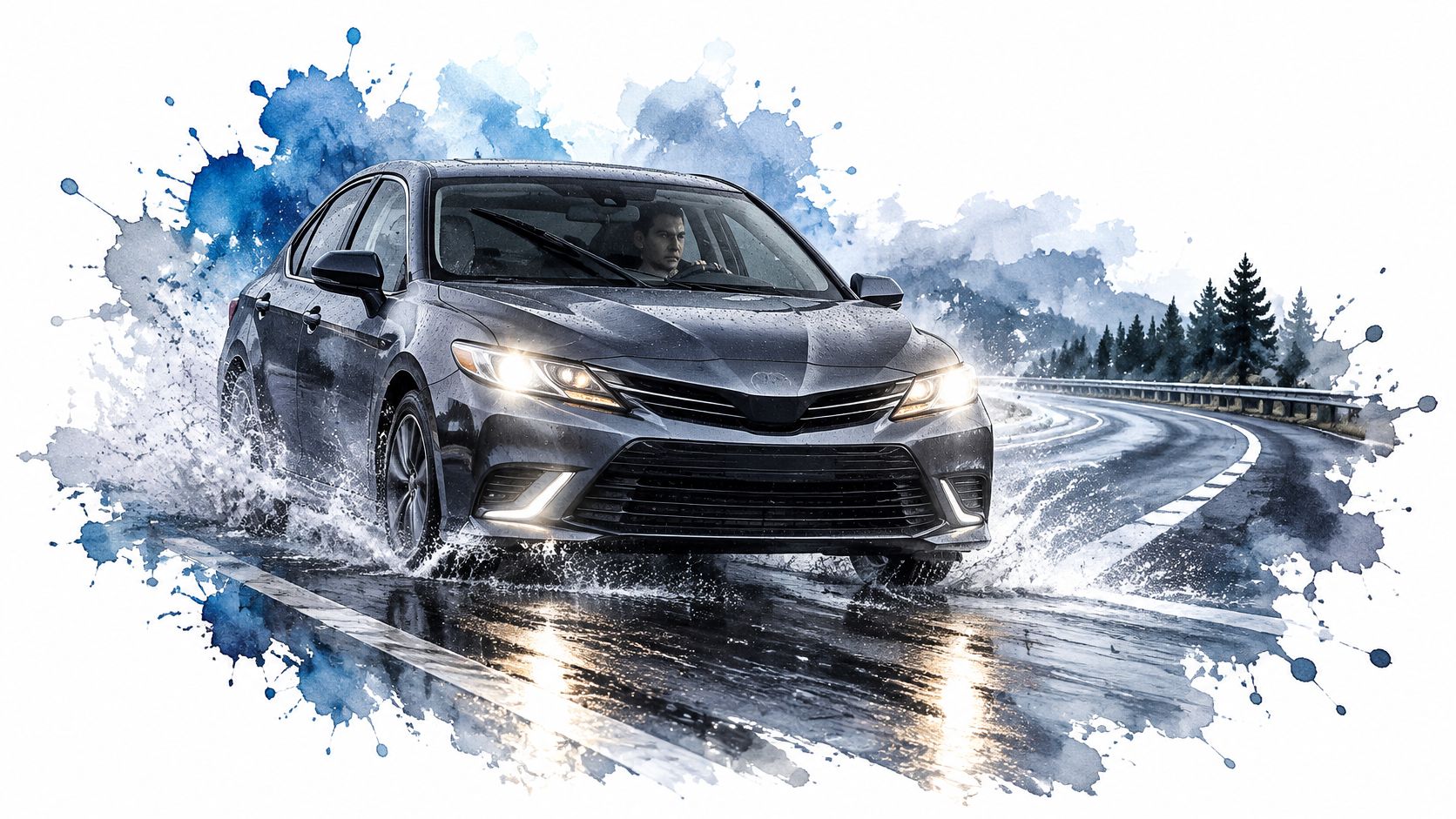
You're heading home on a metro Atlanta highway when the first rain in a week starts to fall. The road doesn't look flooded. There's no standing water, traffic hasn't slowed, and your usual speed feels reasonable. That's exactly when wet roads result in trouble, because grip falls before puddles give you a visible warning.
Good wet-weather driving isn't only about driving slower. It's about making decisions earlier, before a curve, before pooled water, and before you need to brake hard. Once you understand what's happening between your tires and the pavement, those earlier decisions become simple habits.
What Wet Pavement Does to Your Car
After a dry spell, rain lifts oil and dust from the pavement. The road may look clear, but the tires have less grip before puddles appear. A car can feel steady on a straight stretch, then struggle to brake or turn when the driver reaches a curve or intersection. Wet-road risk begins with that early loss of traction, not just with deep water.
According to FHWA guidance on horizontal curve safety, a water film only 0.002 inches thick can reduce friction by approximately 20–30% compared with a dry surface. Water partly separates the tire rubber from the pavement's tiny surface texture. With less grip available, the same steering or braking input can ask more of the tires than they can provide.
Four Changes You Need to Manage
Reduced traction is the first change. Steering can feel less precise, and the car may respond less predictably. Ease off before curves, downhill grades, intersections, and driveways, where braking or turning demands more grip.
Longer stopping distance comes from the same reduced grip. Brakes slow the wheels, but the tires must grip the road to slow the car. A routine stop therefore needs more road on wet pavement. A brake system inspection can help confirm that the braking system is ready, but well-maintained brakes cannot replace friction lost to water.
Hydroplaning happens when water forms a wedge beneath a tire and lifts it from the pavement. Steering and braking control can both weaken. Lower speed gives the tire tread more time to channel water away.
Reduced visibility creates another hazard. Spray, a wet windshield, and glare can obscure brake lights, lane markings, and nearby vehicles. Use low beams, leave more space, and postpone lane changes until you have a clear view.
| Hazard | What Changes | Key Figure | First Response |
|---|---|---|---|
| Reduced traction | Friction drops before standing water forms | About 20-30% less friction under a 0.002-inch film | Ease off before curves and intersections |
| Longer stopping distance | Braking needs more road | Stops take noticeably more road than on dry pavement at the same speed | Increase the following gap |
| Hydroplaning | Tires ride on a water wedge | Risk rises with water depth and speed | Reduce speed and avoid cruise control |
| Reduced visibility | Spray and glare hide vehicles and markings | Keep 4 seconds or more behind traffic | Use low beams, add distance, and delay lane changes |
Why Curves and Intersections Bite First
Tires share their available grip between braking and turning. If you brake while steering, each action has less traction to work with. A curve taken at dry-road speed can send the car wide, while late braking near an intersection leaves less room to respond if traffic stops.
Tire choice matters, too. Traction grades indicate wet-pavement stopping capability: a higher-grade tire should stop in a shorter distance than a lower-grade one. Adequate tread and correct inflation help the tire reach the pavement through the water. That is why managing speed and space before the road looks flooded matters.
Speed, Spacing and the Rain Driving Checklist
A road can become risky before water gathers in visible puddles. As soon as rain wets the pavement, available grip can fall, while spray and glare make it harder to judge what traffic is doing. The Federal Highway Administration rain and flooding page reports that 75% of weather-related crashes occur on wet pavement and 47% occur during rainfall. Annually, wet-pavement crashes are associated with nearly 5,700 deaths and more than 544,700 injuries in the United States.
These hazards work together. Reduced friction leaves less room for braking or turning, while spray can hide brake lights and lane markings. A driver may not notice the smaller safety margin until the car needs to slow down. The practical response begins earlier: adjust speed and spacing while the road still seems manageable.
Measure Space in Seconds
Use at least a 3-second following gap on dry pavement and 4 seconds or more on wet pavement. Choose a fixed object, such as a sign. Once the vehicle ahead passes it, count until your car reaches the same point. If you arrive before four seconds on a wet road, ease back until the gap is larger.
Seconds are more useful than car lengths because the distance between vehicles grows with speed. Practicing the count during hazard perception training can help you judge that space without guessing. The extra room also gives you time to brake progressively if traffic slows, rather than reacting with a sudden pedal press.
| Condition | Following Gap | Speed Guidance |
|---|---|---|
| Dry pavement | 3 seconds | Posted limit, adjusted for traffic |
| Light rain, wet pavement | 4 seconds or more | Reduce speed before curves and ramps |
| Heavy rain or pooled water | 4 seconds or more | Slow further and avoid pooled water |
| Curves, bridges and intersections | Extra space before the hazard | Slow down before entering |
The table is a starting point, not a promise that any one speed is safe in every condition. In heavy rain, slow further if visibility or traction is poor. Avoid driving through pooled water when possible. If spray hides the road or water is moving across it, stop somewhere safe rather than proceeding into an area where the road surface is difficult to judge.
Practical rule: Decide on speed and spacing while the road still looks easy, before the car begins to feel loose.
The Rain Driving Checklist
- Before leaving: Turn on your headlights and check that the wipers clear the windshield without streaking.
- At the start: Build a following gap of at least four seconds.
- Before curves and ramps: Reduce speed while you are still traveling straight. This leaves more grip available for turning.
- On highways: Switch off cruise control so the car does not try to maintain speed through pooled water.
- With every input: Steer, accelerate, and brake smoothly. Abrupt corrections can use up the limited grip.
- In heavy spray: Postpone lane changes when you cannot clearly see vehicles beside or behind you.
- At deep or moving water: Stop rather than proceed. Floodwater can hide its depth, current, and damaged pavement.
Chain-reaction highway crashes show why short following gaps leave drivers fewer options. The highway crash lessons for Wisconsin drivers reinforce that space is a safety tool, not wasted road. For a teen, supervised practice in light rain can build speed judgment through experience. The goal is practical: brake earlier, leave a larger gap, and reduce surprises.
Hydroplaning and Why Shallow Water Can Be Enough
Say you're traveling in the right lane and notice water collected in a shallow wheel rut ahead. The patch looks harmless, but your tire reaches it at highway speed and starts pushing water forward faster than the tread can clear it. A wedge forms, the steering suddenly feels light, and the car stops responding normally.
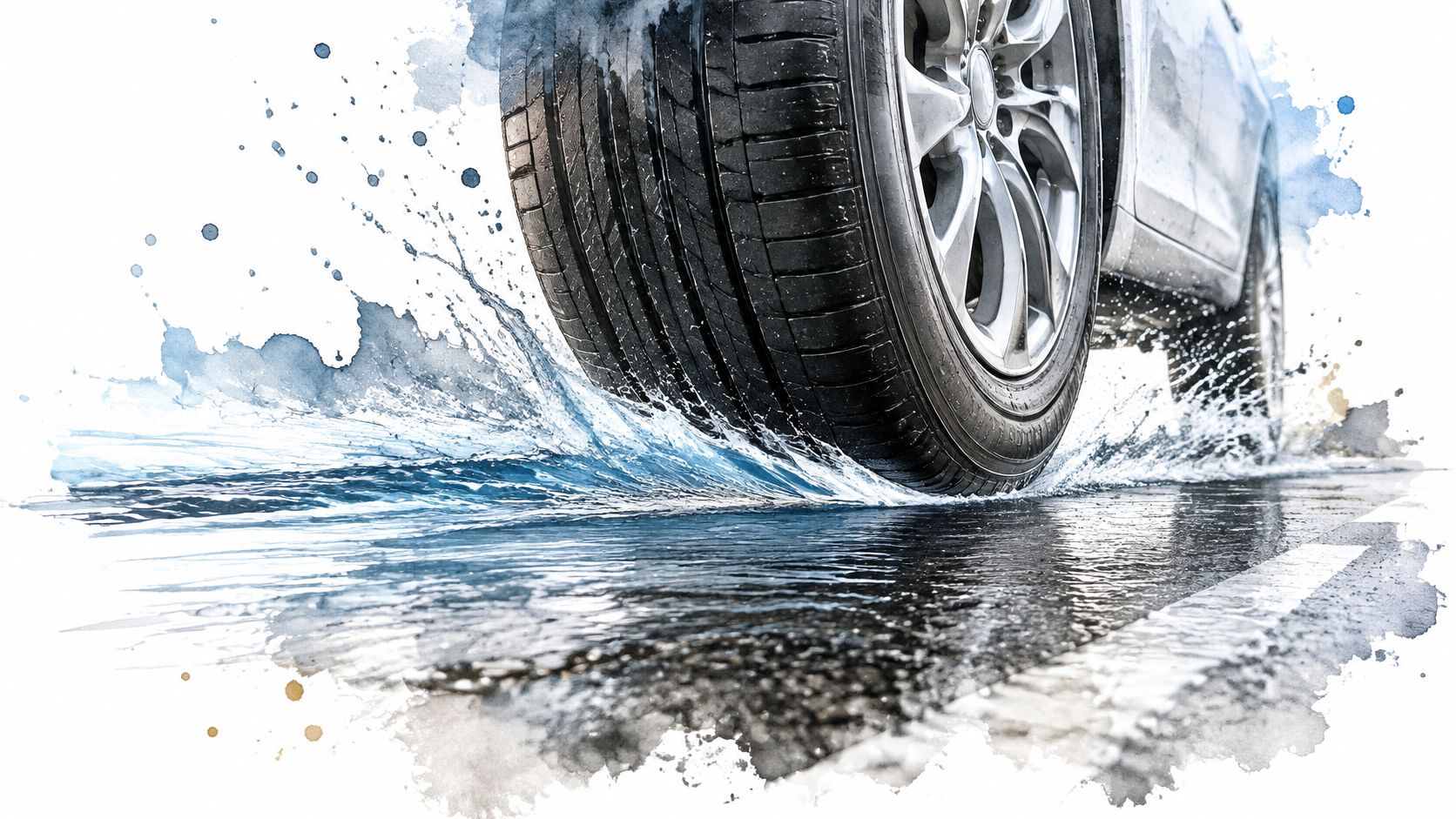
This close view shows how much water a tire must displace even in a shallow puddle.
What Controls the Risk
The FHWA pavement friction guide describes hydroplaning as a water wedge that can lift the tire from the pavement. Risk rises with greater water depth and speed and falls with greater tire pressure, tread depth, and pavement macrotexture. Relatively small amounts of water can reduce friction by 20–30%, while deeper water can produce near-total loss of directional and braking control.
Deeper water doesn't always create a simple, straight-line increase in risk. A University of Georgia report on preventing hydroplaning describes a tire simulation in which risk fell after water depth reached roughly 10 millimeters, because the vehicle may slow or lose sufficient contact earlier in the encounter. The transition into pooled water can therefore be the most dangerous moment, especially if you enter it quickly and then steer or brake.
Around Atlanta, watch lane ruts, bridge decks, shaded pavement that stays damp, and low spots near intersections and driveways. Water doesn't need to cover the whole road. One front tire losing contact can pull the car or make steering feel disconnected.
The video below lets you see the sequence before you have to recognize it from the driver's seat.
If the Steering Goes Light
Warning signs include light steering, engine revs rising without the car gaining speed, and a drifting sensation. Respond in this order:
- Ease off the accelerator: Let speed fall without braking hard.
- Hold the wheel steady: Keep the car pointed where you want to go.
- Avoid sudden corrections: Don't change lanes or make a sharp steering movement.
- Brake gently after grip returns: Wait until you feel the tires reconnect with the pavement.
If the loss of grip develops into a slide, what to do when your car skids provides a helpful next read on staying calm and avoiding overcorrection. The tread grooves are the water's escape path, so worn tires reach hydroplaning sooner and leave you fewer options once it starts.
Tires, Tread and Traction Grades
Your tires do two jobs in rain. The rubber must grip the pavement, and the grooves must move water away so the rubber can reach it. When tread wears down, that escape path narrows and the water wedge forms more easily.
Before a learner's first wet drive, make three checks:
- Inspect the tread: Look across each tire for grooves worn smooth, uneven patches, or exposed wear indicators.
- Check pressure cold: Compare each tire with the recommended value on the driver's door placard, not the maximum printed on the tire sidewall.
- Match condition by axle: Make sure the two front tires and the two rear tires are in similar condition, so one side doesn't clear water much better than the other.
Pressure and tread are the two hydroplaning factors you control directly. Greater tire pressure and tread depth improve the tire's chance of maintaining contact, while the road's macrotexture is already set. That's why a smooth, worn stretch near an intersection may feel slippery sooner than coarse pavement on an open highway.
A tire can look acceptable for a dry errand and still be a poor choice for practicing in rain.
When replacing tires, check the traction grade. A higher-grade tire should stop in a shorter distance on wet pavement than a lower-grade tire, so the grade is more than sidewall decoration. Have questionable tires inspected before booking wet-weather practice. A first lesson in rain should teach judgment, not expose a preventable equipment problem.
Georgia Training Paths and Wet-Weather Lessons
Georgia gives families more than one approved route to a Class D license, but every route separates classroom learning from time behind the wheel. The Georgia Department of Driver Services Joshua's Law requirements set out the standard school-based option with 30 hours of classroom instruction, 6 hours of behind-the-wheel training at a certified school, and 40 hours of supervised driving including at least 6 hours at night. Other routes use parent-taught or virtual instruction.
| Pathway | Classroom Hours | Behind-the-Wheel Training | Supervised Driving |
|---|---|---|---|
| Standard school-based | 30 hours | 6 hours with a certified school | 40 hours, including 6 at night |
| Parent-taught | 30 hours | Parent-taught driving | 40 hours of parent-taught driving |
| Online or virtual | 30 hours through a certified virtual program | 6 hours with a certified school, or parent-taught driving | 40 hours if parent-taught |
Classroom Knowledge Needs Road Time
An online Joshua's Law course can cover the required material at a learner's own pace, including why wet roads result in longer stops and how to choose speed and spacing. That knowledge matters, but it doesn't teach your foot how gentle braking feels or your eyes how a four-second gap looks in spray. Georgia's behind-the-wheel requirement exists because judgment has to work in moving traffic.
Driving lessons packages make that practice deliberate. An instructor can sequence sessions around a learner's schedule and include smooth braking, curve entry, following distance, and lane discipline when conditions allow. After the basics are reliable, advanced driving techniques can build on those habits rather than replace them.
Timing is on the learner's side. There's a permit holding period before the license, which creates room to encounter different conditions gradually instead of cramming every skill into the final month. Start with familiar routes in light rain, then add ramps, bridges, and busier intersections as control improves.
Families should also ask about the Georgia Driver's Education Scholarship Grant Program for students who qualify. Whether a teen chooses an in-person class or an online course, the strongest plan pairs the required instruction with booked driving lessons and steady supervised practice. That's how wet-road rules become automatic habits before test day.
Book Wet-Weather Driving Lessons and Your Road Test
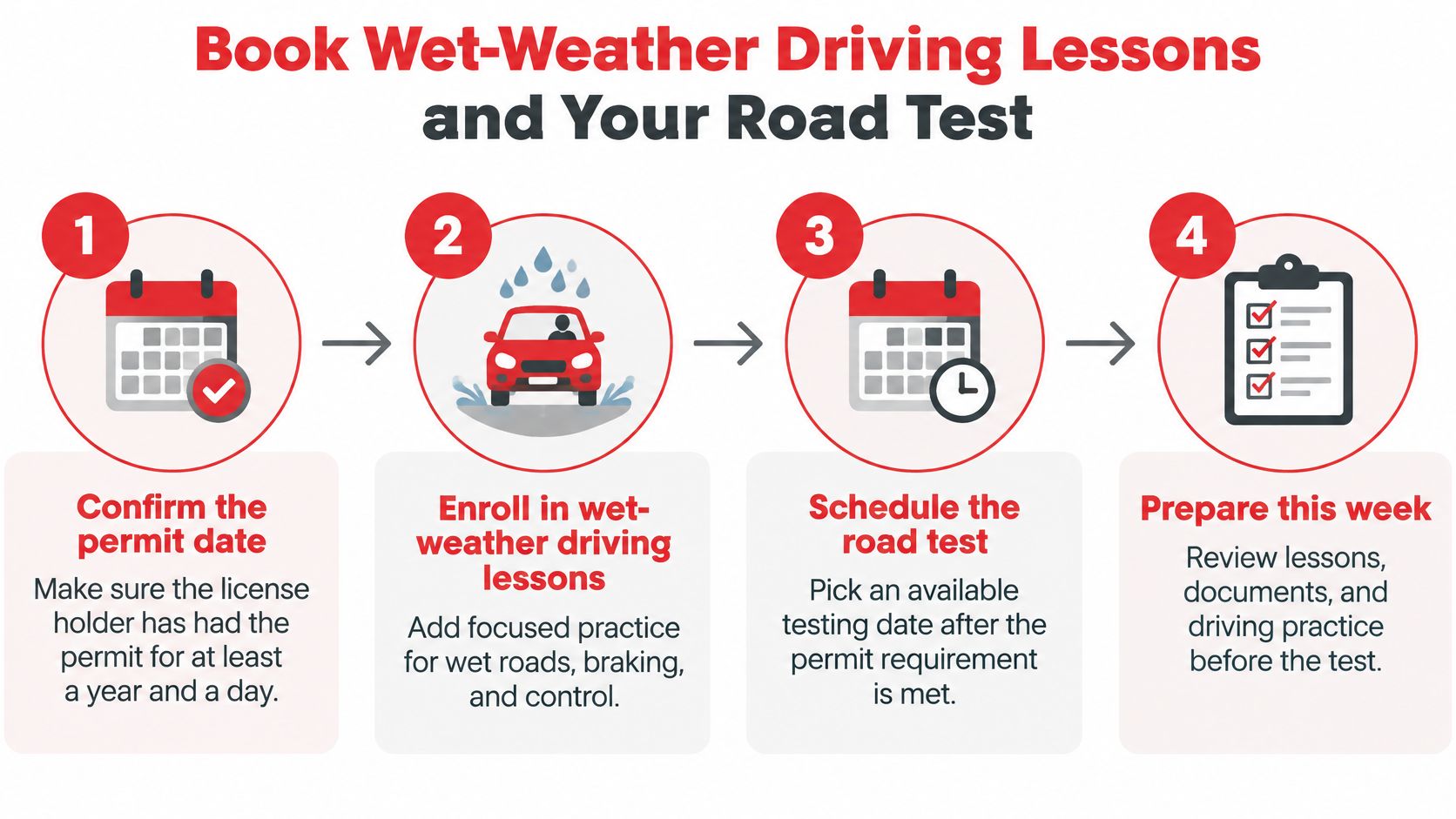
Rain may arrive before your road-test date, so plan early. A learner's permit must be held for at least 1 year and 1 day before applying for a license, according to the Georgia Department of Driver Services licensing guidance. Use that time to complete Joshua's Law education and supervised practice, building wet-road judgment before test day.
Your Booking Path
- Confirm the permit date: Count forward at least a year and a day before choosing a target license date.
- Enroll in Joshua's Law: Select an in-person or online course that fits the learner's schedule.
- Book driving lessons: Ask to practice in wet weather when conditions allow, along with night driving and test maneuvers. On wet roads, early choices about speed, space, and gentle inputs matter before puddles form.
- Pass both knowledge tests: Georgia's Road Rules and Road Signs exams each require 15 correct answers out of 20, as stated in the Georgia Department of Driver Services test information.
- Schedule the road test by appointment: Bring a vehicle that passes the safety inspection, with valid registration and liability insurance. Arrive with a licensed driver who is at least 21 years old.
- Earn the passing score: Applicants must score at least 75% to pass, according to the Georgia Department of Driver Services road test page.
A-1 Driving School offers Road Testing, including the Georgia Road Test, so you can prepare for the required maneuvers and procedures. Its Scholarship Grant Program may help eligible families cover driver education. Arrange lessons before your test date, and include wet-weather practice when conditions permit. Coaching in real traffic can help you adjust speed, following space, and steering smoothly as the road gets wet.
Joshua's Law education, driving lessons, and road testing can each fit into your preparation schedule. Visit A-1 Driving School to enroll, book a lesson, and take the next step toward your Class D license.