
You can get your Georgia learner's permit, called a Class CP permit, at age 15 after passing the vision and knowledge tests. To move to a Class D license at 16, you must hold that permit for 1 year and 1 day, so the date you get your permit matters right away.
A lot of families start asking this question a few weeks before a birthday. A teen is about to turn 15, a parent is trying to map out school, practice driving, and driver education, and everybody wants the same answer. When can you get your permit in Georgia, and what should you do next so you don't lose time later?
That's the part many quick answers miss. In Georgia, the permit isn't just a small first step. It's the starting date for the whole teen licensing timeline. If you understand that early, you can make smarter decisions about studying, scheduling lessons, Joshua's Law, supervised practice, and road test timing.
Introduction to Getting Your Permit in Georgia
Let's use a common example.
A student turns 15 in June and wants to drive as soon as possible. The family's first instinct is usually to focus on the written test. That matters, of course, but the bigger planning question is this: if the student gets the permit soon after turning 15, the clock toward the next license stage starts sooner too.
Georgia allows teens to apply for an Instructional Learner's Permit, or Class CP, at age 15 after passing the required vision and knowledge tests, according to the Georgia DDS introduction to permits and licenses. Georgia also explains that the learner's permit is the first step before moving toward a Class D provisional license in the state's teen licensing path, as shown on the Georgia DDS Class D license page.
Why families get confused
Most confusion comes from mixing up three different ideas:
- Getting a permit means a teen can begin legal supervised practice.
- Holding a permit means time is passing toward later eligibility.
- Getting a license means moving into a different stage with more freedom.
Those are not the same event.
A permit is a learning phase, not independent driving permission.
That's why this question matters so much more than it seems. If your teen waits several months after turning 15, that delay doesn't just push back permit practice. It can also push back the earliest possible date for the next license stage, because Georgia's system is built around graduated privileges instead of a one-and-done license model.
What this means for your family calendar
Think in terms of a starting line. The day the permit is issued becomes the date many families plan around for the next year. That affects summer driver education, school-year practice, lesson scheduling, and eventually road test readiness.
Georgia's learner permit guidance also highlights this practical timing issue. Many people look only at the minimum age, but the permit date can shift the earliest Class D date by more than a year because of the required hold period, as noted on the Georgia DDS learner's permit page.
How Georgia Graduated Licensing Works
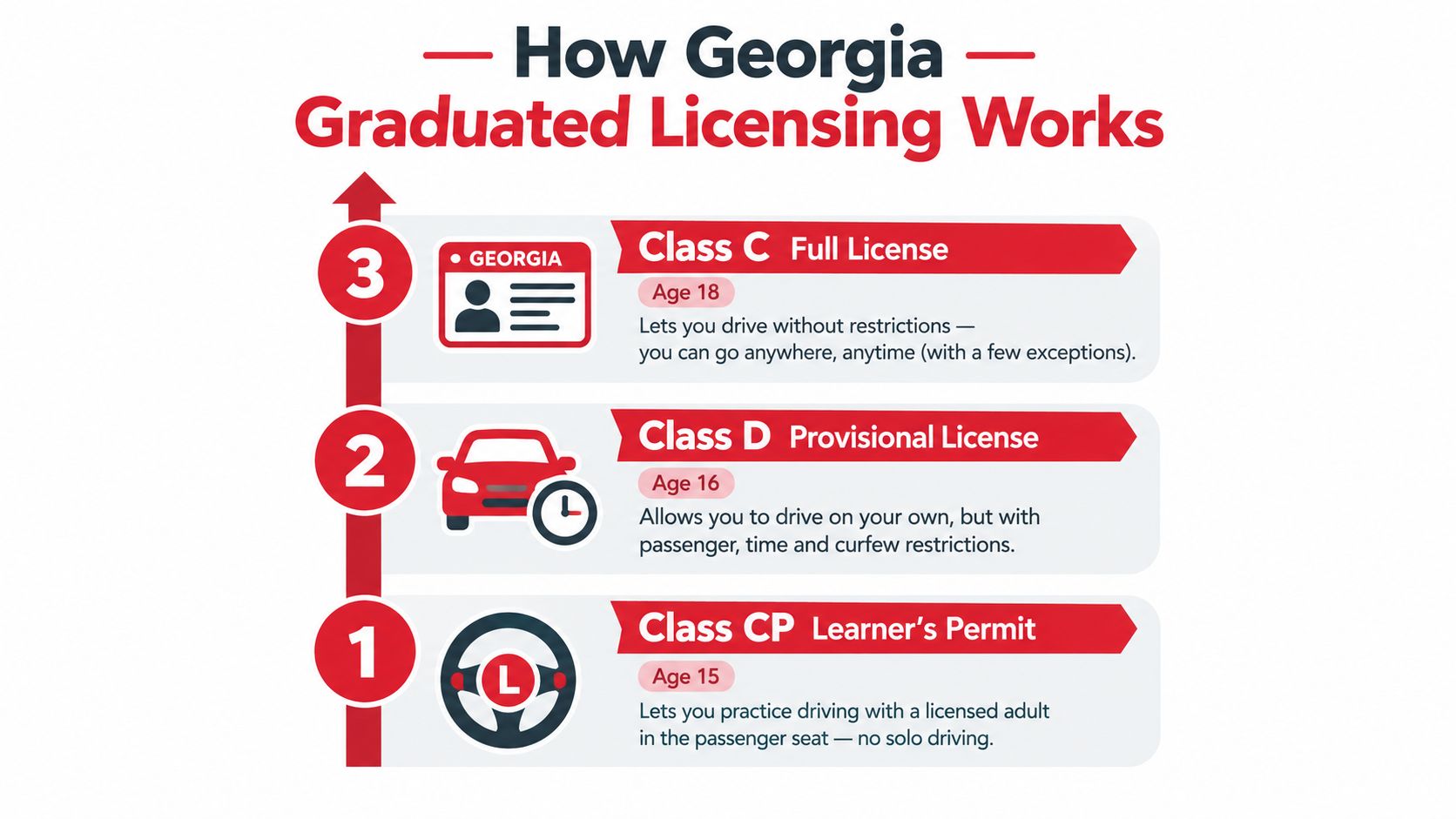
Georgia's teen licensing system works like a ladder. You don't jump from no experience to full driving privileges in one move. You climb one level at a time.
The three-stage ladder
Here's the simple version:
| Stage | Typical Age | What It Means |
|---|---|---|
| Class CP permit | 15 | Learning stage with supervised driving |
| Class D license | 16 | Provisional stage with expanded privileges |
| Class C license | 18 | Full license stage |
The state describes this as a progression, not a shortcut. A teen starts with a permit, builds skill under supervision, then moves into the provisional stage, and later reaches full licensing.
What a permit actually allows
A Georgia learner's permit is a supervised-learning credential. Georgia DDS says permit holders must be accompanied by a licensed adult who is at least 21 years old, and that adult must be seated beside the driver, as explained in the Georgia DDS Class D requirements.
That adult isn't there just for company. The rule exists because the state wants teens to build judgment, scanning habits, parking skill, and traffic awareness before they drive on their own.
Practical rule: If your teen has a permit, they're not in the independent-driving stage yet. Every trip is still a practice trip.
Why Georgia uses this system
This structure makes sense when you think like an instructor. A brand-new driver may know road signs and basic rules, but real-world driving involves timing, awareness, and calm decision-making. Those only improve with repetition.
A permit lets a teen practice with support. A provisional license comes later, after the teen has had time to build routine habits. Then, at adulthood, the system shifts to the full Class C stage.
One page from the Georgia House Budget and Research Office also states that Georgia permits are available at age 15 and that the Class CP permit is granted to applicants who are at least 15 years old after passing the written knowledge exam, as summarized in the Georgia driver education policy brief.
Age and Eligibility Requirements for Your Learners Permit
If you're asking when can you get your permit in Georgia, the age answer is only the beginning. You also need to know whether you're eligible to walk into DDS and complete the application without delays.
The basic checklist
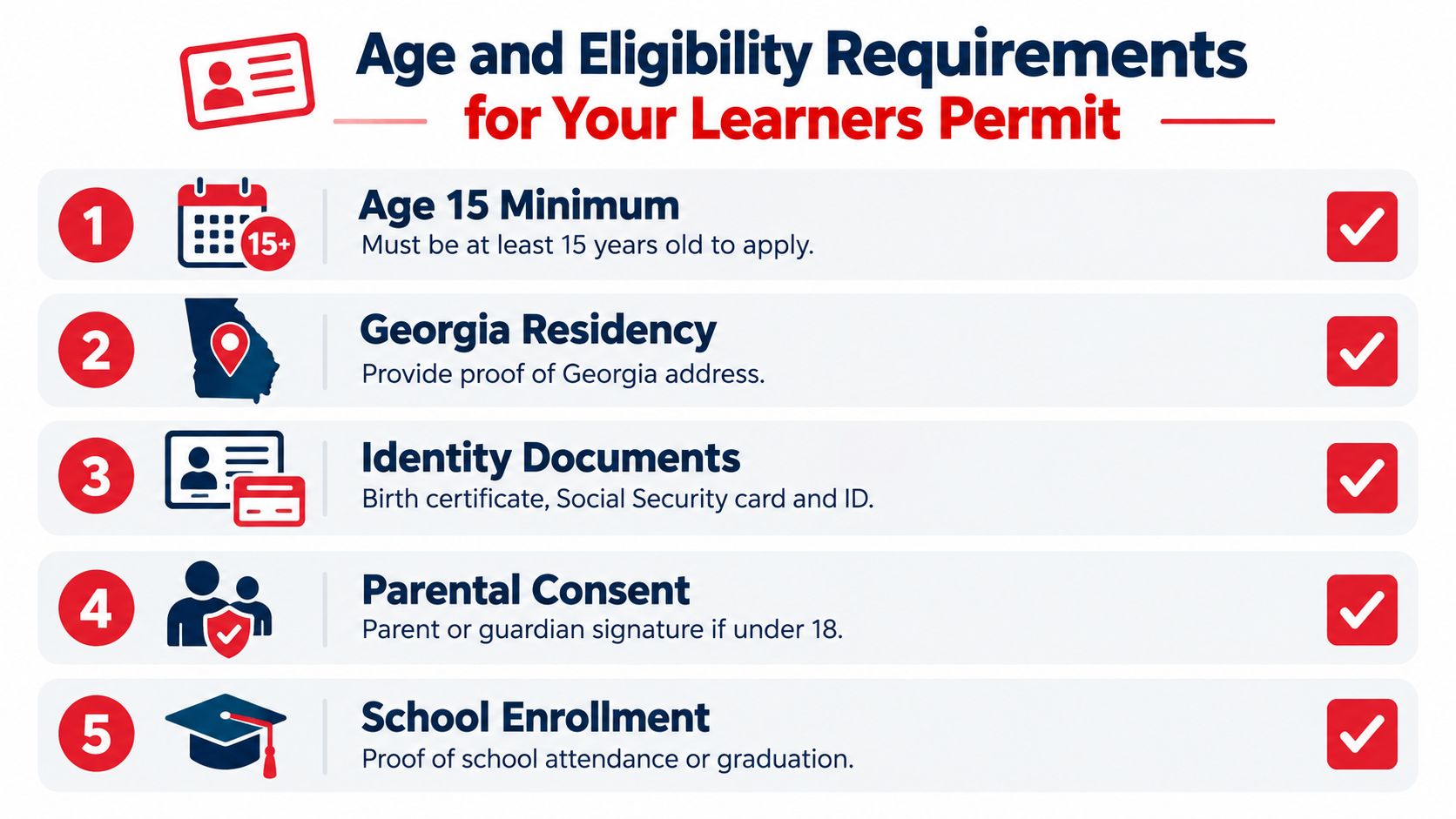
Start with this short checklist before you schedule anything:
- Be old enough: You must be at least 15 years old to apply for a Georgia learner's permit, according to the DDS permit and license introduction.
- Pass the required tests: Your application only becomes valid after you pass the vision and knowledge tests, as described by the same DDS guidance.
- Have an adult sign if needed: For applicants under 18, Georgia requires parent, guardian, or instructor sign-off, as outlined in the DDS licensing section on obtaining a permit or license.
- Bring your documents: Identity, residency, and school-related records often trip people up if they wait until the last minute.
- Understand the permit rule: Once issued, the permit is for supervised driving, not solo driving.
If you want a broader prep list before heading to DDS, this BDISchool permit requirements overview is a useful outside reference, and this Georgia permit requirements guide gives a Georgia-specific walkthrough.
What to expect on permit day
Most families focus on studying the manual, which is smart, but paperwork causes just as many setbacks as the test does. A teen may be fully ready for the knowledge exam and still have to come back another day because a required document or signature is missing.
A good rule is to treat permit day like airport travel. Don't assume you can show up with the essentials in your head. Build a folder, verify the names on documents, and confirm who needs to attend with the teen.
Bring every required item in one trip if you can. The smoothest DDS visits usually come from organization, not luck.
One edge case families should know
Most teens will follow the standard permit-to-Class-D path. Still, there's one exception that families sometimes miss. Georgia states that a 17-year-old who proves military enlistment can be exempt from the 1 year and 1 day permit hold and may be issued a Class C license at issuance, according to the Georgia DDS permit and license section.
That exception won't apply to most readers, but it's important because it shows why broad internet answers can be incomplete. “You can get your permit at 15” is true, but it doesn't explain every timeline.
Joshua's Law and Your Timeline to a Class D License
For most Georgia teens, permit timing turns into real planning. The permit date is not just a milestone. It's the start of the countdown toward a Class D license.
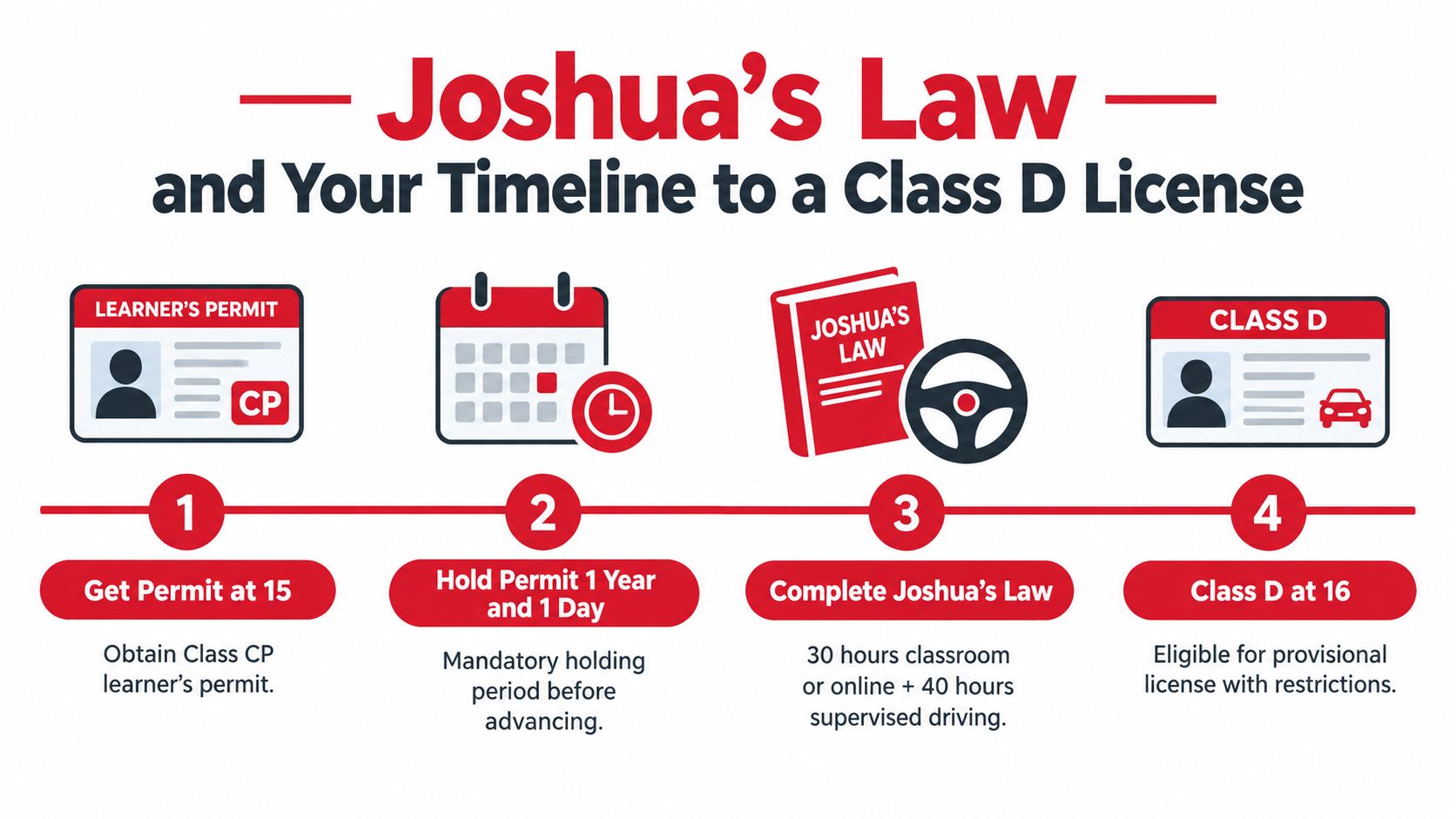
Georgia DDS says a teen must be at least 16 years old and must have held a valid Class CP permit for at least 1 year and 1 day before qualifying for a Class D license, as explained on the Georgia DDS Joshua's Law requirements page.
Why the permit date matters so much
Let's keep this simple.
If a teen gets a permit soon after turning 15, the required holding period starts sooner. If that same teen waits, the legal timeline shifts later too. Georgia specifically ties permit timing to the Joshua's Law pipeline, which is why the date matters for scheduling courses, practice time, and road-test readiness.
Here's the planning logic:
- Get the permit early: The hold period starts earlier.
- Wait to get the permit: The earliest Class D eligibility date moves back.
- Use the permit year well: Complete training and supervised practice during that window.
That's the unique angle many families miss when searching when can you get your permit in Georgia. They think they're asking about one birthday. They're really asking about a licensing calendar that stretches into the next year.
What Joshua's Law adds during that year
For applicants age 16 or 17, Georgia DDS requires a DDS-approved driver education program plus 40 hours of supervised driving, including 6 hours at night, before a Class D license can be issued, according to the Georgia DDS Joshua's Law page. Georgia's scholarship rules also describe Joshua's Law completion as 30 hours of classroom instruction plus 6 hours of behind-the-wheel instruction with an approved instructor in the Georgia Driver's Education Grant Scholarship Program rules.
That means the permit year is not dead time. It's the period when a teen should be building both legal eligibility and real driving skill.
The smartest families don't treat the permit year as waiting. They treat it as training time.
For Class D, Georgia also says applicants must be at least 16, hold a valid instructional permit for one year and one day, pass a road test, and satisfy Joshua's Law requirements, as listed in the Georgia DDS continued licensing section.
A practical timeline families can use
Think in seasons, not just dates.
A teen who gets a permit in the summer can often use school breaks and weekends for structured driving practice. The family can fit classroom or online driver education into a manageable rhythm, then use the months ahead for neighborhood driving, parking lots, local roads, nighttime practice, and test prep.
A teen who delays the permit until later may still do everything correctly, but the entire timeline slides. That can affect plans for sports, school, jobs, and road test scheduling.
For that reason, many families like to map out the full permit-to-license path early. If you want a Georgia-specific breakdown of the legal sequence, this Joshua's Law requirements guide is a practical reference point.
How to Apply for Your Georgia Learners Permit Step by Step
Once you know the timeline, the next job is simple. Get prepared, go in with the right documents, pass the tests, and leave with a permit you can use.
A quick walkthrough helps more than a giant checklist, so here's the order I'd give a student and parent.
To get oriented before test day, this short video gives a helpful overview of the permit process:
The five-step flow
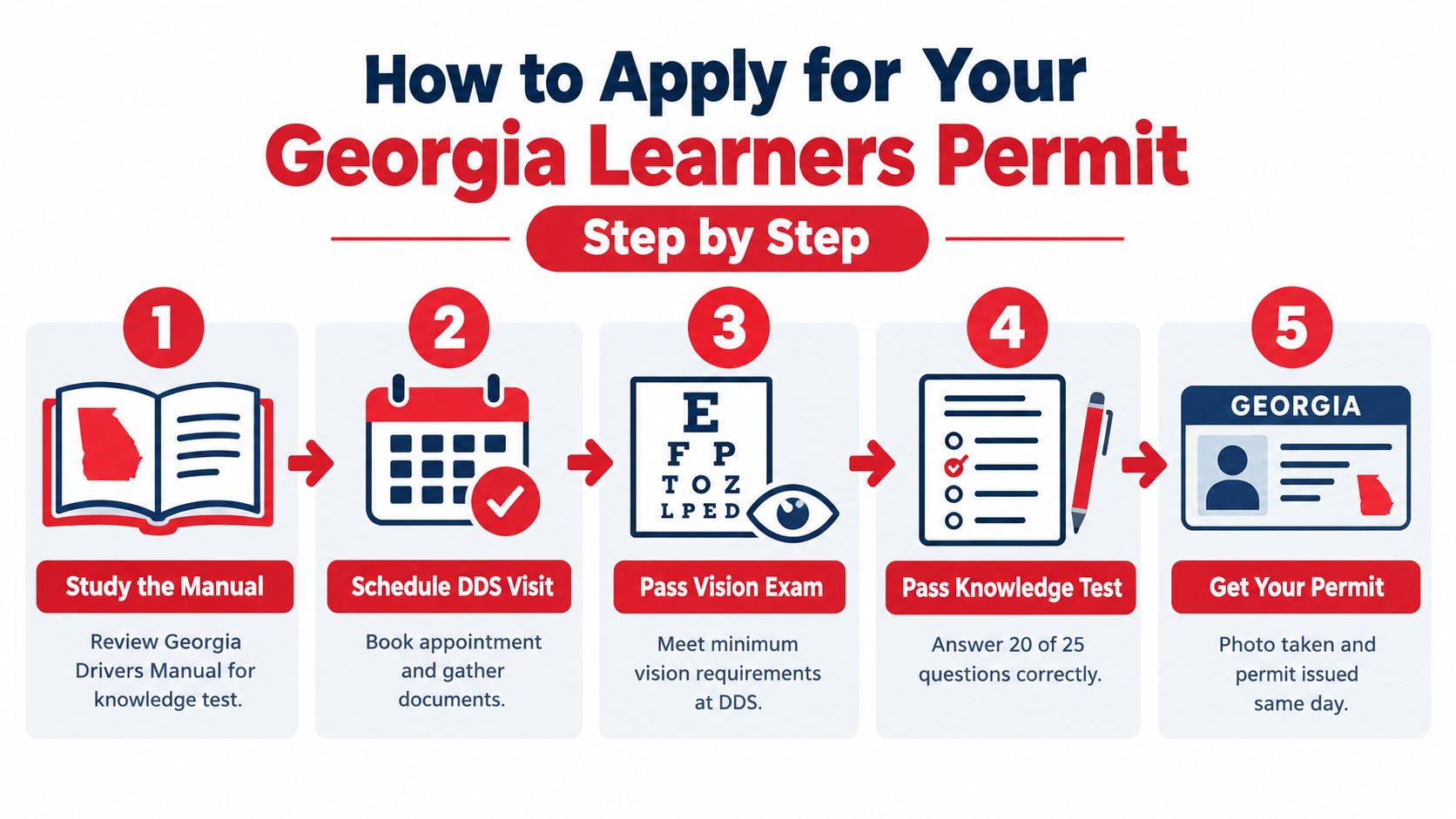
Study before you schedule
Read the Georgia Driver's Manual and focus on signs, rules of the road, and safe driving decisions. Cramming the night before usually shows.Gather documents early
Put everything in one folder and verify that names and details match. If a parent or guardian needs to sign, plan that in advance instead of assuming it can be handled later.Go to DDS for testing
The state requires a vision screening and knowledge test before the permit can be issued. This is the point where preparation pays off.Complete the application process
Once the tests are passed and documents are accepted, DDS can process the permit application.Start supervised driving the right way
The permit opens the door to legal practice, but only under the permit rules.
Under a Georgia learner's permit, the teen must drive with a licensed adult age 21 or older seated beside them.
Common delays you can prevent
I've seen families lose momentum for reasons that had nothing to do with driving skill. The most common issues are simple: incomplete paperwork, underestimating the knowledge test, or showing up without the person who needs to sign.
Use this mindset instead:
- Study in short sessions: A little review over several days usually sticks better than one long cram session.
- Check documents twice: Families often remember the big items and forget the supporting ones.
- Treat the first weeks seriously: Good habits formed right after the permit is issued are easier to keep.
If you want a more detailed Georgia walkthrough of the DDS process, this step-by-step Georgia permit guide can help you prepare.
Choosing the Right Drivers Education and Driving Lessons Path
Once the permit is in hand, families usually face a different question. What's the best way to complete training and build real confidence behind the wheel?
The right answer depends on schedule, learning style, and how much support the student needs in the car.
Comparing your options
Some teens do well in a traditional classroom. Others learn better with online modules they can complete around school, sports, or work. Many benefit from separate driving lessons even if they're also completing Joshua's Law, because supervised family driving and instructor-led coaching aren't the same experience.
Here's a simple comparison:
| Option | Best For | Key Features |
|---|---|---|
| In-person driver's education | Students who like structure and live instruction | Set schedule, classroom environment, direct interaction |
| Online Joshua's Law course | Busy teens who need flexibility | Learn from home, easier to fit around school and activities |
| Behind-the-wheel lessons | Students who need skill-building and confidence | Real-time coaching on turns, parking, lane position, traffic judgment |
| Lesson packages | Families who want a fuller practice plan | Multiple sessions, more repetition, steady progress |
| Road test support | Students close to licensing | Targeted prep, familiar process, focused feedback |
Why driving lessons matter even with family practice
Parents are important practice partners, but they're not always instructors. A parent may know how to drive well and still struggle to teach mirror timing, lane discipline, or how to break a maneuver into repeatable steps.
That's where structured lessons can help. A trained instructor can spot patterns quickly, correct habits before they stick, and give a teen a calmer place to practice harder skills.
One option in Georgia is A-1 Driving School, which offers Joshua's Law courses, online course options, driving lessons, lesson packages, and road testing support across metro Atlanta. For families comparing providers, the practical questions are usually schedule flexibility, course format, instructor availability, and whether lessons can be bundled in a way that fits the student's timeline.
Course completion checks a legal box. Driving lessons build the habits that make the road test and everyday driving feel manageable.
Don't overlook scholarship support
Georgia also has a training support path that many families don't know about. The Georgia Driver's Education Grant Scholarship Program is targeted to residents ages 15 through 17 who hold a valid Georgia instructional permit or driver's license, and it funds Joshua's Law completion through 30 hours of classroom instruction plus 6 hours of behind-the-wheel instruction with an approved instructor, according to the Georgia scholarship program rules.
If your teen qualifies, that can make required training more accessible. It's worth checking scholarship details early rather than after your permit year is already moving fast.
Your Next Steps From Permit to Road Test Success
The clearest way to think about this journey is as a three-part track.
First, get the permit as soon as the teen is ready at 15. Second, use that permit year wisely with Joshua's Law and steady supervised practice. Third, prepare for the road test with enough repetition that test day feels familiar, not rushed.
For most families, the best next moves look like this:
- This week: Confirm the teen's permit eligibility, gather documents, and start studying.
- This month: Pick a driver education path and get early driving practice on the calendar.
- Before the road test window: Make sure practice includes night driving, varied traffic situations, and focused work on the skills that usually create stress.
If your family has an uncommon situation, such as the military enlistment exception for some 17-year-olds, check the state rule carefully and make plans around that specific path. Most teens, though, will follow the standard permit-to-Class-D route.
The main takeaway is simple. When can you get your permit in Georgia? At 15. But the more useful question is whether you're ready to turn that permit date into a smart plan for the year that follows.
If your teen is ready to start that timeline, A-1 Driving School offers Georgia Joshua's Law courses, online driver education options, driving lessons, lesson packages, scholarship information, and road testing support. It's a practical next stop if you want to move from “we know the permit age” to “we have a real plan for permit practice, training, and the road test.”