
A lot of families start in the same place. A teen is ready to drive, a parent opens a laptop, and the search begins with something simple like online drivers ed New Hampshire. Within minutes, the results get messy.
One site says online completion is easy. Another says the course is approved. A third sounds useful but doesn't clearly say whether it satisfies the state's teen licensing rules. That confusion is normal, and it's one of the biggest reasons people enroll in the wrong program.
As someone who works in driver education, I can tell you that such assumptions typically lead to mistakes. People assume “driver's ed” means the same thing everywhere. It doesn't. Each state writes its own rules, and those rules decide what counts, what doesn't, and what still has to happen in person.
Navigating the Maze of Online Driver's Ed
The phrase online drivers ed New Hampshire sounds straightforward. It isn't. The problem is that search results often mix together very different products.
Some courses are built for teens completing a state-required path to licensing. Others are general safety courses, refresher courses, or test-prep products. The pages may look similar, but the legal effect can be completely different. That's why families need to understand the category of course before they ever compare price, schedule, or convenience.
Why search results feel inconsistent
A parent usually wants answers to basic questions:
- Will this course count for my teen's license?
- Can everything be done online?
- What still has to happen with an instructor?
- Is this for a first-time teen driver or for someone older?
Those are the right questions. They're also the ones many course pages answer poorly.
Some providers use terms like “approved,” “online,” or “state accepted” without making it obvious which state they mean, or what part of the licensing process the course covers. That leaves families guessing. If you want a simple primer on how digital driver education generally works, this explanation of what online driver's education is gives useful background before you compare state rules.
Practical rule: Never assume an online course satisfies your state's teen licensing requirements unless the provider clearly says what audience it serves and what legal requirement it meets.
State law decides what counts
Driver education is a legal process first and a course catalog second. That means the state's rules matter more than the marketing language on a website.
New Hampshire is a strong example because its teen driver education structure is detailed and specific. It shows why “online” is only part of the story. In some states, online learning can fit into the process. In others, it can only cover part of the classroom requirement. In nearly every case, real driving practice still matters.
That's the framework to keep in mind. Start with the state rulebook. Then match the course to the rule. If you reverse that order, you risk paying for something that sounds right but doesn't move a teen toward a license.
New Hampshire Driver's Ed Requirements Unpacked
A parent finds an "online drivers ed" course, assumes it will cover everything, pays for it, and later learns the state still requires in-person pieces. That mistake is common because New Hampshire treats driver education like a full training program, not a single product.
For teens, the state-required path includes classroom instruction, observation time, professional behind-the-wheel training, and supervised practice at home. The New Hampshire Division of Motor Vehicles explains that approved driver education for teens includes 30 hours of classroom instruction, 10 hours of behind-the-wheel driving, and 6 hours of observation, along with 40 hours of additional supervised driving with a parent or guardian, including 10 hours at night.
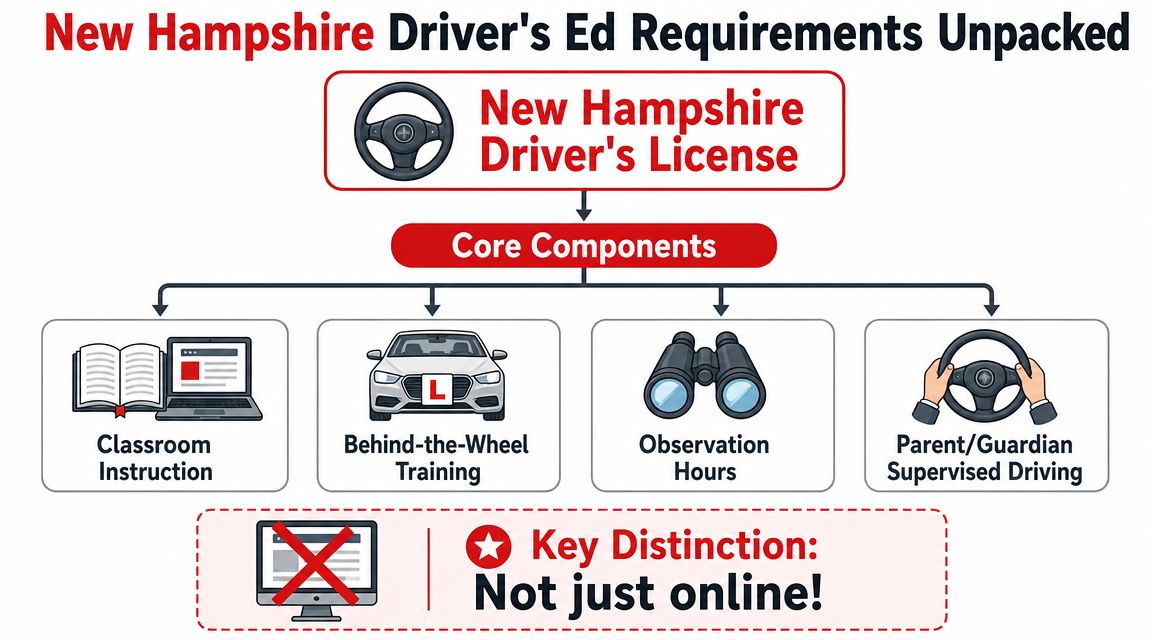
That structure explains the bigger lesson. State rules often divide driver education into separate parts that must be completed in different settings.
A classroom course teaches rules, judgment, and hazard awareness. Observation hours let a student watch traffic decisions in real time. Behind-the-wheel lessons put the student in the driver's seat with a licensed instructor. Parent practice fills in the repetition that no school session can provide. Driver education works like a four-part lab course. If one part is missing, the training is incomplete.
What those requirements mean in real life
Families usually get tripped up on the word "online." In New Hampshire, online instruction can fit into the process, but it does not replace the entire process.
The state allows only part of the classroom phase to be completed online. Under New Hampshire rules, no more than half of the classroom hours may be taught through distance learning, as noted by the New Hampshire Administrative Rules for driver education. In plain terms, a fully online teen driver's ed course does not satisfy the whole New Hampshire requirement by itself.
Here is the practical breakdown:
| Requirement area | What New Hampshire expects |
|---|---|
| Classroom instruction | Formal lessons on traffic laws, risk awareness, and driving decisions |
| Observation | Time spent watching active driving situations with an instructional purpose |
| Behind-the-wheel | Actual driving practice with a qualified instructor |
| Parent or guardian practice | Additional supervised driving, including required night hours |
This is why New Hampshire makes a useful case study for Georgia families too. The labels on course websites can sound similar from state to state, but the legal meaning changes. One state may allow part of class online. Another may tie eligibility to a separate law, such as Joshua's Law in Georgia. The course name stays simple. The rule behind it does not.
Why a certificate alone may not be enough
A certificate only helps if it documents the right training under the right state rule. That is the part families often miss.
If a student completes online lessons but still lacks instructor-led driving, observation time, or the required supervised practice log, the licensing process can stall. Good recordkeeping prevents a lot of stress. Keeping a folder with course records, practice logs, and identity paperwork helps you verify each step. A checklist of what documents you need to legally drive is a useful place to start.
The practical takeaway is simple. In New Hampshire, "online drivers ed" can be one piece of the teen licensing process, but it is not the whole machine. That same state-by-state difference is exactly why Georgia students need a Georgia-specific solution, not a generic online course description.
Finding a Truly Approved NH Driving School
Once you understand the New Hampshire framework, the next challenge is choosing a provider that fits it. Families often lose time during this search. A polished website can make a course look official even when it doesn't line up with the state-required teen path.

What to verify before you enroll
Start by treating enrollment like a compliance check, not just a purchase. Before you pay, confirm that the school offers the full type of training your teen needs.
Use this short screening list:
- Ask whether the course is for first-time teen licensing. Some programs are educational but not designed to satisfy a teen's required licensing path.
- Confirm how classroom hours are delivered. If part of the course is online, ask what portion still must be completed in person.
- Check whether behind-the-wheel training is included. If it isn't, ask whether the school coordinates that separately or expects you to find another provider.
- Ask how observation hours are handled. Families often remember driving time but forget observation time.
- Find out what records you'll receive. You want documentation that matches the state-required components.
Red flags families should notice
A provider deserves extra scrutiny if the website stays vague about the audience, avoids explaining the in-person pieces, or seems to market the same course to every state with only minor wording changes.
Another warning sign is broad language like “complete online” without a clear explanation of what that completion means. In a state with hybrid rules, that phrase can be misleading.
This walkthrough gives a useful visual reminder of how to think through driving school choices before signing up:
Good questions sound boring, and they save money
The best enrollment questions are plain and specific:
- Is this course accepted for New Hampshire teen driver education?
- What parts happen online, and what parts must happen in person?
- Are observation and driving sessions included or separate?
- Who signs off on each completed requirement?
Those questions may not feel exciting, but they prevent the most expensive mistake in driver education. Paying for a course that teaches something useful but doesn't satisfy the legal pathway your family needs.
Why State-Specific Rules Are Non-Negotiable
A parent in Manchester can buy an online course that looks polished, covers traffic signs, and even issues a completion certificate. Then the family gets to the licensing step and learns the certificate does not fit the state pathway they need. That is the problem with treating driver education like a generic digital product.
Driver's ed works more like a building permit than a streaming subscription. The title may sound familiar from state to state, but the rules behind it are local. New Hampshire is a good example because the phrase "online driver's ed" can describe a general learning course, a state-approved teen program, or simple test preparation. Those are not interchangeable.
SafeMotorist makes that distinction plain on its New Hampshire driver education page, where it explains that its online program is not intended to satisfy specific state requirements. That kind of disclosure matters because families often search by convenience first and legal purpose second.
The same course label can mean different things
A course name tells you very little by itself. The useful question is, "What does this course qualify the student to do in this state?"
| Course label | What it may actually do |
|---|---|
| Online driver education | Teach general driving knowledge |
| State-required teen program | Satisfy a defined part of a state's licensing process |
| Permit or test prep | Help with exam study without replacing required instruction |
That is the heart of the issue. Format tells you how the material is delivered. It does not tell you whether the state will accept it.
A helpful way to sort this out is to separate content from compliance. Content is what the student learns. Compliance is whether the program matches the rules set by the state agency, the approved school structure, and any required behind-the-wheel or observation pieces. Families need both.
State rules affect money as well as course selection
The differences are not limited to instruction. Financial help is also state-based.
New Hampshire families can look to the NH Driver Education Fund, which explains scholarship support for students who need help paying for driver education. That detail matters because the key question is often larger than "Can my teen do this online?" It is also "What program does the state recognize, and what help is available to pay for that program?"
This is why a national search result can send families in the wrong direction. A course may be useful, well designed, and still fail the legal test for a specific student in a specific state. New Hampshire shows how easy that mix-up can be. Georgia families face the same kind of risk, but with Georgia's own rules, providers, and required steps.
The Georgia Solution A-1 Driving School and Joshua's Law
Georgia families face the same core problem as New Hampshire families. Search terms are broad, but the law is specific. For teens pursuing the state-required path, the question isn't just whether a course is online. It's whether the training matches Joshua's Law and the practical steps that follow.
For Georgia students who want one place to review course options, road training, testing support, and scholarship information, A-1 Driving School offers online driver education, in-person options, driving lessons, road test services, and information about the Georgia Driver's Education Scholarship Grant Program.
What Georgia families should look for
A Georgia teen usually needs more than a classroom course. The family should check four things together:
- Course type: Is it the driver education course that fits Joshua's Law requirements?
- Delivery option: Can the student take the academic portion online, in person, or through a flexible schedule that fits school and activities?
- Driving lessons: Is there a clear path from class completion into actual on-road instruction?
- Testing support: Can the student move efficiently from training into road test preparation and scheduling?
That full-path thinking is what many national search results miss. They sell the course, but they don't solve the licensing journey.
Why the scholarship angle matters
Families often focus on convenience because that's what the ads highlight. Cost can be the bigger barrier. New Hampshire's scholarship model shows that states recognize this problem and sometimes build funding programs to address it.
Georgia families should take the same issue seriously. If affordability is delaying training, it makes sense to look early at the Georgia Driver's Education Scholarship Grant Program and ask how enrollment timing, seat availability, and lesson scheduling connect to that support.
Local advice: The right driver education program isn't just the one a teen can start quickly. It's the one that lines up with the state rule, the student's schedule, and the family's budget.
From Classroom to Road Test Driving Lessons Make the Difference
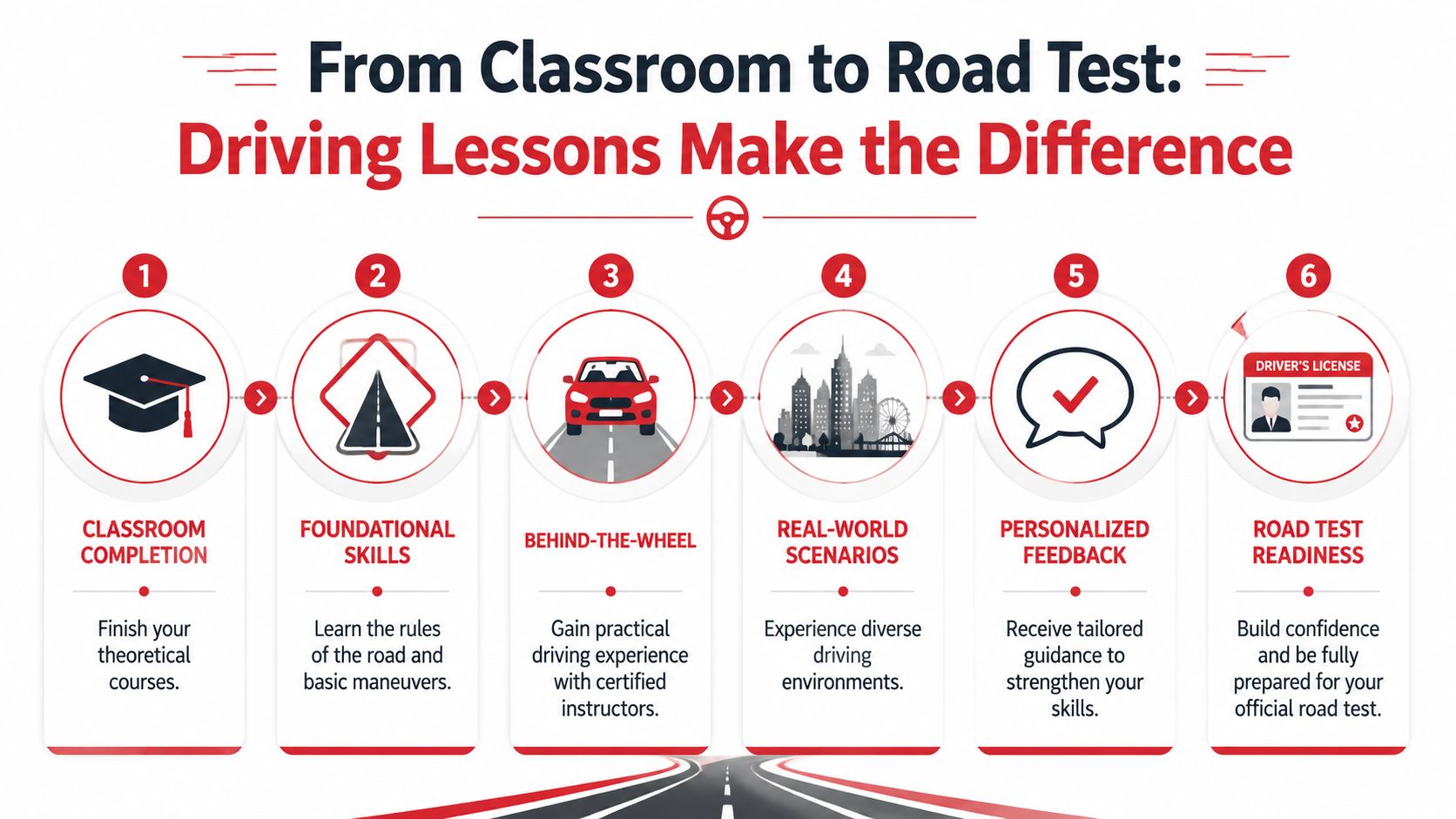
A teen can finish the academic portion, pass quizzes, and still feel overwhelmed at the first busy intersection. That gap matters because licensing rules do not stop at book knowledge. In New Hampshire, the state-approved course and supervised driving pieces work together. In Georgia, the same principle shows up in a different legal path under Joshua's Law. The classroom gives the map. Driving lessons teach the student how to use it in live traffic.
What driving lessons add
Professional instruction turns written rules into repeatable actions. A good instructor teaches more than steering and braking. The instructor shows a student how to scan ahead, judge space, spot risk early, and recover from small mistakes before they become bigger ones.
That is why the benefits of taking driving lessons from an instructor go far beyond course completion. For a Georgia teen, these lessons are the part that fulfills the professional behind-the-wheel instruction tied to Joshua's Law. For families who started by researching New Hampshire rules, that comparison helps clarify the bigger point. Every state builds its own path from study to supervised practice to testing, and the road lessons are where that path becomes real.
Skills that usually improve with coached road time
Students struggle in different places, so lesson planning should match the student, not just the calendar.
- Basic vehicle control such as steady steering, smooth braking, lane position, and clean turns.
- Traffic decisions including gap judgment, lane changes, four-way stops, and merging.
- Road test habits like full stops, mirror checks, signaling, and following directions without rushing.
- Confidence for older beginners who may not need a teen education course but still need hands-on instruction.
Family practice still matters. But parents often have two jobs at once during practice: keeping the drive safe and trying to coach. A trained instructor can watch patterns more objectively and correct them before they become habits.
Why road testing support matters
The last step is not just knowing how to drive. It is showing those skills consistently while nervous, watched, and evaluated.
That is another place where state-specific planning matters. A family that only buys an online course can still be left sorting out lessons, test preparation, and scheduling on its own. Georgia families usually do better with a provider that can connect the classroom requirement, the behind-the-wheel training, and road test readiness in one clear sequence.
Safer drivers are built on feedback given during real decisions behind the wheel, not only on correct answers from a screen.
If you're in Georgia and need a clearer path from driver education to driving lessons and road test readiness, A-1 Driving School is one place to compare online course options, Joshua's Law training, lesson packages, and testing support before you enroll.