
Ready to ace your Georgia driving test, or are you still treating it like something you can cram for the night before?
That's the gap I see most often. A lot of learners spend too much time worrying about parallel parking and not enough time building the calm, repeatable habits that examiners notice. On test day, the difference usually isn't talent. It's whether mirror checks, full stops, signaling, speed control, and basic car readiness happen automatically.
That's why the best driving test tips aren't flashy. They're practical. They help you avoid the small mistakes that pile up under pressure, and they prepare you for the Georgia road test the way it's experienced: in a real car, on real streets, with someone observing every choice you make.
At A-1 Driving School, the most effective preparation usually comes from structured lessons, route familiarity, and enough guided practice that your skills hold up when nerves kick in. That matters for teens working through Driver's Education and Joshua's Law, adults returning to driving, and families trying to decide whether online coursework alone is enough. Usually, it isn't. Online learning helps with rules and requirements. Road skills still have to be built behind the wheel.
If you want to pass and feel ready afterward, start with the fundamentals below.
1. Master the Pre-Drive Vehicle Inspection

A surprising number of road tests go sideways before the car even moves. That's why this belongs near the top of any serious list of best driving test tips.
DriversEd.com notes that the examiner may inspect lights, turn signals, horn, brakes, windshield wipers, and tires, and if the vehicle fails inspection, the exam is automatically postponed. It also stresses bringing your learner's permit, registration, insurance, and any required certificates in advance through its guide on avoiding common mistakes before your driving test.
What examiners notice first
A rushed learner usually checks almost nothing. A prepared driver gets in, adjusts the seat, sets mirrors, fastens the belt properly, and knows where the basic controls are without fumbling.
That sequence sends a message. You're organized, safe, and ready to drive the vehicle you brought.
- Check lights and signals early: Make sure brake lights, turn signals, and headlights are working before you leave home.
- Set your position before rolling: Adjust your seat, steering wheel reach, and mirrors before the examiner starts giving directions.
- Bring the right paperwork: Permit, registration, insurance, and any needed course documents should be easy to reach, not buried in the glove box.
- Know your test vehicle: If you're using a family car, practice in that same car so the controls feel familiar.
If you need a compliant vehicle for testing, A-1 offers a Georgia road test car option that helps remove one common source of stress.
Practical rule: Don't let a paperwork issue or a dead turn signal ruin a test you were ready to pass.
Good posture matters here too. If the seat belt sits awkwardly or the seat position is off, your steering and observation can suffer. This quick guide to seat belt adjustments for safety is a useful reminder that comfort and control go together.
2. Demonstrate Smooth Steering and Vehicle Control
Jerky steering makes a learner look nervous, even when they know the rules. Smooth steering makes the whole drive look more mature.
Examiners don't expect perfection. They do expect control. That means steady hands, clean turns, stable lane position, and no constant sawing at the wheel.
What smooth control actually looks like
Keep both hands in a stable position, steer gradually into turns, and unwind the wheel naturally as the car straightens. If you drift toward lane lines and then snap back, the examiner sees uncertainty.
A lot of test anxiety shows up in the hands first. Learners grip too hard, overcorrect, and turn late because they're staring too close in front of the hood instead of looking where the car needs to go.
Use this practice standard:
- Look farther ahead: The car follows your eyes. Looking down at the pavement right in front of you usually creates wandering.
- Turn once, not in pieces: Make one smooth steering input into the turn instead of several small panic corrections.
- Center the car, don't chase the lines: Aim to stay balanced between lane markings rather than hugging one side.
- Practice in the test car when possible: Steering feel changes from vehicle to vehicle, especially between smaller cars and larger SUVs.
There's also a trade-off here. Some learners focus so much on “keeping both hands perfect” that they become stiff. That doesn't help. You want controlled, relaxed steering, not robotic steering.
When A-1 instructors prepare students for the road test, one of the biggest improvements usually comes from repetition in varied settings. Parking lots teach basic wheel control. Residential streets teach positioning. Busier roads teach composure. That progression works better than doing one marathon practice drive and hoping it sticks.
3. Perfect Your Lane Changes and Mirror Checks
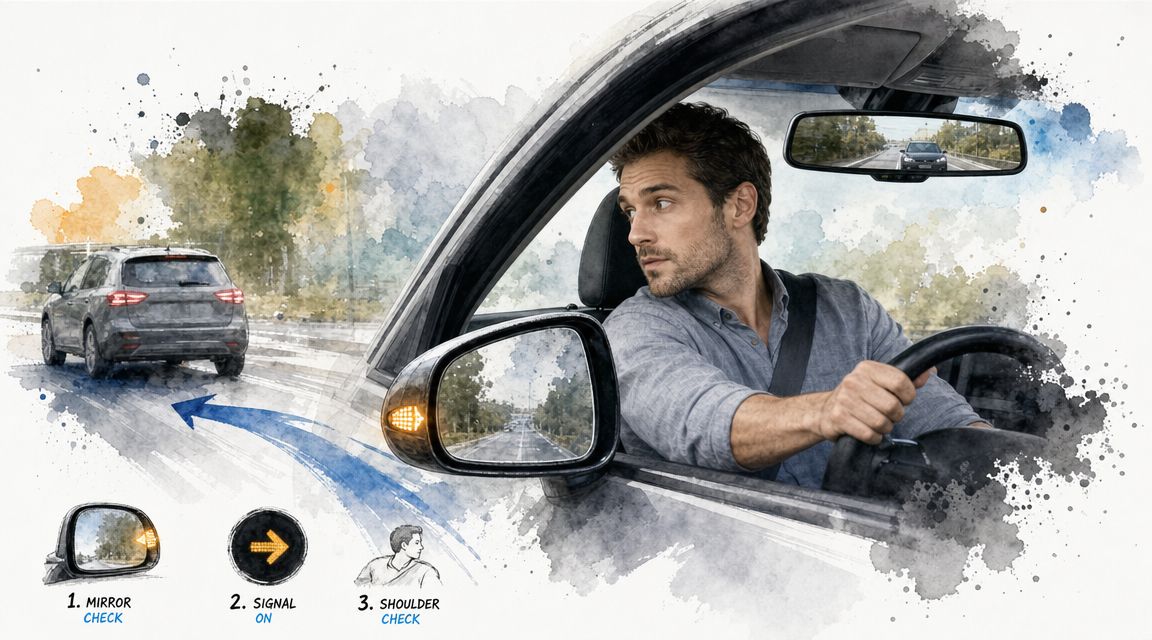
Lane changes expose weak habits fast. If your mirrors are decorative, if your signal comes late, or if you skip the blind spot check, the examiner will catch it.
A technical benchmark worth practicing is keeping your speed within about 5 mph of the posted limit while also checking mirrors every 5 to 8 seconds. That same guide recommends a full mirror, signal, and blind-spot sequence before lane changes, which matches what instructors drill because observation errors are common scoring issues.
Build a repeatable sequence
Don't improvise lane changes. Use the same order every time so it becomes automatic under stress.
A reliable pattern is simple. Check mirrors, signal, check mirrors again, glance at the blind spot, then move over smoothly when the space is clear.
For Georgia learners, formal lessons are more beneficial than online coursework. A screen can explain blind spots. It can't tell you whether your head check is too quick, whether your lane drift starts before your signal, or whether you're forcing a move that should wait. A road instructor can.
If you want a deeper breakdown of timing and head movement, A-1's guide on how to check blind spots while driving is worth reviewing before your next lesson.
Most failed lane changes aren't caused by one huge mistake. They come from leaving out one small step in a rushed sequence.
If your side mirror setup is poor, your confidence drops immediately. This overview of expert tips for mirror installation can help you understand why adjustment matters before the test even starts.
4. Execute Proper Braking and Stopping Techniques
Bad stops are expensive on a road test. They signal weak judgment, weak observation, or both.
The fix isn't complicated, but it does require repetition. You need to recognize stopping situations early, ease off the gas in time, brake progressively, and stop the car completely without rolling.
The habits that protect your score
Official Texas drive-test guidance emphasizes the two-second following-distance rule, full stops at stop signs, and signaling about 100 feet before turns or lane changes. Even though you're preparing for Georgia, those benchmarks line up with the habits examiners want to see anywhere: space cushion, early communication, and clear control.
That also gives you a practical answer to a common student question. How do I know if I'm following too closely? Start with that rule in normal conditions, then leave more room in bad weather or heavy traffic.
- Brake early, not suddenly: Last-second braking feels unsafe even when you stop in time.
- Stop behind the line: Don't creep over markings and don't roll through because the intersection “looks clear.”
- Hold the stop long enough to show it: A complete stop should be obvious to the examiner.
- Signal in advance: Early signaling shows planning. Late signaling looks reactive.
One trade-off here is that overly cautious drivers sometimes create a different problem. They brake too early for everything and hesitate when traffic flow requires a normal, confident response. The goal is smooth and decisive, not timid.
Students often improve this skill fastest when they practice the same few intersections repeatedly with feedback, then expand into unfamiliar routes once the timing feels natural.
5. Navigate Intersections with Confidence and Caution
Intersections are where examiners learn the most about your judgment. You're processing signs, signals, pedestrians, lane position, right-of-way, and oncoming traffic all at once.
That's why shaky drivers often do fine on straight roads and then lose points at the first busy turn. The intersection compresses every weakness into one moment.
Slow your mind down before you enter
Approach early. Read the whole space. Decide what matters first.
If you wait until you're already at the line to figure out the signal, the turn lane, the crosswalk, and opposing traffic, you're behind. Good intersection driving starts before you arrive.
A simple way to practice is to talk your way through the approach during lessons:
- Identify the control: Stop sign, green light, red light, protected arrow, or uncontrolled entry.
- Check the crosswalk area: Pedestrians change the timing of everything.
- Choose your lane path: Enter and exit the turn in the correct lane without drifting wide.
- Commit when it's safe: Don't inch halfway into decisions you haven't made.
I've seen many learners make the same mistake here. They focus on the examiner's last spoken instruction more than the road itself. If the instruction is “turn left at the next light,” your real job is still scanning speed, lane position, signals, and right-of-way. The instruction is only the destination. Safe execution is what gets scored.
Instructor reminder: At intersections, calm observation beats fast reactions. Most mistakes happen because the driver rushed the decision, not because they lacked knowledge.
Busy Atlanta-area traffic makes this skill especially important. If you can handle intersections cleanly under supervision during lessons, the road test starts to feel much more manageable.
6. Manage Test Anxiety and Mental Preparation

Some students don't fail because they can't drive. They fail because nerves interrupt routines they already know.
That's an important distinction. Anxiety doesn't usually erase your skills. It makes you rush, grip too hard, forget mirror checks, or second-guess simple decisions.
Prepare your mind the same way you prepare your driving
The most useful approach is familiarization. Practice in the same type of environment you'll test in, drive with someone who corrects mistakes in real time, and rehearse the start of the test so the first few minutes don't feel brand new.
Another part is reducing preventable stress. Get your documents ready the day before. Confirm the vehicle. Sleep normally. Arrive early enough that you're not walking in flustered.
Try this on test day:
- Use one reset breath at each stop: Inhale, relax your shoulders, and release tension from your hands before moving again.
- Narrate your next action in your head: “Mirror, signal, brake.” Short cues help under pressure.
- Treat one mistake as one mistake: Many students compound a minor error by mentally spiraling into the next one.
- Drive the present moment: Don't think about whether you've already passed or failed. Focus on the next safe decision.
There's also a practical limit to mental tricks. If a student is anxious because they haven't practiced enough, breathing alone won't solve it. Confidence comes from evidence. A few strong lessons, a mock test, and repeated work on weak spots usually calm nerves more than motivational speeches ever will.
That's one reason driving lesson packages matter so much. They give students enough repetition to trust themselves.
7. Understand Georgia's Specific Road Test Requirements and Joshua's Law
What trips up Georgia test takers more often. Driving mistakes or paperwork mistakes? In my experience at A-1, both can delay a license, and the paperwork side catches plenty of families off guard.
Georgia students need preparation that matches Georgia's licensing process, not a generic checklist pulled from another state. For teens working toward a Class D license, Joshua's Law affects the path to testing, and the easiest way to avoid last-minute problems is to sort out the requirements before the road test is on the calendar.
Start by separating knowledge requirements from driving performance. Online Driver's Education helps students cover rules of the road, complete required coursework, and keep Joshua's Law training on track with a flexible schedule. Behind-the-wheel lessons serve a different purpose. They correct the habits examiners mark down, such as incomplete stops, poor lane position, slow mirror checks, or turns that finish too wide.
A focused review of the Georgia road test requirements and preparation process also helps families match the right training to the right stage. That matters because many students study hard, then show up unsure about what Georgia examiners expect from the vehicle, the route, or the scoring.
A practical plan looks like this:
- Use online coursework to satisfy Joshua's Law and review Georgia rules.
- Use in-car lessons to fix habits an examiner will see right away.
- Use a road test prep session close to the exam date to catch small errors before they cost points.
- Ask whether the Georgia Driver's Education Scholarship Grant Program applies to your family.
There is a trade-off. Online learning is easier to schedule and usually less stressful for families. It also leaves a gap if the student knows the rule but cannot perform it cleanly under pressure. That is why the strongest test prep usually combines formats in order instead of treating them as substitutes.
A-1 Driving School has worked with Georgia drivers since 1987, and that experience shows up in a more practical kind of preparation. Students do not just need enough information to pass a quiz. They need the right instruction at the right time so Georgia's road test feels familiar when test day arrives.
8. Build Experience Through Progressive Lesson Planning
This is the biggest separator between students who feel shaky and students who look ready. They don't just practice more. They practice in the right sequence.
California DMV teen-driver guidance says learners must complete 50 hours of supervised practice, including 10 hours at night, while building core maneuvers such as lane changes, turns, freeway entry and exit, and parallel parking in progressively more challenging settings. Even if you're testing in Georgia, that structure reflects a smart principle: treat practice like a measurable habit, not a one-time review.
Don't cram what should be layered
A single long practice drive can leave a student tired and overconfident. A better plan starts with low-pressure skills, then adds complexity over time.
That might look like parking lot control first, then residential turns, then lane changes on multi-lane roads, then busier traffic, then a mock test. Each layer gives the next one a foundation.
The trade-off is obvious. Lesson packages require time, scheduling, and money. But cramming often creates only temporary familiarity. Progressive lessons build habits that stay with you after the test.
A-1's lesson structure can be especially useful for Georgia learners who need more than a quick refresher. Students preparing for Joshua's Law, adults starting late, and nervous drivers usually benefit from a package that gives enough repetition to fix the actual issue instead of guessing at it.
One more point matters here. National driving test outcomes show that passing isn't automatic even for people who show up ready. A driving-test statistics roundup reports a UK national average pass rate of 48.5% with 1,945,225 tests conducted in 2023/24, while another cited average is 46%. The lesson isn't that Georgia works the same way. It's that road tests reward consistency, and consistency usually comes from structured preparation, not hope.
8-Point Driving Test Tips Comparison
If you want a quick way to see what matters most on the Georgia road test, use this comparison the same way our instructors do at A-1. Focus first on the items that are easy to clean up fast, then put extra lesson time into the skills that usually break down under pressure.
| Skill / Topic | Difficulty on test day | What you need to practice it well | What improvement usually looks like | Best time to focus on it | Why it matters to a Georgia examiner |
|---|---|---|---|---|---|
| Master the Pre-Drive Vehicle Inspection | Low | A road-ready car, a short checklist, a few rehearsals | Fewer preventable problems before the car even moves | The week before the test and right before check-in | Shows you can confirm the vehicle is safe and follow directions calmly |
| Demonstrate Smooth Steering and Vehicle Control | Medium | Repetition on neighborhood roads, turns, and parking areas | Straighter tracking, cleaner turns, steadier speed control | Early practice and every mock test after that | Examiners notice control problems quickly, especially on turns and lane position |
| Perfect Your Lane Changes and Mirror Checks | Medium | Multi-lane roads, mirror routines, blind-spot checks, instructor feedback | Fewer missed checks and better timing in traffic | After basic steering and speed control feel consistent | This is a common place for point losses because observation habits are easy to spot |
| Execute Proper Braking and Stopping Techniques | Low to Medium | Stop sign practice, traffic-light timing, following-distance work | Full stops, smoother braking, less rushing at the line | Early, then refresh often | Rolling stops and late braking are simple errors that can cost you fast |
| Handle Intersections with Confidence and Caution | High | Real intersections, right-of-way review, guided repetition in traffic | Better judgment on turns, gaps, signals, and stop order | Mid to late-stage prep, once basic control is steady | Many Georgia test mistakes happen where several decisions stack up at once |
| Manage Test Anxiety and Mental Preparation | Low | A repeatable pre-test routine, route familiarity, and coached practice | Fewer panic mistakes and better recall of habits you already know | The night before and the hour before the test | Skill drops when nerves take over, even for drivers who perform well in lessons |
| Understand Georgia's Specific Road Test Requirements and Joshua's Law | Medium | DDS rules, permit and education requirements, and A-1 classes | Fewer surprises with paperwork, eligibility, and test expectations | Before scheduling anything | Georgia families lose time by preparing the driving but missing the state process |
| Build Experience Through Progressive Lesson Planning | High | Multiple lessons, targeted feedback, and enough time between sessions to improve | Stronger habits, better retention, and more confidence under test pressure | Best started weeks before the exam | Layered practice helps students fix the exact habit the examiner is likely to mark |
The trade-off is simple. Pre-drive checks and stopping habits are faster to improve. Intersections, lane changes in traffic, and test-day nerves usually take more coached repetition.
That is why our instructors in Georgia rarely judge readiness by one good drive. We look for consistency across these eight areas, because the road test rewards drivers who can repeat the same safe habits on command.
Your License is Within Reach Take the Next Step
Passing your Georgia driving test comes down to a few things done well, over and over. You need a road-ready vehicle, clear observation habits, smooth control, complete stops, solid intersection judgment, and enough practice that nerves don't knock those skills loose on test day.
That's why the best driving test tips are usually the simplest ones. Check the car before the test. Set your mirrors and seat before moving. Signal early. Stop fully. Watch your speed. Leave enough following distance. Check mirrors consistently. Make lane changes with a complete observation routine. None of that is glamorous, but it's what passes tests and keeps new drivers safer afterward.
For Georgia teens, there's also a planning side that matters just as much as driving skill. Joshua's Law coursework, online class options, supervised practice, lesson scheduling, and road test timing all work better when families treat them as one process instead of separate errands. If you're eligible for the Georgia Driver's Education Scholarship Grant Program, it's also worth asking about that early rather than waiting until the last minute.
If you're an adult learner, the same principle applies. Don't assume reading rules or watching videos will fix hesitation behind the wheel. If your challenge is execution, you need guided driving lessons. That's often the fastest way to improve because an instructor can correct the exact habits that keep costing you points.
A-1 Driving School is one relevant option for students who want Georgia-focused preparation, including Driver's Education, Joshua's Law courses, online learning options, driving lessons, lesson packages, and road test support. For many students, the most useful path is a combination: complete the coursework requirement, build skills through lessons, then do targeted road test preparation in the same kind of conditions you'll face on exam day.
Your license is within reach. Don't wait until the week of the test to get serious. Build the habits now, get feedback while there's still time to improve, and give yourself a test day that feels familiar instead of intimidating.
A-1 Driving School can help if you want a clearer path from permit to passing score. Explore Joshua's Law courses, online Driver's Education, driving lessons, lesson packages, road test services, and scholarship information at A-1 Driving School.