

You're probably in that familiar spot, a parent with a calendar full of work shifts and a teen who's ready for the next step but not ready to sit in traffic all afternoon for class. In Georgia, teen driving school online has become the practical answer for a lot of families because it fits real schedules, not ideal ones. The part that still causes confusion is what online coursework can cover, what still has to happen in person, and how all of it connects to Joshua's Law and a Class D license.
The good news is that the path is clearer than it first looks. Georgia families usually need three things to line up, a state-approved 30-hour driver education course, the required behind-the-wheel training, and enough supervised practice to build real confidence before the road test. A flexible online class can handle the classroom portion, while in-car lessons and road-test prep handle the part no video can replace.
A lot of the value comes from understanding the difference between convenience and completion. Online drivers ed can make the classroom step easier to manage, but it doesn't erase Georgia's licensing rules, and it doesn't replace a skilled instructor sitting in the car. For families comparing programs, that distinction matters just as much as price or schedule.
For a closer look at course and lesson bundles that combine both sides of the process, see online drivers ed and behind-the-wheel packages.
Why Georgia Teens Are Choosing Online Driver's Education
A Georgia parent usually starts this search the same way every other busy family does, on a phone, between dinner and bedtime, trying to figure out whether a teen can finish driver education without missing school, sports, or work. That's where teen driving school online stands out. It gives families a way to move forward on the classroom requirement without locking themselves into one building or one bell schedule.
Online driver education is no longer some fringe option. A federal review found that online teen driver education had become a measurable mainstream path in several states by the late 2000s, with California at 33% to 50%, Georgia about 40%, and Texas about 35% to 40% of teens completing driver education online. The same review said Wisconsin was under 5%, which shows how much state policy and local access shape what families choose. In Georgia, the report noted that in 2009 about 40% of teens completing classroom driver education did so online, so this isn't a novelty, it's part of how many families already get it done. Federal review of online teen driver education adoption
Practical rule: If a program says it is “online,” that only tells you how the classroom portion is delivered. It doesn't tell you whether the teen still has to complete in-car lessons, parent practice, or a state-specific road test.
What parents usually want to know first
Most families are not shopping for the fanciest platform. They want to know if the course fits around a school day, whether the teen can work at a steady pace, and whether the certificate will count toward licensure. Those are the right questions, because a driver education course is only useful if it gets a teen closer to the license without creating scheduling chaos.
A solid online program also helps families who split responsibilities between parents. One adult can track the course completion while another handles supervised practice, and the teen can work through lessons when the house is finally quiet. That kind of flexibility is why online learning often makes the process feel less like a project and more like a plan.
If you're comparing options, the key isn't whether online is “easier.” The question is whether the course is approved, structured, and paired with enough in-car instruction to move a teen safely through Georgia's requirements.
Understanding Joshua's Law Requirements for Teen Drivers
Georgia parents often hear Joshua's Law early in the licensing process, then get mixed messages about what it requires. The short version is simple. For a teen under 18, the law ties licensure to driver education, supervised practice, and a road test path that proves the teen has done more than just sit through lessons.
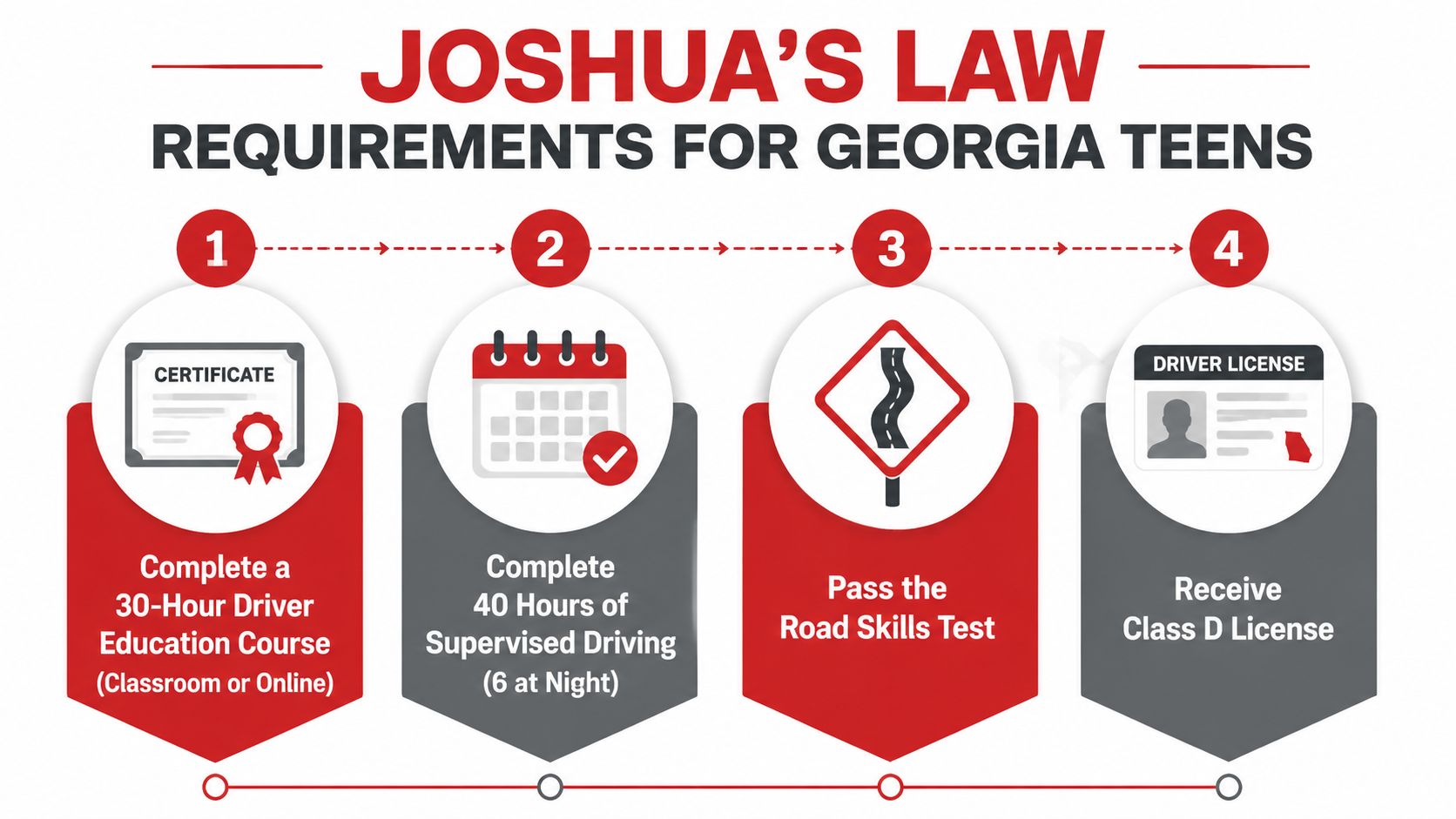
The classroom step
The first box to check is the 30-hour driver education course, which can be completed in a classroom or online format. That's the part many families can schedule around school, work, and sports. Online delivery helps here because the student can move through the material without being tied to a fixed room or fixed time.
The driving step
The next box is the part online learning cannot replace, 6 hours of behind-the-wheel training with a certified instructor. Teens need a trained adult to coach lane position, scanning, braking, parking, and hazard response in real traffic. A video can explain a skill, but only in-car practice shows whether the student can do it.
The supervised practice step
Georgia teens also need 40 hours of supervised driving, including 6 hours at night. That practice is where parents become part of the training team. The goal is not just mileage, it's exposure to different conditions, different traffic, and different levels of confidence so the teen doesn't arrive at the test with only classroom knowledge.
The waiting period
Teens must also hold a learner's permit for 12 months before moving on to the next licensing stage. That waiting period gives families time to layer instruction and practice in a way that feels gradual instead of rushed. Joshua's Law course information
A teen who completes the online class early but delays supervised practice doesn't really save time. The permit clock still runs, and the driving habits still have to be built.
Georgia families sometimes ask whether the online class alone is enough. It isn't. The safest path is to treat online coursework as the classroom foundation, then pair it with instructor-led driving lessons and parent-supervised practice until the teen is ready for the road test.
Online vs In-Person Driver's Education Programs
The classroom part of driver education looks different depending on the format, but the state purpose stays the same. Whether a teen sits in a classroom or logs in from home, the goal is to learn rules, risk awareness, and decision-making before getting behind the wheel. The mistake families make is assuming online means watered down. It usually means more flexible, not less serious.
Here's a simple comparison many parents find useful.
| Factor | Online Course | In-Person Classroom |
|---|---|---|
| Scheduling flexibility | Self-paced, can fit around school and family routines | Fixed class times, easier for students who do better with structure |
| Learning pace | Student can pause, review, and revisit lessons | Instructor sets the pace for the group |
| Engagement | Often uses video, simulations, and interactive exercises | Direct teaching, live discussion, peer interaction |
| Best fit | Families needing flexibility and independent study time | Students who learn better in a structured room |
Why online can feel more engaging than people expect
High-quality online teen driver education is often built around video, synchronous presentations, simulations, and interactive exercises, not just a stack of slides. AAA's teen online course uses those formats in a self-paced structure, which is a good example of how digital driver education can be more active than people assume. AAA teen online driver education course
The technical side can matter too. Some simulator-based systems require Windows-only compatibility, a quad-core CPU, at least 2 GB RAM, and a dedicated graphics adapter. That tells you something important, advanced virtual driving tools are designed to be real training tools, not simple web quizzes.
Why in-person still has a place
In-person classes can help students who need a set schedule and a room full of peers to stay focused. A good instructor can spot confusion quickly and clear it up on the spot. For some teens, that live back-and-forth is the difference between passing a module and remembering it later on the road.
Bottom line: online and in-person can both satisfy the classroom requirement, but neither one replaces the behind-the-wheel part that teaches a teen how to drive in real traffic.
For schools and training programs that need to manage enrollment, calendars, and reminders, a strong scheduling system matters just as much as the teaching format. A useful overview of that side of the business is the Coachful guide on the best LMS for small companies, which shows how education programs organize delivery behind the scenes.
Enrollment Steps and Timeline to Your Georgia License
Most families do best when they stop treating the licensing process like a single event and start treating it like a sequence. A teen gets the permit first, then completes the classroom work, then builds driving hours with a parent and an instructor, then takes the road test once the pieces are in place. That order keeps the process calm and avoids the scramble that happens when a road-test date gets booked before the teen is ready.
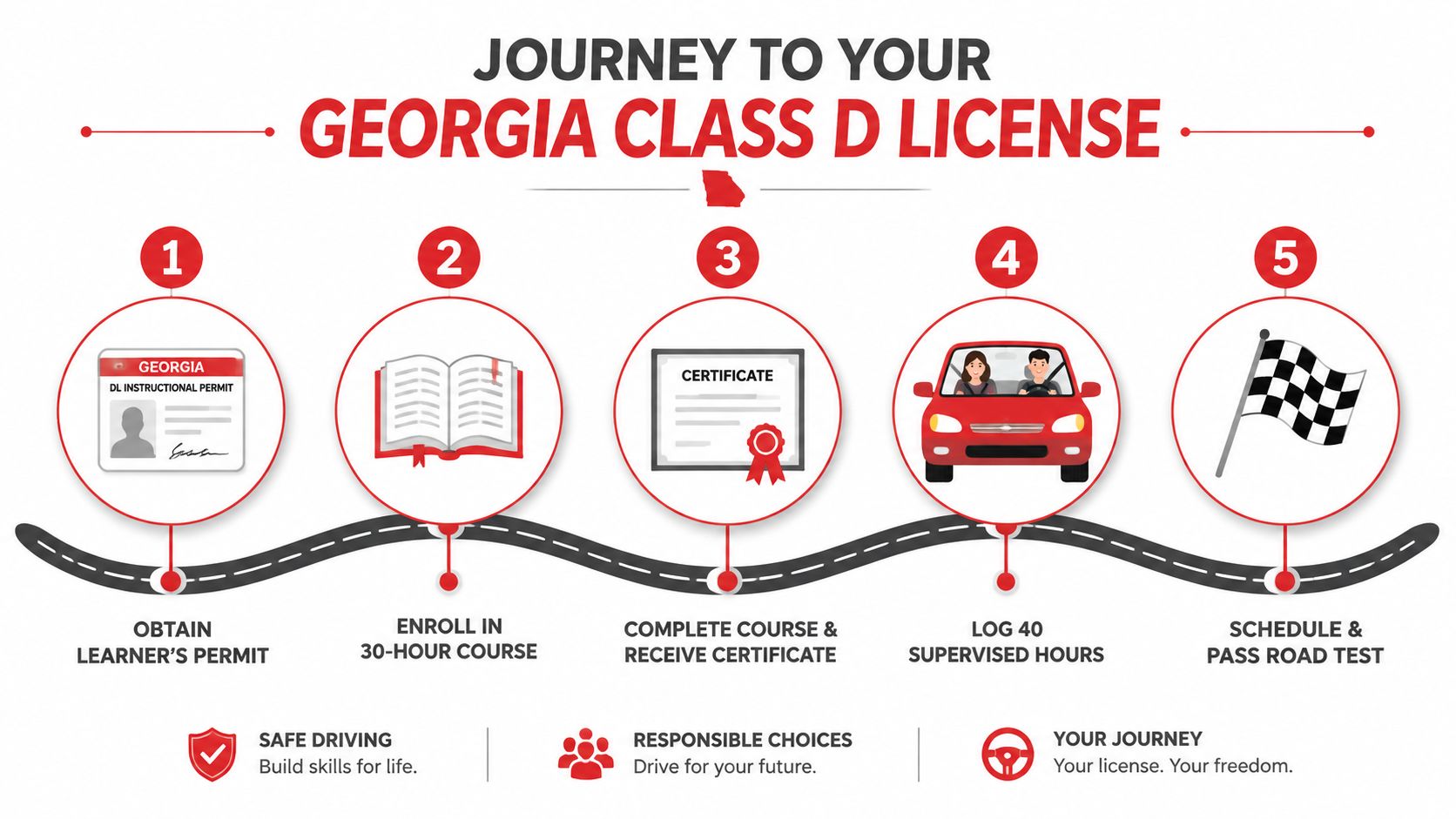
Start with the permit and paperwork
The learner's permit is the starting line, not the finish line. Once the permit is in hand, the family can enroll in a 30-hour course and start building a schedule that includes both online lessons and supervised driving time. Missing paperwork is one of the easiest ways to slow things down, so parents should keep identity documents, permit records, and completion certificates together from the beginning.
Schedule lessons before the calendar fills up
Behind-the-wheel instruction works best when it's scheduled early. Many families wait until the last possible moment, then discover that instructors and vehicles are already booked. A better approach is to line up the professional lessons while the teen is still working through the classroom material, so the driving practice and course content reinforce each other.
Build practice into the week
The 40 hours of supervised driving, including 6 night hours, don't have to happen all at once. Families usually make more progress when they break the practice into short, repeatable drives, grocery store runs, school pickups, neighborhood loops, and then busier roads once confidence improves. That steady repetition gives parents more chances to coach without overwhelming the teen.
Keep the road test for the end
The road test should come after the teen can drive without constant reminders. Families sometimes book it too soon because they want the process over with, but that often leads to a failed attempt and a delay. It's better to wait until the teen can manage turns, backing, lane changes, and traffic flow with less coaching from the passenger seat. How to enroll in driver's ed
Georgia families often ask how long the whole process takes. The honest answer is that it depends on schedule, practice consistency, and how quickly the family moves through each requirement. The teens who finish smoothly are usually the ones whose parents treat the process like a routine, not a rush.
How A-1 Driving School Supports Georgia Teen Drivers
Parents usually want one place that can handle the classroom, the in-car instruction, and the road-test step without making them piece together three different providers. That's where A-1 Driving School fits the Georgia teen journey. The school offers in-person and online Driver's Education, teen driving lessons, lesson packages, virtual learning options, and road-test preparation and testing assistance, all built around the compliance path families are already trying to follow.
With 18+ metro Atlanta locations, including Athens, families have options when they need lesson times that fit school and work. A-1 also serves as the only provider holding the Fulton County Board of Education contract, which matters for families and schools that want a district-connected pathway for Driver's Education across Fulton County Schools and numerous Atlanta high schools.
The school's long track record is also relevant. A-1 says it has served Georgia drivers since 1987, backed by 38+ years of experience, 15,000+ classes annually, and 100,000+ satisfied drivers. For parents trying to compare providers, those facts point to scale and continuity, not just a one-off course listing.
A-1 also connects families to the Georgia Driver's Education Scholarship Grant Program, which is important because cost can be the reason a teen delays training altogether. For some households, scholarship access is what turns driver education from a vague future plan into something the teen can complete. The larger lesson is simple, affordability affects timing, and timing affects readiness.
The road-test side matters too. Professional lessons help a teen move from classroom knowledge to actual road skill, and road-test prep gives the family a focused practice target instead of guesswork. The right lesson package can make that transition much smoother because it lets the instructor correct habits before they become test-day problems.
The school also offers online enrollment, which helps parents avoid another round of phone calls and office visits. If you're comparing Georgia teen driving school online options and want both classroom flexibility and in-car training in one place, A-1's course and lesson pages are a practical starting point.
Decision Checklist and Frequently Asked Questions
A good driving school should make the next step obvious, not confusing. Before you enroll, check whether the program is state-approved, whether instructors are certified, whether the school offers behind-the-wheel lesson packages, whether scheduling works for your family, and whether scholarship help is available if cost is a concern. If the answers are vague, keep looking.
Quick parent test: if the school can't clearly explain what the online class covers, what the car lessons cover, and what the teen still has to do at home, the program probably isn't organized well enough to trust with your teen's schedule.
A few questions come up again and again.
Does an online driver education course expire?
Usually the issue isn't the idea of “online” itself, it's whether the course completion stays valid under the rules tied to the permit and licensing timeline. Families should confirm that detail before waiting too long to finish the in-car or road-test steps.
What if my teen fails the road test?
That doesn't mean the process is over. It usually means the teen needs more practice in the specific areas that caused trouble, then another try after that weak spot is fixed.
How does the scholarship grant program work?
Families should treat it as a financial access question first and a paperwork question second. The best move is to ask early about eligibility and application timing so the teen doesn't lose momentum while waiting on an answer.
Should we choose online if my teen is nervous behind the wheel?
Online can reduce pressure during the classroom part, but it won't replace supervised driving. Nervous teens usually do better when online coursework is paired with patient, structured in-car lessons.
If you're ready to move from research to enrollment, choose a program that can handle the classroom, the driving lessons, and the road-test prep in one clear path. A-1 Driving School offers Georgia teens online coursework, instructor-led lessons, and practical support for the steps that come next, so you can visit A-1 Driving School and start lining up the right course and lesson package today.