77% of traffic crashes involve driver error according to driver-safety research summarized by Safety Insurance and ICW Group, and that single fact changes the way I teach road control. Advanced driving techniques aren't about showing off. They're about reading risk early, handling the car smoothly, and making fewer sudden moves when traffic, weather, or another driver creates a problem.
For Georgia drivers, that matters on the roads people use every day, not just on a practice course. On a rainy commute into Atlanta, on a blind-spot lane change around busy interstates, or on a tight rural curve after dark, the driver who knows what to do before the car gets unsettled has the advantage. The people I've trained for years usually don't need more courage. They need a clearer sequence, cleaner habits, and enough repetition to make the right response automatic.
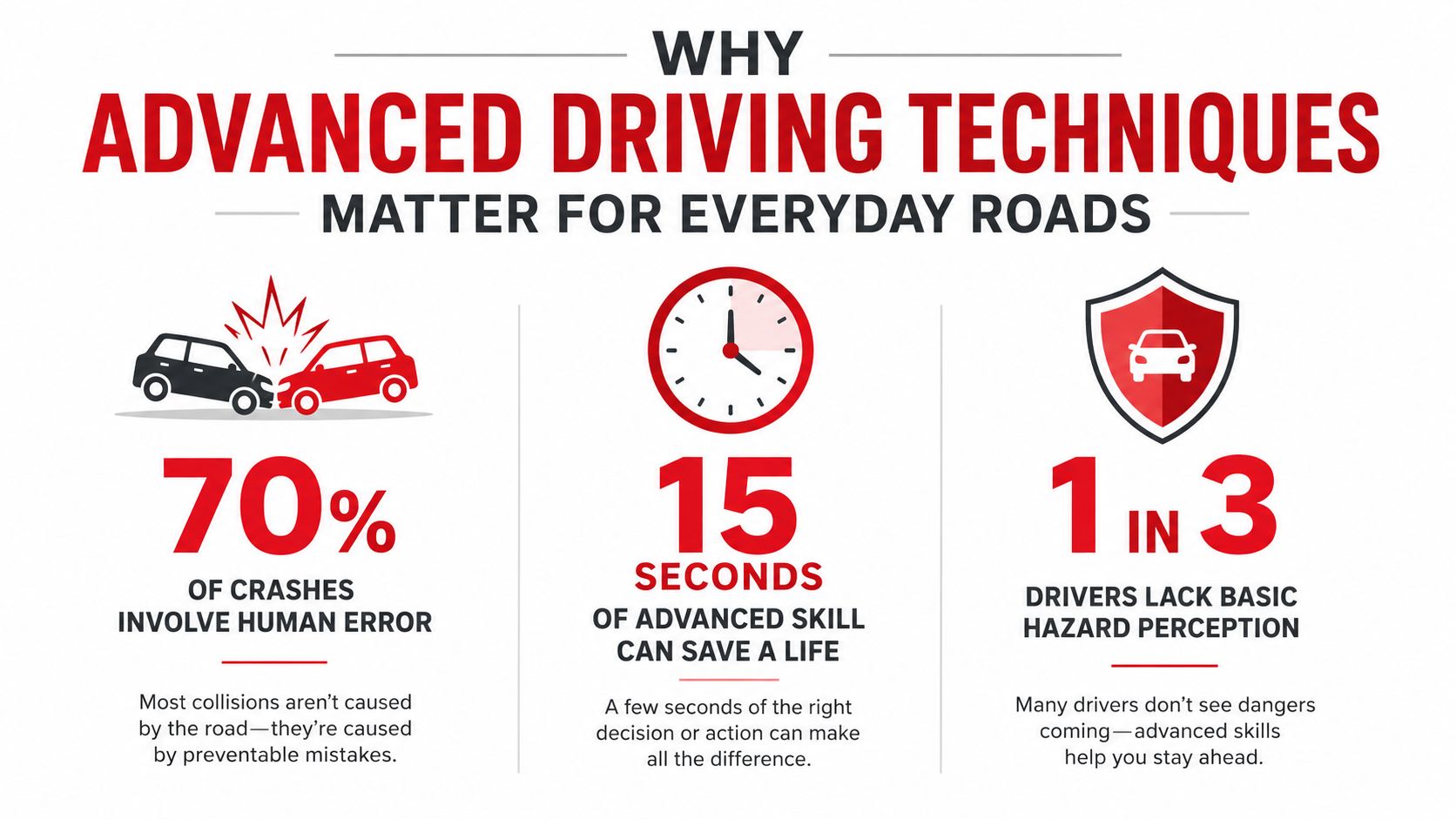
Why Advanced Driving Techniques Matter for Everyday Roads
The reason advanced driving techniques matter is simple, most serious mistakes start with human behavior, not bad luck. Safety Insurance's crash research shows 43% of first-year drivers and 37% of second-year drivers are involved in crashes nationwide, while advanced driver training reduced first-year-driver crash involvement to 4.6% in a four-year study. The same source also notes that ages 15–20 make up 6.7% of the driving population yet are involved in 20% of all crashes and 14% of motor vehicle deaths. That's why I tell teens and parents that advanced training is not a luxury skill, it's a response to real crash exposure. Safety Insurance crash statistics
Georgia roads punish small mistakes
On Georgia highways, the dangerous part usually isn't the dramatic event, it's the small error that piles up. A late mirror check on a crowded lane change, a rushed stop in wet traffic, or a curve entered too fast can create a chain of corrections the driver never planned for. The goal of advanced driving is to reduce those corrections before they start.
Federal crash data also shows why training has shifted toward anticipation and control. NHTSA reported 12,151 traffic fatalities in 2022, or 29% of all traffic crash fatalities, occurred in speed-related crashes, and 300,595 injuries, or 13% of all crash injuries, were also speed-related. Pew Research, citing federal data, reported 27.8% of fatal crashes in 2022 involved speeding, and 31.3% of fatal crashes involved at least one alcohol-impaired driver. Those numbers explain why advanced training focuses on judgment, not just rule memorization. Driving statistics and federal crash data
Practical rule: if a technique only works when the road is empty, it's not the right skill to build first.
What the rest of the road skill set looks like
The road skills that matter most are the ones drivers use under pressure, braking, steering, scanning, and lane control. That includes how you stop smoothly, how you enter a curve, how you read blind spots, and how you adjust when rain or darkness cuts your margin. It also includes knowing what your car can and can't do before you try anything harder.
That's the mindset I use with Georgia teens and adults in the car. We don't chase track-day language or flashy maneuvers. We build repeatable habits that fit daily driving, because the next surprise on the road won't wait for a lesson plan.
Vehicle Checks and Prerequisites Before You Practice
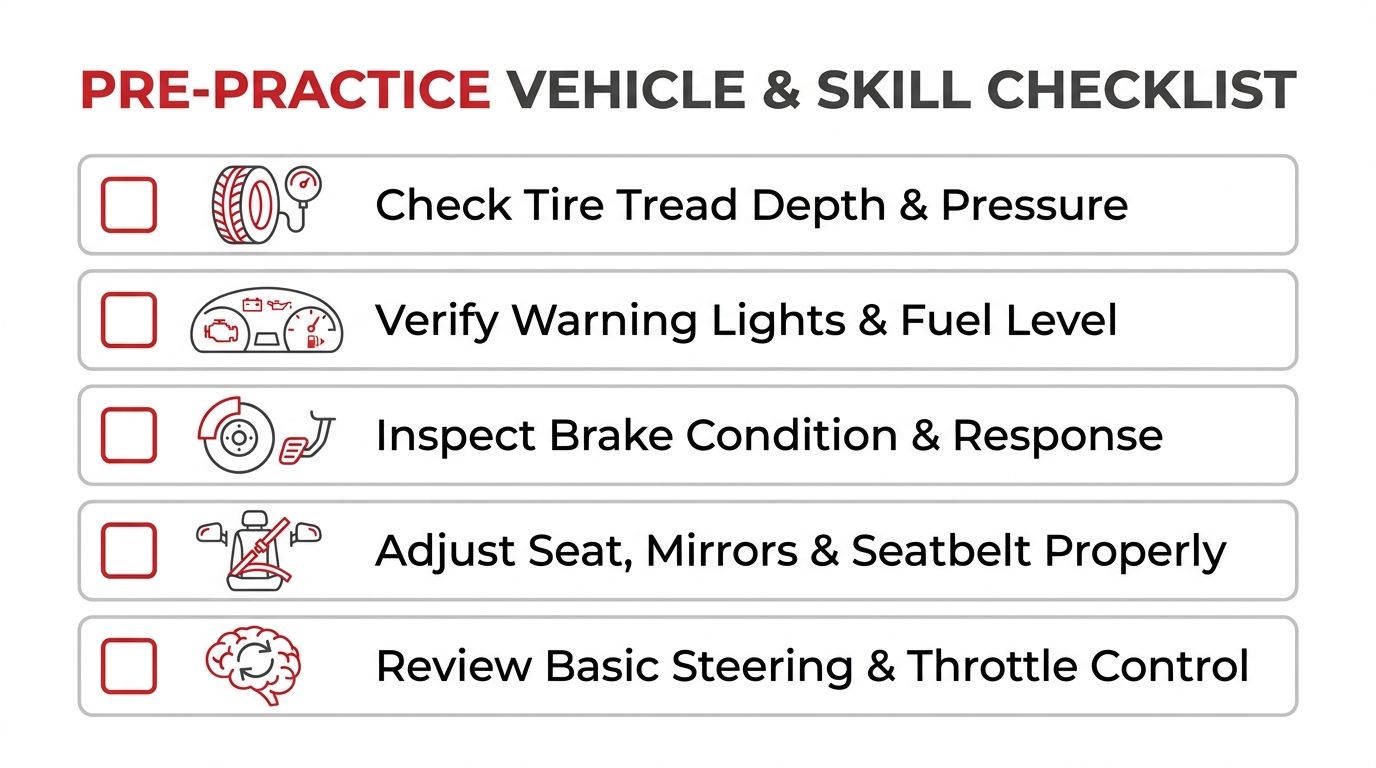
No advanced maneuver works well in a car that isn't ready for it. If the tires are underinflated, the brakes feel soft, the mirrors are set poorly, or the seat forces you to reach for the wheel, the driver starts at a disadvantage. The same is true for mental setup. You need to know whether the car has ABS, understand how weight transfers when you brake or turn, and choose a place where mistakes won't put anyone at risk.
Start with the car, not the maneuver
A short pre-practice check keeps the lesson honest. I want drivers to look at the tires, the dashboard, the brake response, and the seating position before they ever try a harder stop or turn. If the car gives warning lights, pulls under braking, or feels sloppy on the wheel, the issue belongs in maintenance before practice.
A clean setup also matters for perception. Mirrors should show traffic, not the side of the car. The seat should let the driver press the pedals without locking the knee or leaning too far back. When the body is out of position, steering and braking become slower and less precise.
For a simple reference, A-1's own vehicle inspection checklist is the kind of pre-drive habit that helps students build consistency before lessons begin.
Instructor's habit: I always verify that a student can sit tall, see well, and reach every control without stretching. If that isn't right, the drill waits.
Match the practice spot to the skill
The safest place to begin is an empty parking lot or another low-risk space with room to stop, steer, and reset. That setting lets a driver feel how the car transfers weight when the brakes come on or when the wheel turns quickly. It also lowers the pressure that makes people overcorrect.
A-1 Driving School instructors use that same logic in behind-the-wheel lessons. We start with what the student can control, then add complexity only after the basic pattern is clean. That approach matters because advanced driving depends on repetition, not just explanation. A skill that feels awkward in a calm space gets much harder once traffic, rain, or a curve is involved.
Mastering Threshold Braking and Emergency Stops
Braking is where a lot of drivers lose composure. They hit the pedal too hard, release too early, or pump it when the car is already unsettled. The better pattern is a three-phase brake action, gentle pressure first, a progressive build, then a smooth release just before the stop or turn-in so the car stays settled. That's the difference between stopping in control and stopping with a jolt.
Build pressure instead of grabbing the pedal
In a sudden slowdown on the highway, the driver's first instinct is often to stab the brake. That usually transfers weight too abruptly and makes the car feel nervous. Three-phase braking fixes that by letting the car settle under increasing pressure instead of shocking it.
For performance-oriented control, instructors talk about threshold braking, reaching strong but controlled deceleration without locking the wheels, then easing off as the hazard passes or the turn approaches. On the street, the useful lesson is simpler. Press firmly enough to stop quickly, but keep the input smooth enough that the tires keep working for you.
That same principle helps in wet conditions. The car needs grip left over for steering if the road changes under you. If the driver slams the pedal, the car has less ability to respond to a lane change, a curve, or a correction.
ABS changes the mistake drivers make
A common old habit is pumping the brakes. On ABS-equipped cars, that can work against the system. Expert instruction warns that with ABS you should keep steady brake pressure rather than pumping, because pumping can reduce the anti-lock system's effect. The pedal may pulse, and that's normal. The right response is to hold firm, not to panic and release.
Keep your eyes where you want the car to go, and let the brakes do the work.
For skid recovery, the same calm logic applies. Lift off the accelerator, avoid panic braking, and countersteer in the direction of the skid while looking to the escape path. Those steps sound simple, but under pressure they're harder than they look. That's why I train braking as a sequence. Once the sequence is familiar, the driver doesn't have to invent a response in the moment.
Advanced Cornering and Curve Management for Public Roads
Cornering errors show up fast on Georgia roads. A driver can enter a wet ramp too hot, misjudge a rural bend with a faded shoulder, or cut a neighborhood curve without enough sightline to react. Public-road cornering asks for a calmer method than track driving. Finish most braking before the turn, then ease off the brake as you add steering. That keeps the tires focused on one main job at a time, which helps the car stay settled as it enters the curve.
Look through the curve before you turn
A good driver does not stare at the hood. Road training guidance recommends looking about 15 seconds ahead into the curve, using central vision to read the path before the wheel turns. Another common teaching point is to keep scanning left, front, and right space so you know what options you have if something changes. Advanced driving location notes
That habit matters because curves hide more than scenery. They can hide stopped traffic, debris, slower vehicles, and animals. If you are already braking in the bend, some of the tire's grip is already spoken for when you may need it for steering or correction.
Use the road's shape, not panic inputs
The mistake I see most often is a hard brake in the middle of the turn. The car leans more, weight shifts suddenly, and steering response gets less predictable. A cleaner approach is to slow before the curve, hold a steady line through it, and make only small corrections if the road changes unexpectedly.
If the rear of the car starts to step out, the response should stay controlled. Lift the throttle, avoid panic braking, and countersteer in the direction the car is sliding while your eyes stay on the route you want. Drivers usually look at the problem first, which makes the correction harder. Training the eyes to stay on the exit gives the hands and feet a chance to follow the right path.
Curve rule: brake early, steer cleanly, and give the tires one main job at a time.
For drivers who want guided practice on road reading, A-1 Driving School's lesson structure includes time for lane positioning, controlled turns, and highway merge skills that carry over to everyday driving. Their night driving guidance also helps students handle curves after dark, when glare and limited visibility make the road feel narrower than it is. For drivers who need help with windshield clarity in changing weather, anti fog car window techniques can reduce one more distraction before a turn.
Adapting Your Technique for Rain, Night, and Winter Conditions
Rain changes the road first, then it changes the driver. The steering feels lighter, braking distance grows, and the car's reactions get less forgiving if the inputs are abrupt. In Georgia, that shows up on interstate commutes, on slick surface streets, and on long night drives where glare makes every reflection harder to judge. The practical answer is not just “drive slower.” It's to change speed, spacing, and hand position on purpose.
A rain commute demands margin
The clearest rule for wet weather is to reduce speed by roughly one-third in rain and about one-half in snow, while increasing following distance and avoiding sudden steering, braking, or throttle inputs. The same guidance recommends keeping hands at the 3 and 9 o'clock positions for maximum control. Advanced defensive driving techniques for responsible drivers
That hand position gives the driver more steering authority with less strain. It also helps when the road goes from wet to puddled in a few feet. I tell students to think in terms of calm corrections, not big movements.
Night driving needs a different scan
Dark roads make the headlight beam your main source of information. That means the eyes have to move farther ahead, not fixate on the glare coming at you. A-1's night driving guidance fits that same idea, because night driving is as much about scanning discipline as it is about speed choice.
If the windshield fogs, visibility drops fast and the driver's stress rises with it. A useful outside reference on anti fog car window techniques can help drivers understand how clear glass supports better scanning before they even start the car. The same is true of black ice risk on bridges and overpasses. When the surface looks wet near freezing, treat it with extra caution.
Winter habits still matter in Georgia
Snow and ice don't show up often in Georgia, but when they do, the car behaves very differently. Braking can take dramatically longer, and every input has to be smooth. The point isn't to become a winter rally driver. It's to make sure the car stays predictable when traction disappears.
Georgia drivers who practice these adjustments early usually cope better when the weather turns. They don't guess, they already know how much more space they need, how gently they have to turn, and how quickly glare or fog can erase their margin.
Blind Spots, Evasive Maneuvers, and Roundabout Technique
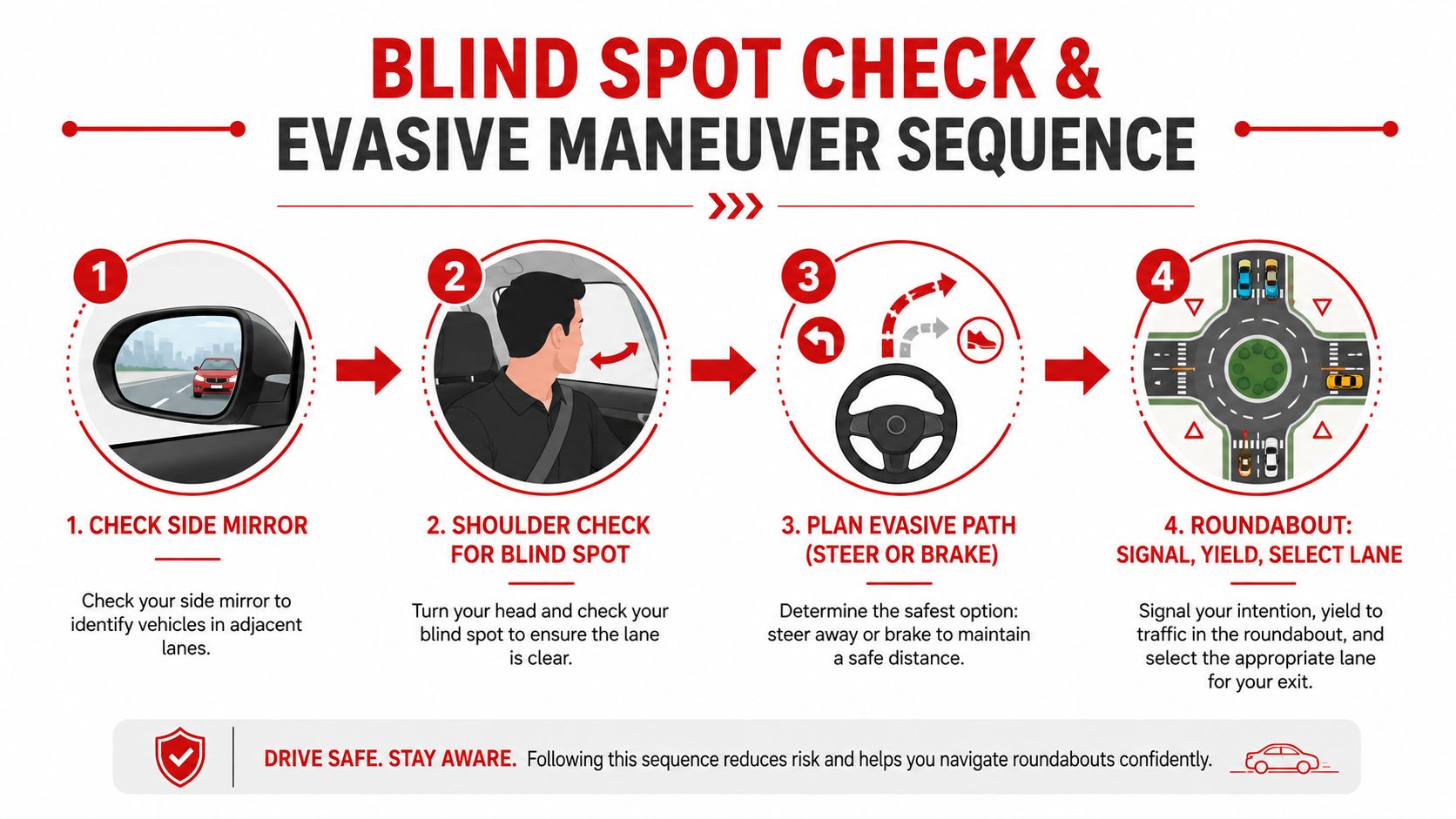
Blind spots cause many low-speed crashes because drivers treat them like a theory question instead of a habit. The safe sequence is simple, mirror check, signal, direct shoulder and head check, then move. That order matters on lane changes around Atlanta, on merges onto fast highways, in roundabouts, and even when opening a door near cyclists or motorcyclists.
Sequence beats guesswork
A mirror alone never tells the full story. The glass shows part of the lane, but it cannot confirm what sits beside the rear quarter panel, and that is where side-swipe risk usually hides. You need to verify the space with your own eyes before you commit to the lane change, which is why shoulder checks still matter even in cars with good mirrors and cameras. The car only moves safely if the driver confirms the space is open.
A useful outside guide with safer driving tips from T1A Auto reinforces the same idea, mirror use is only part of the check. The full sequence keeps the driver from drifting into a vehicle that never showed up clearly in the mirrors.
Evasive moves need a path, not a panic
When a car ahead stops short or a lane blocks unexpectedly, the driver has two choices, brake or swerve. The right choice depends on available space, speed, and balance. Look at the escape route, not the obstacle. The hands follow the eyes, and the car goes where the driver is focused.
Roundabouts create a different problem because they demand awareness of entry speed, lane selection, and yield behavior in a tight space. A proper roundabout approach starts with a signal and a clean assessment of traffic flow, not a last-second dive into the circle. A-1's roundabout driving guide is useful because it treats the maneuver as a sequence, not a guess.
The safest evasive move is the one you decide on before the car gets unsettled.
The pattern I teach is straightforward. Check the side mirror, confirm the blind spot, pick the escape path, then steer or brake without hesitation. Drivers who know that sequence recover more cleanly and make fewer side-swipe mistakes.
Building Your Skills with A-1 Driving School in Georgia
A driver can understand a maneuver and still miss the timing. That gap shows up on real Georgia roads, where a lane change has to happen between fast traffic, a rain-slick interstate can change traction in seconds, and a rural curve can tighten sooner than the driver expects. Structured lessons help close that gap because they give teens and adults a place to practice braking, lane changes, curve reading, and hazard scanning with feedback while the situation is still fresh. A-1 Driving School offers customized driving lessons and lesson packages that support that kind of step-by-step practice, along with Joshua's Law driver education options for Georgia teens who need the classroom requirement for a Class D license.
Georgia families also have another piece to consider, the Georgia Driver's Education Scholarship Grant Program, which helps eligible teens with driver education costs. For students who need flexibility, A-1 provides both in-person and online course options, so classroom learning can fit around behind-the-wheel instruction instead of competing with it. The school also supports road test preparation and testing assistance, which helps students move from instruction to licensing with fewer gaps in the process.
Why lesson packages matter
Lesson packages work because advanced skills do not stay polished after one drive. A student may understand threshold braking in one lesson, then need another session to handle wet-road spacing, a cleaner lane change, or the judgment needed before a curve on a two-lane Georgia road. Repetition with an instructor keeps the habits steady and keeps older reflexes from taking over when the road gets busy.
That structure helps adults too. A driver who has spent years behind the wheel may still need work on roundabouts, night scanning, or confidence on interstate ramps where traffic closes in quickly. A lesson package gives enough time to correct those habits without rushing the learning process.
Real practice matters, and classroom tools can support it. For drivers who want extra context outside the car, immersive racing sims for events can be useful for reaction timing and scene awareness, but they do not replace coaching in a real vehicle where road speed, weather, and other drivers change the picture.
A direct path from learning to licensing
Joshua's Law is a required step for many Georgia teens, and it does more than fill a form. It helps build the observation and vehicle-control habits that show up every day, from checking traffic before a merge to keeping the car settled through a curve. When online course options, road test support, and behind-the-wheel lessons line up, students get a cleaner path from first class to first license.
If you are ready to build real road control, choose the lesson format that fits your schedule, and ask about Joshua's Law, road test preparation, and driving lesson packages that fit your needs. The right training makes everyday Georgia driving calmer, safer, and easier to manage.