
A designated driver is the person who agrees to stay completely sober and drive everyone home safely. In the United States, the idea spread fast after 1988, and by 1991, 37% of Americans reported serving as a designated driver.
Maybe you're a parent waiting up for a teen after a football game, a new driver heading to a concert with friends, or a student trying to sort out one simple question before the night starts. Who's driving home, and can everyone trust that plan when the night gets noisy, late, and a little chaotic?
That quiet question matters more than many realize. A lot of groups talk about getting home safely, but they don't always decide the details early enough. Someone says, "We'll figure it out later," and later is exactly when judgment gets weaker, phones die, people split up, and nobody wants to be the one to change the vibe.
The good news is that this isn't complicated when you treat it like a driving skill instead of a last-minute promise. A designated driver plan works best when it's simple, spoken out loud, and agreed on before anyone leaves. That same kind of planning mindset is what good driver's education teaches from the start.
Introduction to Safe Trip Planning
A group of friends is heading to a birthday dinner in Atlanta. One person drives. Another says they might meet up later. Somebody mentions that there could be drinks at the restaurant or afterward. Everyone keeps moving, nobody wants to make it awkward, and the ride home gets pushed into the background.
That is usually where trouble starts. Not always because somebody meant to make a bad choice, but because the group never made a clear one.

The ride home should be part of the plan
Safe trip planning isn't only for adults at bars. Teens and parents in Georgia run into the same planning problem around parties, post-prom dinners, graduation events, concerts, game nights, and trips where older siblings or mixed-age friend groups are involved. Even if your teen doesn't plan to drink, they still may end up riding with people who made different choices.
A designated driver is really a pre-trip decision. You pick the driver before the event. You confirm that person won't drink. You set the pickup and departure plan before the group gets scattered.
The safest ride-home plan is the one you decide before the first distraction, not after it.
Small details make the plan easier to keep
Groups often do better when the designated driver has a clear role, not a vague title. That can include holding the car keys, knowing the address, deciding where everyone meets at the end of the night, and saying up front what happens if the plan falls apart.
Sometimes it also helps to make sobriety feel normal instead of isolating. If the driver wants something social to order, this ranked list of non-alcoholic beers can give groups easy options that still feel part of the occasion.
For teens, parents, and brand-new drivers, the bigger lesson is this. Safe driving starts before the engine turns on. The same habits that help someone pass a road test, paying attention, planning ahead, and sticking to a decision, also help a group get home safely.
What a Designated Driver Really Means
People often ask what is designated driver in the simplest possible terms. The clearest answer is this: one person agrees not to drink so they can drive others home safely.
That sounds basic, but the meaning gets blurry in real life. Some people hear "designated driver" and think it means the least impaired person in the group. That is not the safety model.
The role is more like a pilot than a passenger
A designated driver isn't just "the one with the car." The role is closer to a team captain or pilot. Everyone else in the group may be relaxing, socializing, or losing focus. The driver cannot.
A road-safety definition commonly describes a designated driver as a person who agrees to abstain from alcohol and drive one or more people who have been drinking. Some modern programs allow the driver to stay below the legal BAC limit rather than remain fully abstinent, but the standard safety model is full sobriety because the whole point is to remove alcohol-impaired decision-making from the person controlling the vehicle (Journal of Road Safety).
For teens and new drivers, that full-sobriety standard matters even more. New drivers are still building judgment, scanning habits, and confidence under pressure. Adding any amount of alcohol to that mix takes a hard job and makes it harder.
Where people get confused
A lot of confusion comes from mixing up three different ideas:
| Situation | What people sometimes assume | Safer interpretation |
|---|---|---|
| Someone had "just a little" | They can still be the driver | The designated driver should stay alcohol-free |
| Nobody planned ahead | The least impaired person can drive | Switch to a backup ride |
| The driver feels fine | Feeling okay means driving is okay | Safety depends on the plan, not the feeling |
What makes this role work is clarity. Not vibes. Not guessing. Not bargaining at the curb when everyone is tired.
Easy definition: A designated driver is the person who agrees ahead of time to stay completely sober and drive others home safely.
If you want one sentence to remember, use that one.
Core Responsibilities and Best Practices
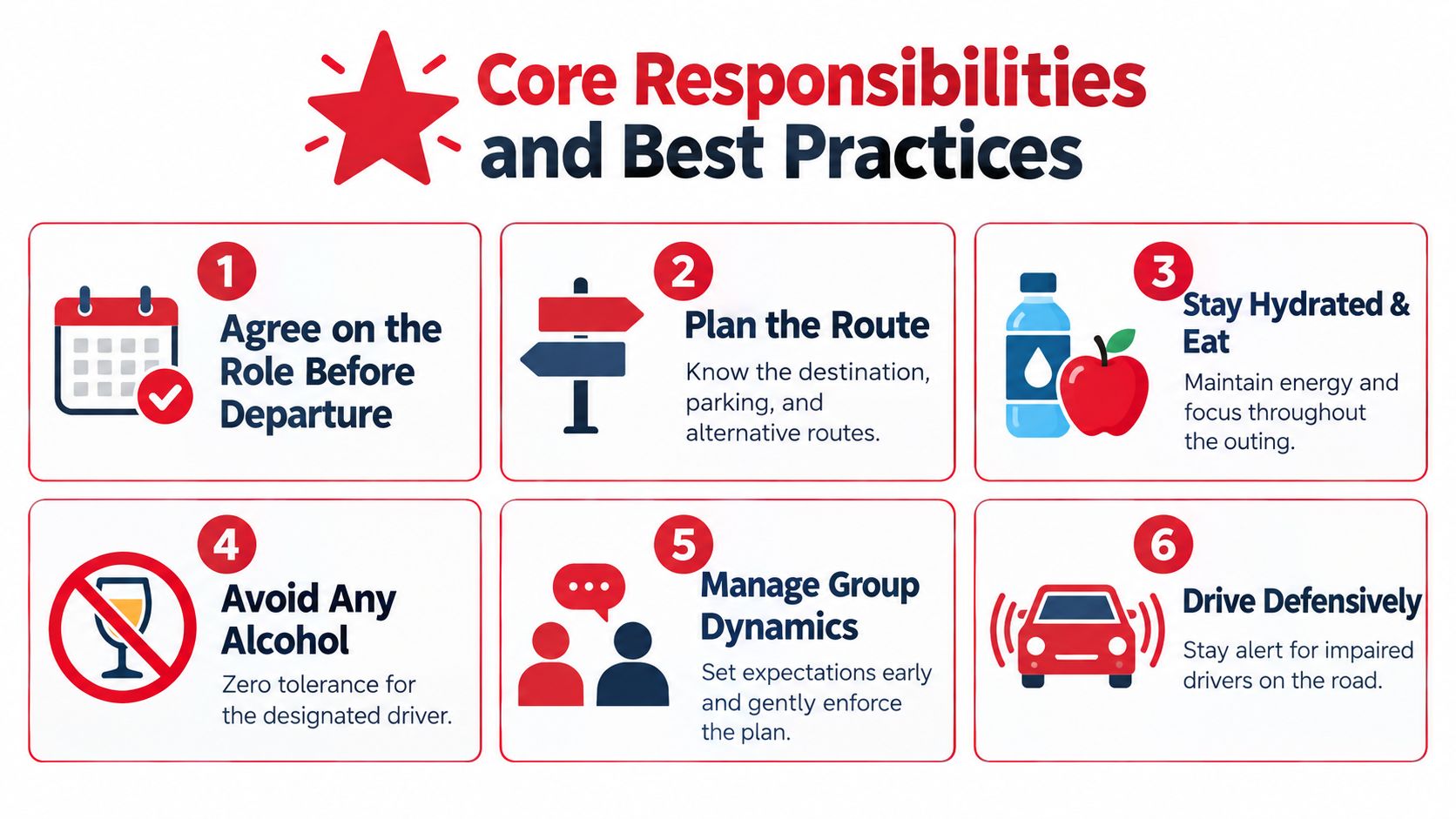
A designated driver agreement only works when somebody does the job all the way through. That job starts before anyone leaves home, continues during the event, and ends only when everyone is where they need to be.
Before the outing
The strongest plans are usually short and spoken plainly.
- Name the driver early: Pick the driver before the group leaves. Don't wait until the end of the night.
- Say the rule out loud: "You're driving, so you're not drinking tonight." That removes wiggle room.
- Set the return plan: Agree on where the group will meet, when they'll leave, and what happens if someone wants to stay longer.
- Know the backup: If the driver can't continue, the group needs another safe ride. A parent, rideshare, or trusted adult is better than forcing a weak plan.
A simple family version works well for teens. Parent asks four questions: Who's driving? Where are you going? When are you leaving? What's the backup if plans change?
During the event
This part is less about driving skill and more about staying steady while other people get distracted.
- Keep the keys with the driver: That reduces last-minute swapping.
- Stay distraction-aware: The designated driver doesn't need to act like security, but they do need to stay alert.
- Watch the group count: If five people came together, five people shouldn't vanish into three different rides without somebody noticing.
- Protect the plan politely: A calm sentence works better than an argument. "I'm driving tonight, so I'm sticking with soda."
Practical rule: If the group starts negotiating whether the designated driver can have a drink, the plan is already slipping.
After the event
The end of the night is when rushed decisions happen. People are tired, phones are low, and everyone wants to get home quickly. That is exactly when the designated driver should slow things down.
- Gather everyone first. Don't move the car while the group is still scattered.
- Check destinations. Make sure the route still makes sense.
- Change plans if needed. If a passenger becomes disruptive, if the driver feels too tired, or if the group lost track of someone, stop and call for help instead of improvising.
- Finish the full handoff. For teens, that may mean making sure everyone gets to the door, not just the curb.
A designated driver isn't successful because the title sounded responsible. They're successful because they followed through on details.
Why the Designated Driver Idea Became a Social Norm
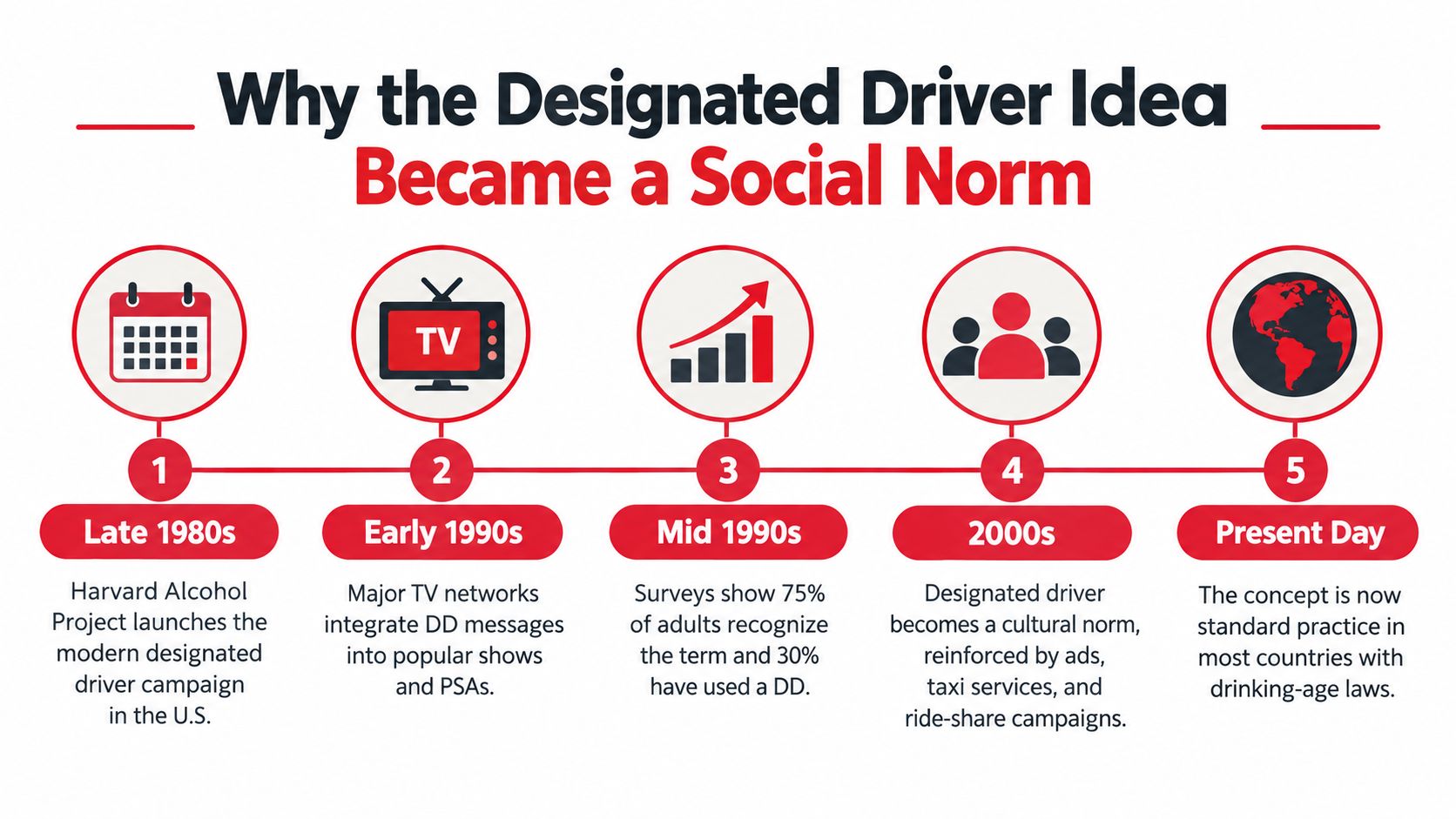
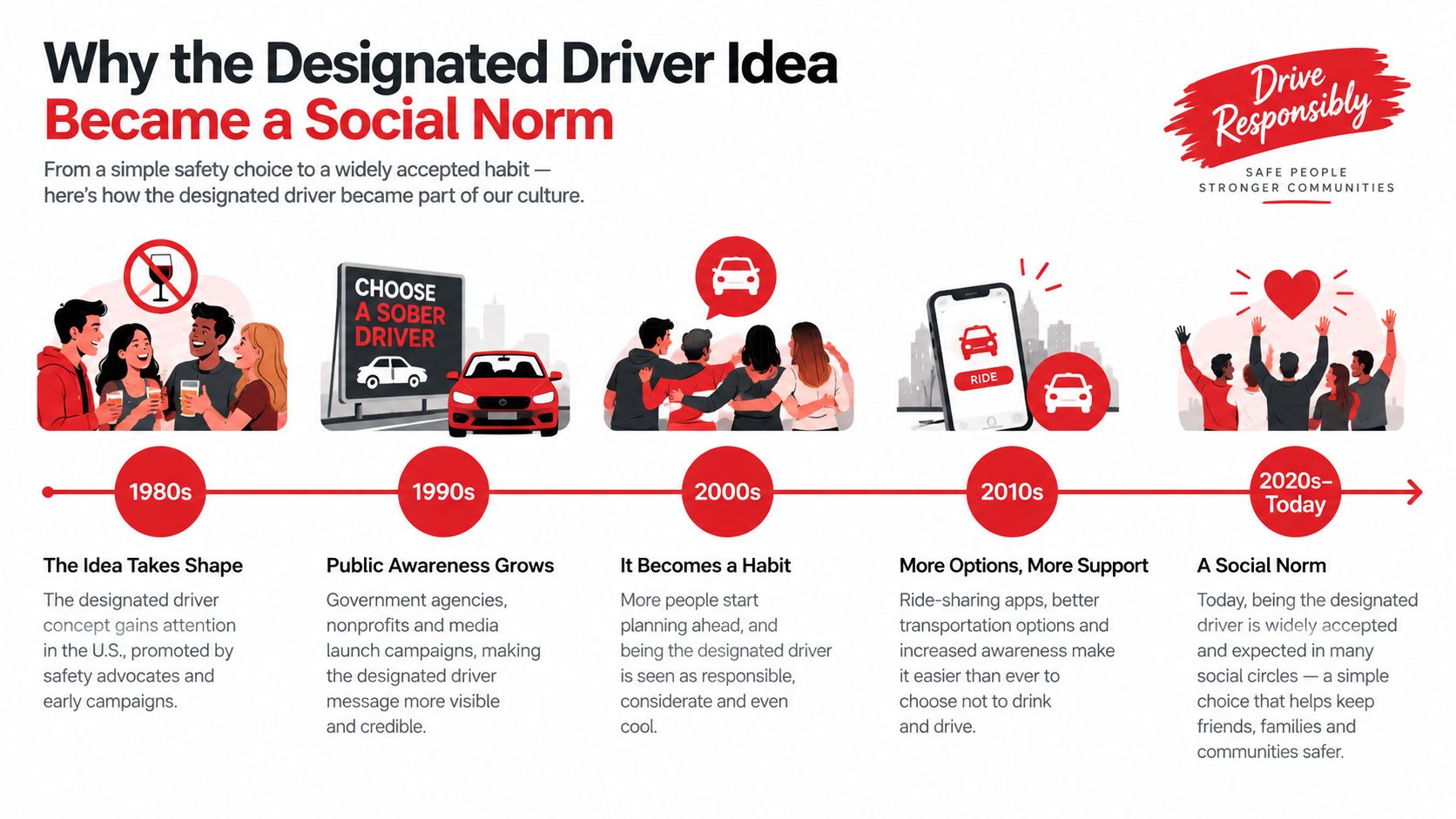
The designated driver idea caught on because it gave groups a simple, memorable job. One person stays sober. Everyone gets home. It was easy to explain, easy to repeat, and easy for pop culture to adopt.
The modern designated-driver movement in the United States was popularized in 1988 through the Harvard Alcohol Project. Harvard notes that when the campaign began in late 1988, annual U.S. alcohol-related traffic fatalities exceeded 23,000. By 1991, the proportion of Americans serving as a designated driver had reached 37%. By 1998, a majority of adults who drink had either served as a designated driver or been driven home by one, and among frequent drinkers consuming five or more drinks in the previous seven days, 62% reported that experience (Harvard Alcohol Project).
Popular doesn't always mean fully proven
An honest explanation helps here. A lot of people assume that because designated driver campaigns became widely known, research must show a clear drop in crashes from those programs alone. The evidence is more cautious than that.
A systematic review reported an average 13 percentage-point increase in people saying they always select a designated driver, yet found no significant change in self-reported impaired driving or riding with an impaired driver (TRID review summary). A later public-health evidence synthesis also concluded that the evidence is insufficient to say designated-driver programs reduce alcohol-impaired driving or alcohol-related crashes at the population level (evidence review in NCBI Bookshelf).
That doesn't make the idea useless. It means we should understand what it does well. It appears strongest as a trip-level planning tool, not as a magic solution that fixes every impaired-driving problem across a whole population.
Why families should still care
For parents and teens, this distinction is helpful. You don't need to pretend the concept solves everything. You need a plan that works tonight, with your group, in your car, on your route home.
If you want a brief Georgia-specific overview of legal and personal fallout, this guide on consequences of drunk driving in Georgia gives useful context without replacing practical ride planning. Georgia families may also want to review the state's Drive Sober or Get Pulled Over campaign as part of that larger conversation.
Common Misconceptions That Put Groups at Risk
The most dangerous misunderstandings aren't dramatic. They're ordinary, casual, and familiar.
"It's fine if the driver only has one."
"They ate food, so they're okay."
"They're the most sober one here."
"We're only going a short distance."
Those are the phrases that weaken the agreement.
The biggest myth is that a little alcohol is still okay
One of the most useful facts in this whole conversation is also one of the most uncomfortable. A roadside study found that about 40% of self-identified designated drivers had not abstained, and 18% had breath alcohol concentrations at or above 0.05 g/210 L (PMC study).
That tells us something important. Many people say "designated driver" while practicing a much looser version of the role.
So if your group says a designated driver is "the one who can still handle it," you're not using the safety model. You're using a gamble.
If the driver drank, even a little, the group should stop calling that person the designated driver and switch to another ride plan.
Food and coffee don't turn an impaired driver into a safe driver
Food may change how someone feels. Coffee may make them feel more awake. Neither one turns a drinking driver into the sober, reliable driver the group agreed on earlier.
This is why parents should teach the phrase, not just the rule. Teens need language they can use in the moment:
- "We said the driver wasn't drinking, so we're changing plans."
- "I'm not getting in the car if you've been drinking."
- "Let's call for a ride and deal with the car later."
Short sentences work because they don't invite a debate.
The safest person in the room still might not be safe to drive
Groups often compare one person to everybody else. "She's the most sober." "He's better than the rest of us." That comparison misses the standard.
The standard isn't "better than the others." The standard is the zero-drinking agreement. If your group struggles with that gray area, this article on how much you can drink before driving can help explain why guessing based on how someone feels is unreliable.
A good backup habit is to rotate the role from event to event. One friend drives this time. Another takes the role next time. That keeps the job from landing on the same person and makes it easier to respect.
How Georgia Teens and Parents Can Plan Ahead
Georgia families do well when they treat ride-home planning like any other driving routine. You don't wait until you're halfway through a lane change to decide where you're going. The same logic applies here.
A short parent-teen check-in before the outing can sound like this: Who are you with? Who is driving? Where will you be? When are you heading home? If that driver can't drive, who is the backup? Keep it calm and matter-of-fact. The goal isn't a lecture. It's a usable plan.
Connect trip planning to driver training
This is one reason driver's education matters. Safe choices are easier when a teen already thinks in routines, risk checks, and backup plans.
Georgia's Joshua's Law requires 16- and 17-year-olds seeking a Class D license to complete an approved driver education course. The approved course can be satisfied through one of four methods: 30 hours classroom plus 6 hours behind-the-wheel and 40 hours supervised driving, including 6 at night; 30 hours classroom plus 40 hours parent-taught behind-the-wheel; 30 hours online plus 6 hours behind-the-wheel and 40 hours supervised driving; or 30 hours online plus 40 hours parent-taught behind-the-wheel (Georgia DDS Joshua's Law requirements).
Georgia DDS also states that teens under 18 must show proof of a DDS-approved driver education course and complete 40 hours of supervised driving with at least 6 hours at night before earning a Class D license. The state describes the program as a 30-hour theoretical component plus a practical behind-the-wheel component (Georgia DDS driver's manual information).
Online courses, lessons, scholarship support, and road testing
Some families need classroom instruction. Others need online scheduling flexibility. Many need both, plus actual time in the car with an instructor. That's where planning becomes practical instead of abstract.
The Georgia Driver's Education Grant Scholarship Program is limited to Georgia residents ages 15 through 17 who have a valid Georgia instructional permit or driver's license, and the program is designed to fund driver education that satisfies Joshua's Law requirements (Georgia scholarship rule).
For families comparing options, look for a school that offers:
- Joshua's Law pathways: Online or classroom formats that meet state requirements.
- Driving lessons and lesson packages: This is often the most useful piece for teens who need practice with turns, traffic, parking, and decision-making.
- Road test support: Especially helpful for students who want a clearer path from training to testing.
- Flexible scheduling: Evening, weekend, and school-friendly time slots make consistency easier.
One local option is A-1 Driving School, which offers Georgia driver education, online course options, driving lessons, lesson packages, and road testing support through multiple metro Atlanta locations.
Parents also may want to talk with teens about backup transportation beyond a designated driver. This piece on the In Memory In Action partnership is a useful reminder that ride safety includes planning the alternative, not just naming the first driver.
A brief reminder about consequences can be part of the talk, but it shouldn't be the whole talk. If you want a short seasonal refresher, 5 ways to avoid a DUI this holiday season fits best as a backup conversation. The main skill is still planning the trip before the keys ever move.
Building Safer Habits Beyond One Night
A designated driver plan works best when it becomes normal, not dramatic. Families don't need a long speech every weekend. They need a repeatable habit.
One habit is language. Ask the same questions every time. Who's driving? What's the route home? What's the backup? Another habit is timing. Make the decision before the outing, not after. A third habit is honesty. If the plan breaks, switch plans quickly instead of trying to rescue a weak one.
Safe driving habits grow through repetition
Driver's education helps because it teaches structure. Driving lessons help because they turn structure into action. A road test checks whether a student can perform skills under pressure, but real driving life also asks whether that student can plan ahead, resist group pressure, and make a calm decision when plans shift.
A designated driver agreement is not a substitute for driver training. It's one of the habits that good training should support.
What to do next
If your teen is preparing for a Class D license, this is a good time to build both tracks at once. Work on the formal requirements. Practice the practical conversations. Make sure the student knows how to drive, how to judge a situation, and how to leave with a safe plan.
If you're comparing Georgia options, focus on what will help your family follow through. Online coursework can make the academic piece easier to finish. Driving lessons and lesson packages can build confidence behind the wheel. Road test preparation can make the final step less stressful. Scholarship information can make training more accessible for eligible teens.
The big idea is simple. Safe nights out don't start in the parking lot. They start with training, planning, and clear agreements made while everybody is still thinking well.
If you're ready to turn safe trip planning into real driving skills, A-1 Driving School offers Joshua's Law courses, online Georgia driver education, driving lessons and lesson packages, scholarship guidance, and road testing support. For teens and parents, that creates a clear path from learning the rules to practicing them on real roads with a plan you can use.