

The earliest ordinary Georgia Class D license is available at age 16, but only after you've held a Class CP learner's permit for at least 1 year and 1 day and completed the Joshua's Law education and driving-practice requirements. You must also meet the remaining licensing requirements and pass the road-skills test.
You might be looking at a birthday on the family calendar while your teen asks whether they can drive to school afterward. Before you promise a license date, pull out the learner's permit. The permit issue date is the real start of the clock, and the months between that date and the road test are your opportunity to fit in coursework, driving lessons, and family practice.
When Georgia Says You Can Get a License
A teen passes the written tests, gets a permit, and asks the obvious question: “When can I get my actual license?” The answer starts with understanding that Georgia treats a learner's permit and a provisional license as different stages.
The permit opens the door to supervised practice. It doesn't authorize unrestricted driving, and finishing a driver-education course doesn't turn it into a license. Your family needs to plan around both the waiting period and the work completed during it.
A birthday isn't the whole calendar
Think of the permit period like a school year you can't skip just because you finished an assignment early. Completing coursework ahead of schedule is useful, but it doesn't erase the required time. Likewise, reaching the eligible birthday doesn't make unfinished driving practice disappear.
For a teen who wants to drive independently as soon as legally possible, the practical question is broader than “When can you get your license in GA?” Ask instead: “What needs to be finished by our earliest eligible date?”
That shift gives the parent and teen different jobs:
- The teen's job: Complete the course, participate actively in lessons, and practice the skills an instructor identifies.
- The parent's job: Make room for supervised driving, keep paperwork together, and coordinate appointments.
- The shared job: Check progress before the road-test date gets close.
Neither the course certificate nor a stack of completed practice sessions answers every licensing question. Education, supervised experience, ADAP completion, and successful road testing belong on the same calendar.
Keep the adult route separate
Applicants 18 and older follow a different route and may apply for a regular non-commercial Class C license, rather than the under-18 Class D provisional license, as explained in the Georgia DDS teen driving laws FAQs.
For families planning the teen route, start early enough to choose lessons deliberately. You want time to compare classroom and online Joshua's Law courses, arrange professional instruction, explore scholarship assistance, and decide where to prepare for the road test.
Calendar rule: Set the target date from the permit, then schedule the training around it. Don't book training around a birthday alone.
The Graduated Path from Permit to Class D
Georgia's graduated system gives a new driver supervised experience before moving toward greater driving privileges. The order matters: Class CP permit, supervised learning, eligibility review, and the Class D road test.
Use the timeline as a broad map, then check the details that apply to your teen.
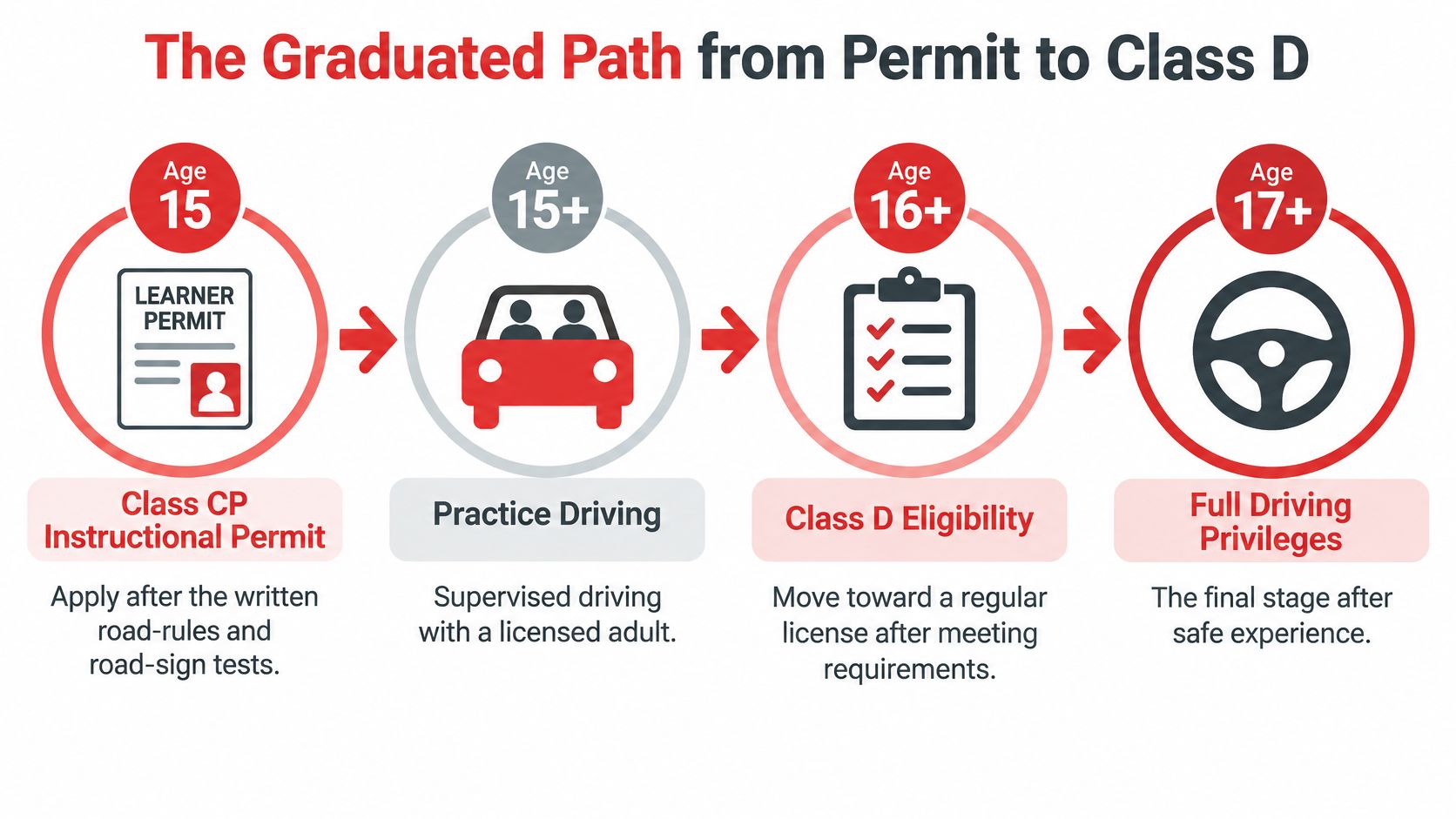
Begin with permission to practice
At 15, a prospective driver may apply for a Class CP instructional permit after passing the written road-rules test, road-sign test, and required vision screening. Georgia's graduated framework was established through the Teenage and Adult Driver Responsibility Act of 1997, commonly called TADRA, to build experience progressively between ages 15 and 18, according to the DDS teen-driving guidance cited above.
Once the permit is issued, treat it as permission to begin learning behind the wheel, not permission to drive alone. A parent should help the teen understand that distinction before handing over the keys.
The next practical step is to arrange an appropriate supervising adult and a manageable practice setting. As an instructional approach, begin with basic vehicle control before asking the teen to handle unfamiliar traffic situations.
Move toward the test without skipping a stage
The Class D stage requires more than time passing. The applicant must satisfy education and practice requirements, meet documentation rules, and pass the road-skills test. Major traffic violations that suspend or invalidate eligibility can also affect the plan.
Keep these checkpoints separate:
- Permission to learn: The permit allows supervised practice.
- Readiness to test: Training and practice help the teen prepare to demonstrate driving skills.
- Eligibility to apply: DDS requirements determine whether the applicant can move forward.
- Successful testing: The teen still has to pass the road-skills evaluation.
A teen can feel confident behind the wheel without having every document ready. A parent can have the paperwork organized while the teen still needs work on observation or vehicle control.
That's why a calendar should include both administrative tasks and actual driving. Mark course completion, lesson appointments, practice opportunities, and a paperwork review as distinct activities.
Don't interpret the final stage of a graduated-driving graphic as automatic unrestricted driving after a course. Class D is a provisional license, not just another name for the adult Class C route. When checking eligibility, use the license class and the applicant's circumstances rather than relying on a birthday label alone.
Joshua's Law Requirements Before Age 16
The work completed before the eligible license date matters as much as the date itself. Joshua's Law connects driver education with practical experience, so an online course by itself isn't the complete licensing pathway.
The checklist below shows the main training components. It describes preparation for the provisional license, not permission to obtain that license before the minimum eligible age.
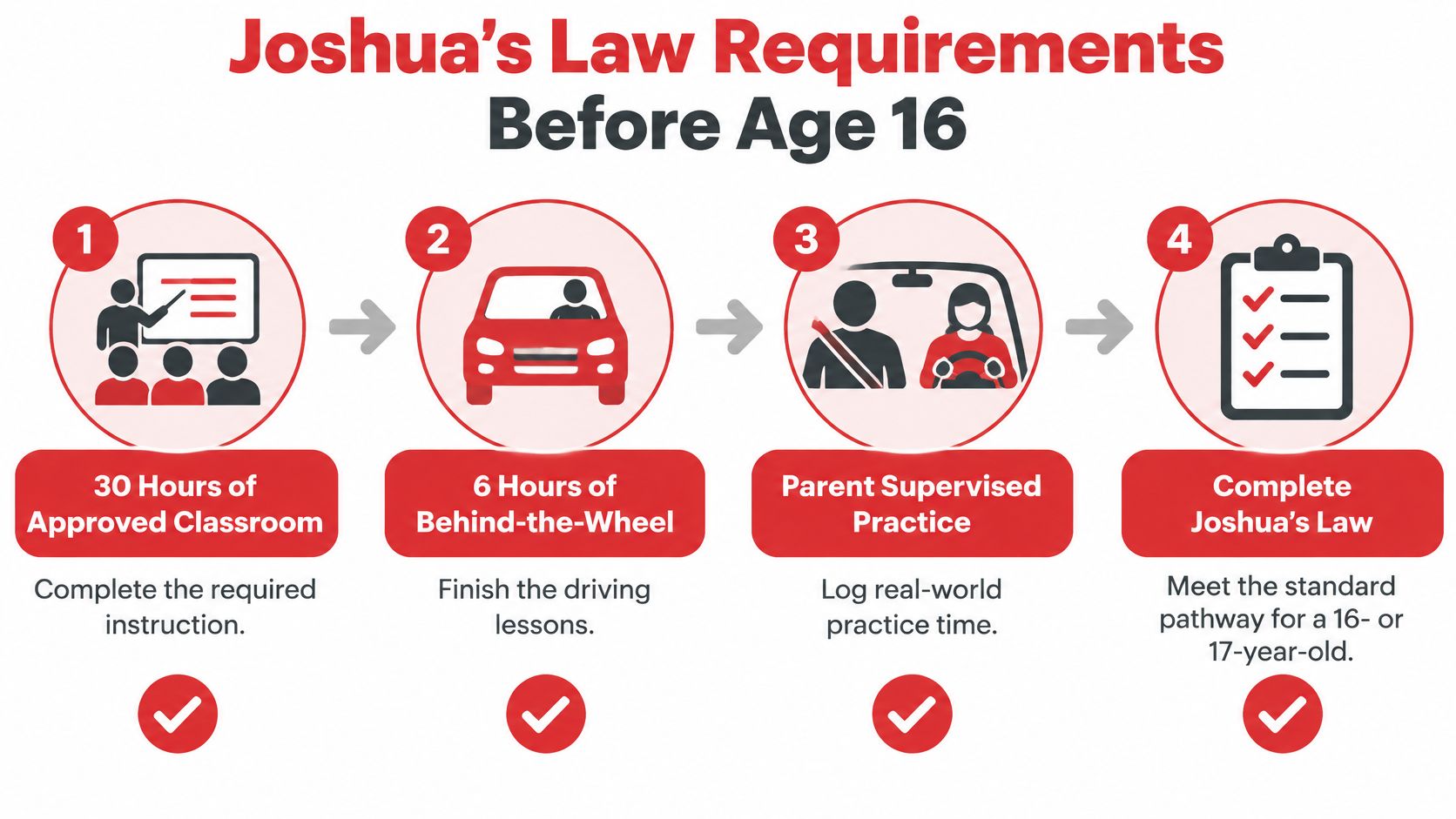
Separate coursework, instruction, and family practice
The standard pathway for a 16- or 17-year-old includes the following, according to the Georgia DDS Joshua's Law requirements:
- Approved instruction: Complete 30 hours of classroom instruction or an approved virtual equivalent.
- Certified behind-the-wheel training: Complete 6 hours with a certified instructor under the standard instructor-led pathway.
- Additional supervised driving: Complete at least 40 hours with a parent or guardian, including at least 6 hours at night.
- Other licensing gates: Complete ADAP or eADAP, satisfy the permit-holding requirement, and pass the state road test.
These are different learning activities. Coursework helps the student understand rules and driving decisions. Professional lessons give the teen guided practice with an instructor, while family driving creates opportunities to apply those skills repeatedly.
Don't assume the instructor hours replace the additional supervised practice. When comparing packages, ask which part of the selected Joshua's Law pathway the package fulfills.
Count hours, not lesson appointments
A requirement measured in hours isn't necessarily a requirement for the same number of appointments. If you're considering six professional driving lessons, ask how long each lesson lasts and how the package documents the certified training.
The useful buying question is: “Does this package satisfy the instructor portion of our chosen pathway, and what practice should we complete between lessons?” That's more helpful than comparing package names alone.
The Joshua's Law requirements guide can help your family organize the course and practical-training pieces before enrolling.
Turning older doesn't remove the education standard
DDS applies the same core education requirements to 17-year-olds applying on or after July 1, 2021, under its Joshua's Law guidance cited above. Don't plan around the idea that waiting for that birthday automatically lets a teen skip driver education.
Keep alcohol and drug education on the checklist as the required ADAP component, then put your scheduling effort into the longer work: coursework, instructor availability, and steady supervised driving.
Before buying a package: Ask what it includes, which completion records you'll receive, and what the parent still needs to supervise.
What a Real Timeline Looks Like at 15
Consider a hypothetical teen who receives a permit just after the eligible birthday. The family circles the next birthday as license day, but the permit anniversary falls later. The required extra day comes after that anniversary, not after the birthday.
Georgia requires a valid permit held for at least 1 year and 1 day, along with successful testing, ADAP/eADAP, school-enrollment documentation, and continued eligibility, as detailed in the DDS Class D application requirements. That makes the issue date, rather than a guessed birthday deadline, the date to calculate from.
Georgia Class D Timing Check
| Milestone | Timing | What must be true |
|---|---|---|
| Permit issued | Start of the permit clock | Read the actual issue date and keep the permit valid |
| Education and lessons | During the learning period | Complete the selected approved pathway |
| Supervised practice | Throughout preparation | Include the required nighttime experience |
| Eligibility review | Before the test appointment | Confirm the holding period, documents, and record |
| Road-skills test | Once eligible and prepared | Pass the test and satisfy the remaining application requirements |
When the family starts training late
Now consider a family that puts off coursework because school and activities are busy. The teen reaches the hoped-for license date with plenty of interest in driving but unfinished education.
Waiting longer can provide more time to complete the pathway. It doesn't, by itself, erase the education requirement for an underage Class D applicant. The practical response is to schedule the missing course and lessons, not assume another birthday fixes the problem.
If your teen hasn't received a permit yet, review when you can get your permit in Georgia before choosing a target license date.
When a move changes the paperwork
Qualifying time held on an out-of-state learner's permit can count after transfer, under the DDS Class D guidance cited above. A move to Georgia doesn't automatically mean the family must restart the waiting period.
Ask DDS how the prior permit history applies before calculating the new timeline. Keep the earlier permit information available for that conversation.
Then work in plain order: check the issue date, confirm validity, reserve a DDS road-test appointment early, and gather identity, residency, school-enrollment, and responsible-adult documents. A folder with completed paperwork won't replace driving readiness, but it can keep a prepared teen from arriving without something necessary.
How Driver Education and Lessons Fit Together
Choosing online or classroom instruction answers where the teen learns the theory. Choosing a driving-lessons package answers how the teen receives practical coaching. Those choices should support each other rather than compete for the same place on the calendar.
Use this comparison to separate the classroom decision from the behind-the-wheel decision.
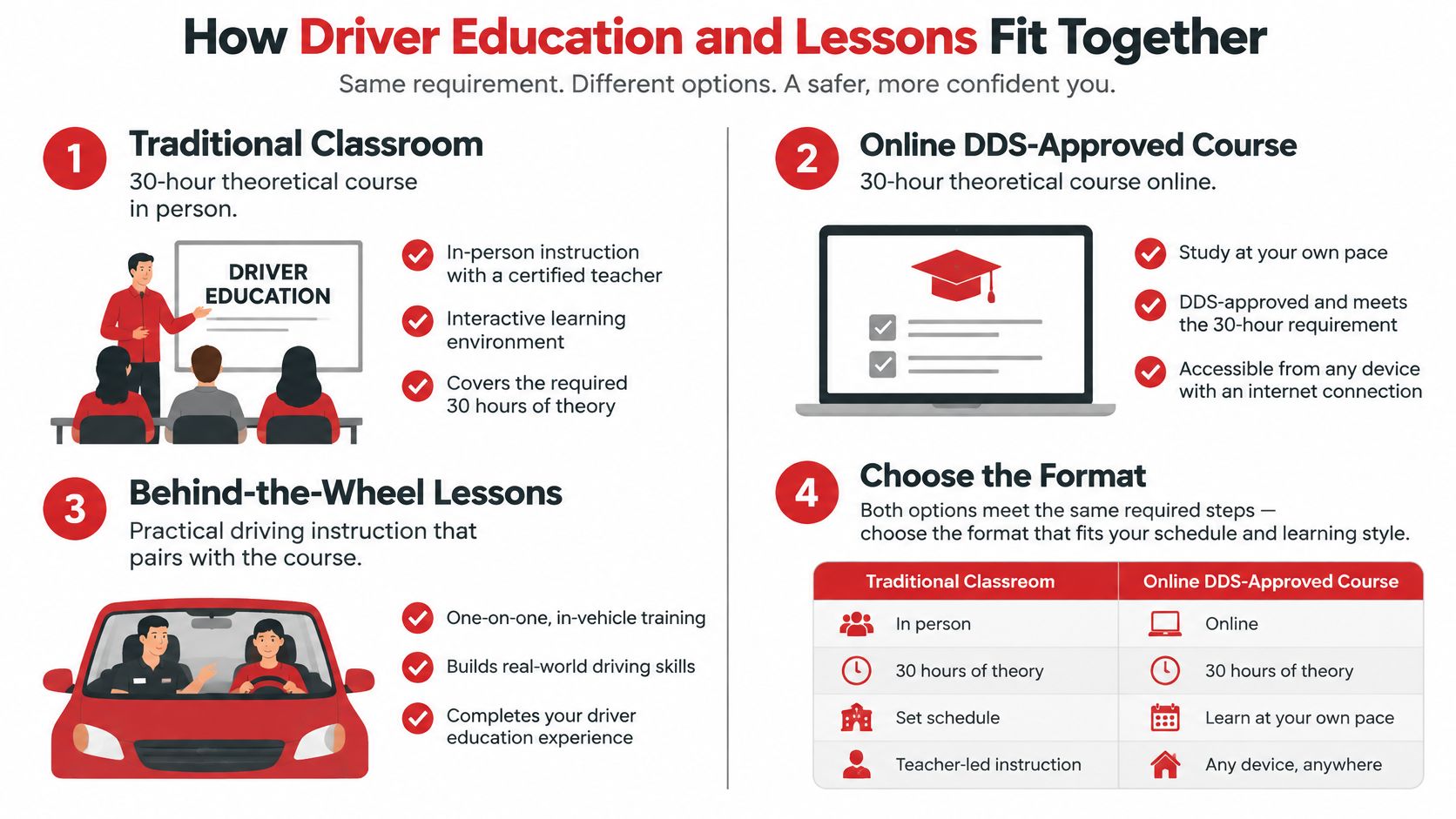
Pick the course format your teen will finish
Georgia permits the required 30-hour theoretical course in a traditional classroom or online through a DDS-approved provider. Depending on the selected Joshua's Law pathway, practical training may involve a DDS-certified instructor or the state's Parent/Teen Driving Guide, as explained in the DDS driver education FAQs.
An online option can fit around a changing family schedule. A classroom option may suit a teen who benefits from a set meeting time and direct discussion. Neither format should be mistaken for a substitute for actual driving practice.
Compare the choices by what your teen needs:
- Online coursework: Choose an approved course and reserve regular time to complete it.
- Classroom instruction: Check that the class schedule works with school, activities, and transportation.
- Professional lesson packages: Ask about certified instruction, lesson duration, scheduling, and preparation for road testing.
- Parent-guided practice: Confirm the selected pathway and understand what the supervising adult must do.
Make the lesson package the practical connection
A-1's Atlanta-area options include DDS-aligned classroom and online Joshua's Law education, customized teen and adult driving-lesson packages, and scheduling across metro Atlanta locations. One useful approach is to pair the course with professional lessons, then use parent practice to reinforce the instructor's feedback.
Ask for specific practice priorities after each lesson. For example, the next family session might focus on smoother stops, earlier observation, or more consistent lane positioning rather than repeating a familiar drive.
The video below can be viewed alongside your course-and-lesson planning.
Know what the supervising adult must confirm
For supervised driving, the accompanying adult must be at least 21, hold an unexpired Class C license, sit beside the teen, and be capable of controlling the vehicle if necessary, under the DDS FAQs cited above. Make sure the person accompanying the teen meets those conditions before practice begins.
Georgia doesn't require a driving log, but a parent, guardian, or authorized certified instructor must affirm that the required supervised hours, including nighttime driving, were completed. Keeping a personal practice record is still a sensible organizational choice, even though it isn't a state-required log.
Road Testing and the Scholarship Grant Path
A completed course certificate shows that the student finished instruction. It doesn't show every skill the student can demonstrate behind the wheel. Passing the road-skills test remains necessary, even after the education and practice work is complete.
Families also need to consider training costs early enough to explore assistance before they postpone lessons.
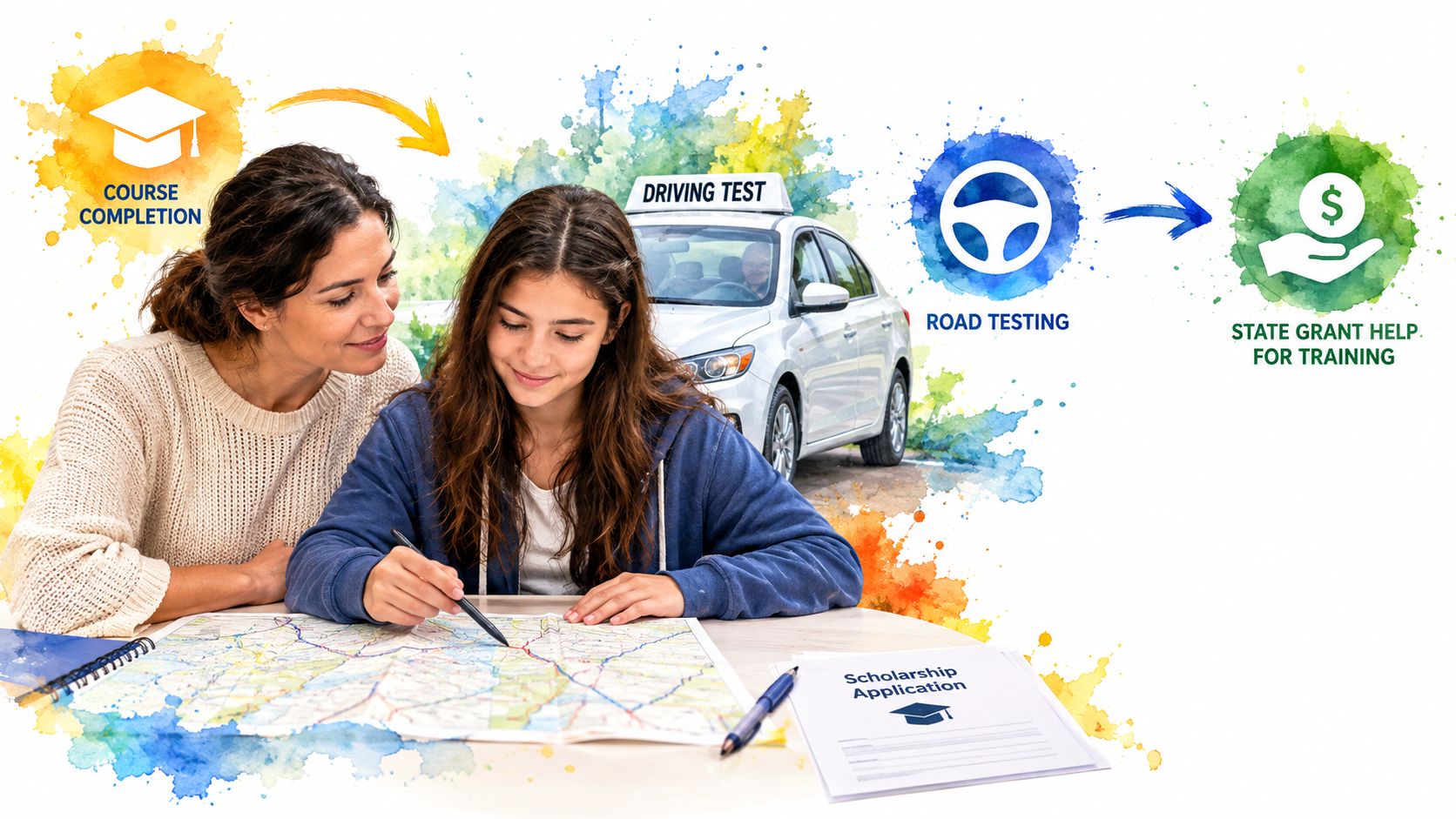
Connect lessons with the road test
School-based road testing can be an alternative to testing only through DDS where an authorized option is available. A-1 offers road-test preparation and testing assistance, so ask which services apply at your preferred location and how they fit your teen's eligibility date.
Don't assume a driving-lessons package automatically includes the test. Confirm what you're booking, what records you need, and whether a separate appointment is necessary.
For preparation, ask the instructor to assess concrete skills:
- Vehicle control: Smooth starts, controlled stops, and consistent speed.
- Turning and positioning: Deliberate turns and appropriate lane placement.
- Observation: Checking the surroundings and recognizing when conditions change.
- Lane changes: Coordinating observation, signaling, and movement.
These are useful coaching priorities, not a promise of a passing result. If a skill still needs attention, use the remaining practice time to address it rather than treating the appointment as immovable.
Ask about scholarship assistance before delaying training
The Georgia Driver's Education Scholarship Grant Program offers training at state expense for qualifying applicants. Review the Georgia driving-lesson scholarship information and ask about eligibility, enrollment, and which training options are covered.
Don't build the family budget around an assumed award. Confirm approval and the applicable arrangements before treating assistance as secured.
A practical combined plan is to choose an approved course, arrange the appropriate lesson package, ask about grant assistance if cost is a barrier, and coordinate road-test preparation. Handle the funding question early enough that you still have room to schedule training.
Finishing an online module and being ready to drive are different achievements. Use lessons to identify what the teen should practice before the test.
The value of professional instruction is the connection between knowing a rule and applying it while steering, observing, and making decisions. That's where a thoughtful lesson package belongs in the licensing timeline.
Your Next Step Toward a Georgia License
This week, take out the permit and write down its issue date. Calculate the required holding period using the DDS timing rule, then compare that date with your teen's course progress, practical training, and supervised experience.
Treat the result as an earliest eligibility target, not a guaranteed license appointment. Your teen still needs to be prepared, eligible, and successful on the road test.
Put the course and lessons on the same calendar
Start with the work you can schedule. Choose online or classroom Joshua's Law instruction, then arrange a driving-lessons package that fits the selected pathway and your family's availability.
Don't leave professional instruction until the end of the permit period. As a planning recommendation, place lessons early enough that the teen has time to use the instructor's feedback during family practice.
A short enrollment conversation should answer practical questions:
- Course fit: Which approved format works with the student's schedule and learning preferences?
- Lesson coverage: What certified training does the package include, and how are appointments arranged?
- Practice priorities: What should the parent reinforce between lessons?
- Testing arrangements: What preparation and testing assistance is available?
- Funding options: What should a qualifying family do to explore the scholarship grant?
A-1 provides easy online signup and multiple time slots, so compare available options rather than waiting for a single class opening. Ask about course enrollment and lesson scheduling together, especially if your teen has a busy school calendar.
Choose preparation over a birthday promise
Parents don't need to promise a license on a particular birthday to keep a teen motivated. Give the teen a plan they can act on: finish the coursework, attend lessons prepared to learn, and participate consistently in supervised practice.
Check progress together. If nighttime experience or an instructor appointment is still missing, address that specific task instead of vaguely deciding the teen needs to “drive more.”
The license date is the day the permit hold, education, required practice, documentation, and successful road test all line up. Booking the course and lessons is how your family starts turning that date from a hope into a workable plan.
A-1 Driving School offers classroom and online Joshua's Law driver education, customized driving-lesson packages, and road-test preparation and testing assistance. Visit A-1 Driving School with your permit issue date handy to explore course enrollment, schedule lessons, and ask about the Georgia Driver's Education Scholarship Grant Program.