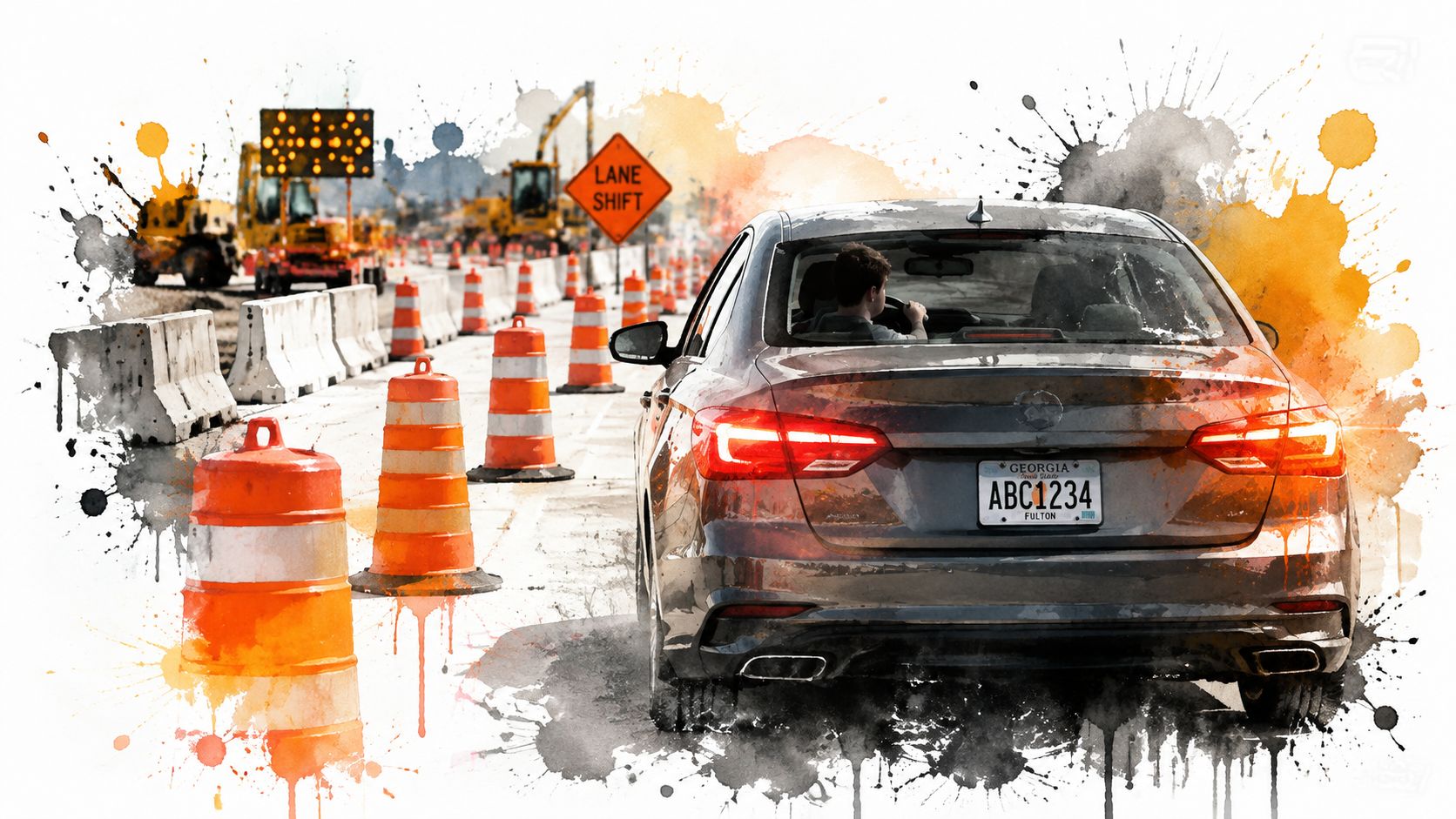
If you're headed out on GA-400, I-285, or I-75 with a teen in the passenger seat, you already know the moment that spikes everyone's nerves. The cones show up, the lane narrows, and the road you thought you knew suddenly behaves like a different street.
That's why construction zone safety has to start before the orange cone. The skill isn't just spotting work ahead, it's reading an altered roadway, keeping your hands calm on the wheel, and adjusting speed early so the car never gets rushed into a bad decision.
The risk is real. In 2023, the National Safety Council reported 898 fatalities and 40,170 injuries in work zone crashes in the United States, and 568 of those deaths happened in construction zones specifically (National Safety Council work zone data). The Federal Highway Administration also notes one work zone fatality for every 4 billion vehicle-miles of travel and for every $112 million spent on roadway construction (FHWA work zone facts). That's the backdrop every new driver in Georgia needs to understand before they ever try to “just get through it.”
Why Construction Zone Safety Starts Before the Orange Cone
A teen on I-285 at rush hour sees a lane shift and no workers on foot. That's where a lot of bad judgment starts. A parent in the next seat may say, “Just keep going,” but the road has already changed, and the driver who still treats it like a normal lane is the one who gets surprised.
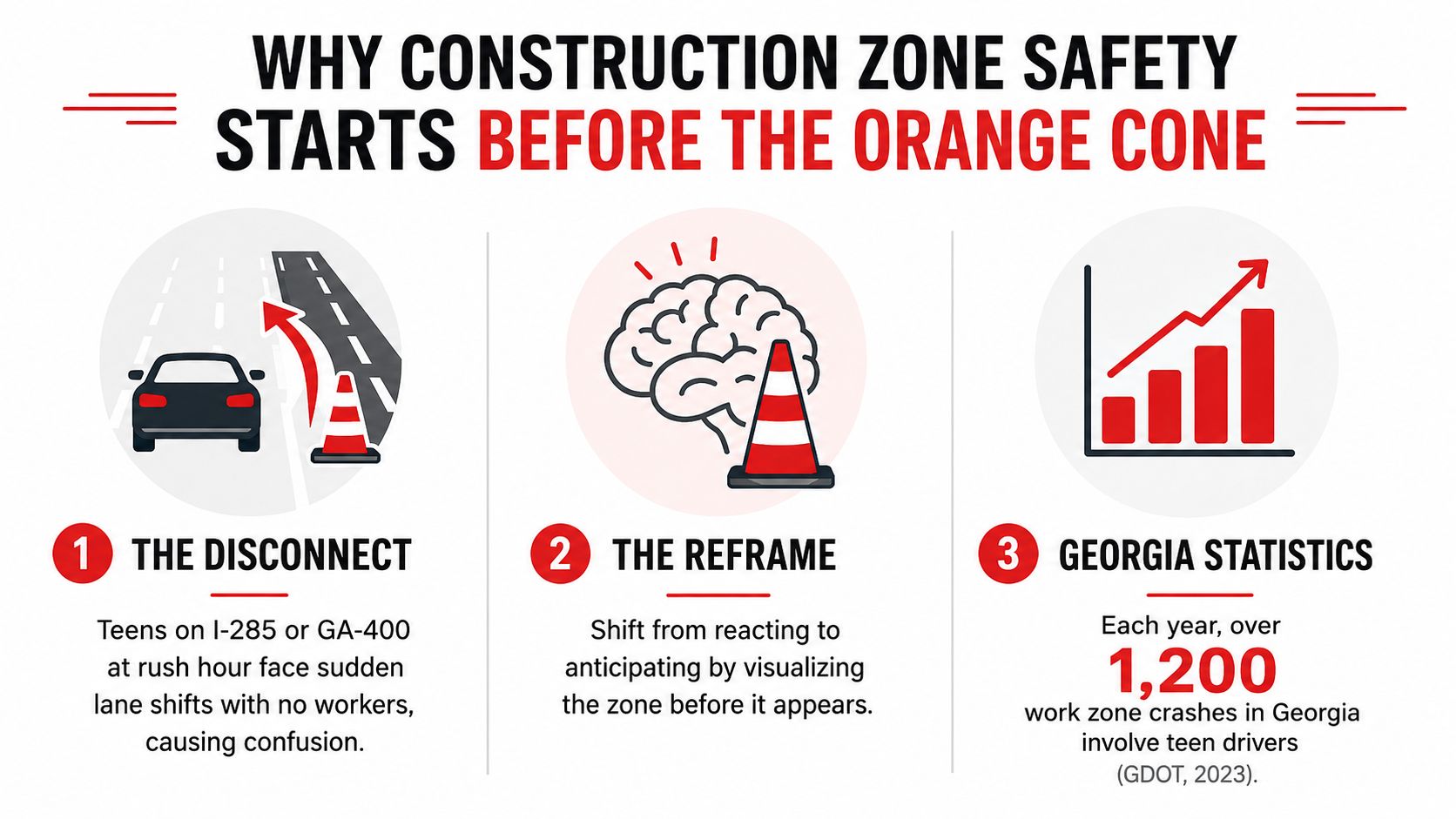
The better mental model is simple, a construction zone is not just a place where people are working, it's a different road geometry. Lanes get narrower, merges come earlier, shoulders shrink, pavement can be uneven, and temporary signals can replace the timing a driver already knows. That changes what your eyes need to do and what your hands and feet should stop doing, especially if you're new and still building habits.
Practical rule: Start slowing down before the cone line changes your options. If you wait until the taper, you've already given yourself less room to think.
What changes in the roadway
A work zone can remove your normal buffer in seconds. A shoulder you rely on for correction may disappear, a lane line may move left, and a smooth merge may turn into a compressed decision point. That's why older family habits like “just keep your speed steady” can be risky advice for a new driver who still needs clear, early cues.
For a behind-the-wheel lesson, this is usually the first teachable moment. An instructor doesn't just tell a teen to “watch out,” the instructor points out where the road has changed, asks the student to name the new lane path, and then has them hold a stable speed before the zone starts to tighten. That sequence, notice, identify, commit, is what makes a driver calmer when the cones appear.
The next step is preparation, because the right mindset works better when the car is ready and the route is already in your head.
Pre-Drive Preparation That Sets You Up to React
A work zone exposes weak preparation fast. If your tires are soft, the car wanders more when lanes tighten. If your headlights and taillights are dirty, temporary lighting and shadows make it harder to read the lane edges. If your phone is buzzing, you're already behind the car in front of you, and that's a bad place to be when brake lights stack up unexpectedly.
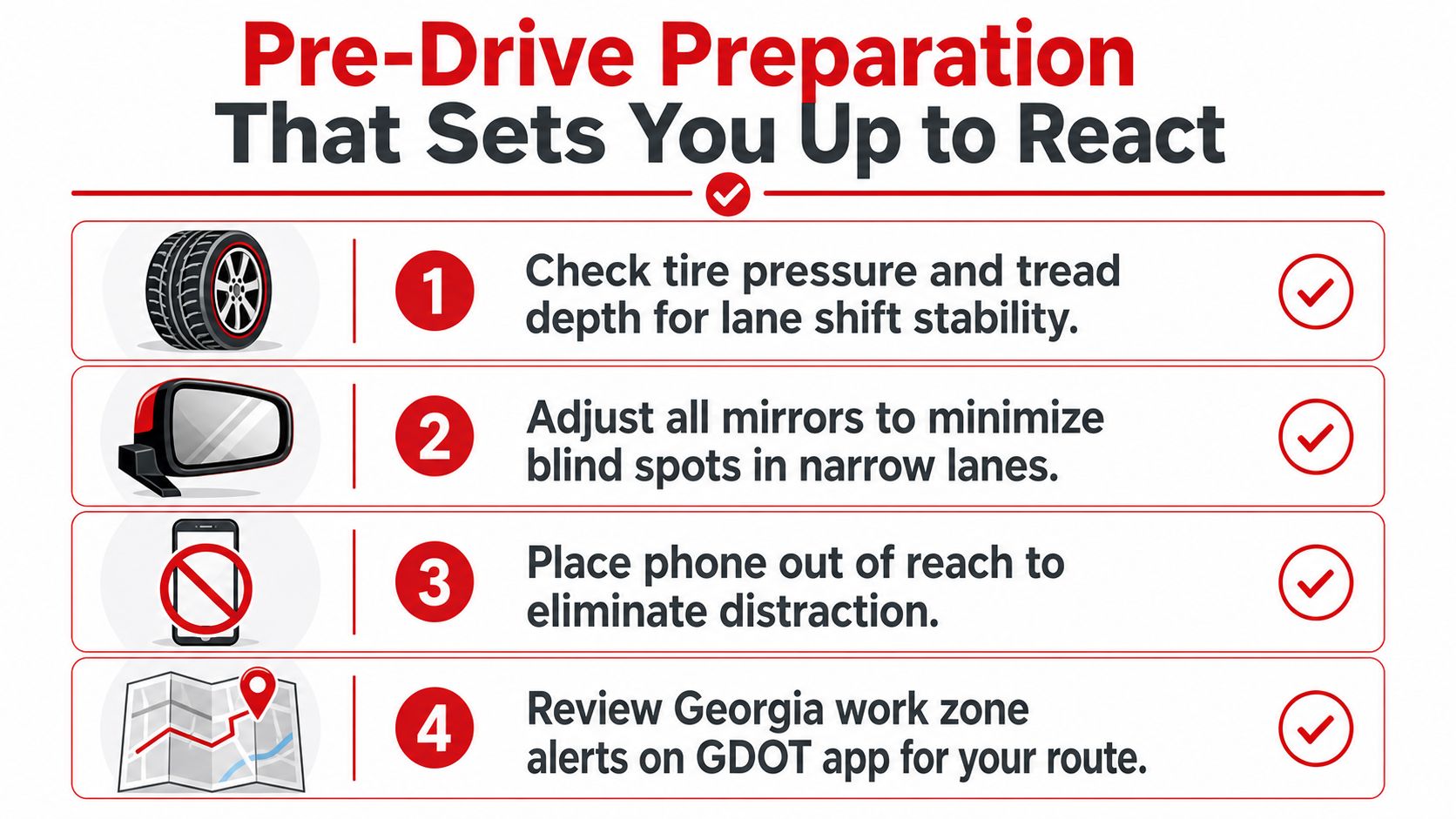
A simple prep routine before the key turns
- Check tire pressure and tread. Narrow lanes and sudden shifts punish sloppy vehicle control, so you want the car to track predictably.
- Clean headlights, taillights, and windshield glass. Dust and glare make temporary lighting harder to read, especially after milling or night work.
- Silence the phone and put it out of reach. In a work zone, the warning often starts several cars ahead, not at the first cone.
- Review the route before you leave. If you know where the likely work areas are, you'll stop treating them like surprises.
A good lesson package should include this kind of setup, because the goal isn't only to steer through cones. It's to teach a student how to arrive alert, organized, and ready to make one clean decision at a time. That's where a teen begins to separate driving from just operating pedals.
The driver who prepares at home has more time in the zone to scan, breathe, and pick a lane without panic.
On Georgia commutes, it helps to think through the roads you already use, including GA-400, I-75, and I-285, before the trip starts. The driver who has mentally rehearsed the route usually stays calmer when the first sign appears, because the mind isn't trying to solve the whole problem at once. For reaction training, a focused resource like how to improve reaction time fits naturally with that habit, because a quicker response only helps when it's paired with early awareness.
Once the car is ready and the route is in your head, the signs stop feeling like a trap and start acting like a cue.
What to Do the Moment You See the Signs
The first sign should change your behavior before the cones force it. That means your eyes go from the center of the lane to the whole road picture, your right foot eases off the gas, and your hands settle in, not tense up. If you're looking for workers, equipment, lane arrows, and the next merge point at the same time, you're already driving better than the teen who just stares at the taillights ahead.
Use the signs to make one early decision
Pick your lane before the taper starts. The biggest mistake is waiting until the merge lane disappears and then trying to push in at the last second. That move creates stress for everyone around you, and it's exactly where drivers get boxed in.
If a flagger steps out or a temporary signal takes over, treat that direction as the control point for the roadway. If the flagger's motion seems unclear, slow further and wait for the instruction to become obvious. Don't improvise, because hesitation plus speed is what causes ugly fixes.
There's also a very Georgia habit that needs attention. When traffic on the opposite shoulder has a crash or a backup, people rubberneck, and that stare drifts the car toward the zone at the wrong speed. Keep your eyes where your lane path is going, not where the drama is.
If you have to choose between curiosity and lane discipline, choose lane discipline every time.
This is the kind of coached repetition a behind-the-wheel lesson should drill. A student learns where to look, when to lift, and how early to commit to the lane, instead of hearing a generic “be careful” and hoping it sticks. That's one reason customizable driving lessons matter, because the correction happens on the road, not in theory.
The next problem is the one careful drivers still miss, the hazards that don't look dangerous until you're already in them.
Common Hazards Drivers Miss in Georgia Work Zones
A work zone with no workers present can fool people into relaxing too much. But the risk doesn't disappear when the crew steps away, because the roadway is still altered, and the lane path still demands attention. That's why the empty zone can be just as unforgiving as the active one.
Hazards that catch experienced drivers too
Night glare is the first one. Portable lighting can flatten depth perception, so cones and barrels may look farther apart or easier to thread than they really are. FHWA specifically recommends glare-control screens in some transition and crossover settings, which tells you glare isn't a minor nuisance, it's a design problem (FHWA aging road user handbook chapter on work zones).
Milled pavement is another trap. Freshly cut asphalt can look dry and ordinary, but the surface can change how the car feels under the tires. A student who keeps a steady, modest speed and avoids sudden steering inputs handles it far better than the driver who jerks the wheel after noticing the texture.
Short merges create the last big problem. When two lanes end very close together, there's no room for a dramatic correction. The right habit is to merge early, match the flow gently, and keep enough space ahead so you're not trapped if the lane narrows again.
The best coaching makes those hazards concrete on an actual Atlanta road. That's where live correction beats a video, because the instructor can point to the exact taper, the exact glare angle, and the exact spot where the student should have moved over sooner. Whether a family books a 2-hour, 4-hour, 6-hour, or 8-hour driving lesson package, the value is in that real-time correction, not just the label on the package.
If you want a broader set of public guidance on lane control and traffic control basics, it also helps to look at materials that explain how agencies mark roadwork, including comply with AS 1319 signage, because better sign reading starts with knowing that the signs are there to reshape driver behavior, not decorate the roadside.
Georgia Work Zone Laws, Fines, and What Actually Happens to Your License
Georgia treats work-zone violations seriously because the behavior is serious. In plain English, that means the penalty isn't just about a ticket, it's about the crash risk your speed and choices create for workers, passengers, and the family in the next lane. A young driver needs to understand that the law follows the danger.
| Mistake | Georgia Consequence | Defensive Habit |
|---|---|---|
| Speeding through an active work zone | Doubled fines and a possible surcharge when workers are present | Slow early and hold a steady, lower speed |
| Ignoring lane-control signs | Citation and points that can stack toward suspension | Read the taper before you reach it |
| Following too closely in a merge | Higher crash exposure and a bad stop-short option | Leave more space and commit earlier |
| Treating work zones like normal traffic | Insurance problems for years after a citation | Drive the altered roadway, not the old one |
Georgia drivers also need the broader licensing picture. Points from a citation can add up toward a DDS suspension threshold, and insurance can feel the effect for the next several years after a violation. That's why it's smarter to treat every work zone as a skill check instead of a dare.
A road test examiner in Georgia will notice work-zone behavior too, because safe lane choice, speed control, and calm observation are part of the same driving standard. If you're using what the Move Over Law means in Georgia as a companion topic, the connection is obvious, road users who give space and slow down reduce the chance that a roadside or work-zone mistake turns into a collision.
The family takeaway is simple. The legal consequence matters, but it's not the main reason to drive carefully. The reason is the human one, the worker on foot, the driver next to you, and the teen behind the wheel who still needs clean habits.
A Parent and Teen Practice Plan That Actually Builds the Skill
A useful practice plan should connect the classroom, the car, and the test. Joshua's Law Driver's Education gives teens the required theory through 30 hours of classroom or online instruction plus 6 hours behind the wheel, and then the road practice turns those ideas into reflexes. That pairing matters because work-zone driving isn't memorization, it's timing, gaze control, and speed discipline.
A simple family sequence
Start with the learning format that fits the schedule. Some families want an in-person classroom, others need the online Driver's Education option for a packed week, and both can support the same safety foundation. If cost is the barrier, the Georgia Driver's Education Scholarship Grant Program may help families who qualify, which makes training more accessible without changing the learning standard.
Then move into live practice. A-1's customizable driving lesson packages are useful because they let the instructor focus on exactly what the teen still misses, lane choice, mirror checks, speed judgment, or merging under pressure. A school with deep local experience matters here, and A-1's role as the Fulton County Board of Education contractor means the curriculum aligns with what many Atlanta-area students already see through their schools.
After that, road-test prep and testing bring the process together. A student who has already practiced work-zone scanning, smooth braking, and early lane commitment usually walks into the test with more confidence, because the motions feel familiar. That's the difference between hoping the driver is ready and knowing they've practiced the exact skill.
A short pause helps before the final step.
The goal for a parent isn't perfection, it's trust. When a teen has seen these situations in lessons, heard the corrections, and practiced them on real roads, handing over the keys feels a lot less like a gamble.
After an Incident and Your Next Steps as a Georgia Driver
If there's a fender-bender or near-miss in a work zone, move the car to a safe lane position if you can do it without creating another hazard. Turn on hazard lights, call 911 if anyone may be hurt, and tell the dispatcher whether workers are present or equipment is still active nearby. Then keep your movements calm and visible.
The next 24 hours matter too. Take photos of the signs, cones, lane shifts, and any visible damage, and notify insurance promptly. If the driver is a teen, expect reporting questions from DDS or the licensing process that may ask what happened and where.
For a step-by-step aftermath guide, the school's accident response procedures are a practical starting point. That same habit of calm, documented response is part of what turns a scary moment into a teachable one.
Construction zone safety isn't luck, it's a repeatable driving skill. If you want your teen to build it the right way, A-1 Driving School offers Driver's Education, Joshua's Law courses, online options, road-test prep, scholarship-friendly enrollment, and driving lesson packages that fit the situation your family is facing. Visit A-1 Driving School to book training that turns work-zone nerves into steady hands, better eyes, and safer speed choices.