

In Georgia, a certified defensive driving course takes up to 7 points off your driving record, and it can never drop your total below zero. The reduction is available once in any 5-year period, and the course has to be a DDS-certified 6-hour Driver Improvement program.
So how many points does defensive driving take off for the driver who is already at 14 and holding a suspension notice? Seven, on paper. Whether that saves the license depends on arithmetic most drivers never run. Georgia suspends a license at 15 points within 24 months, which means a 7-point cut removes roughly half the threshold. It isn't a reset button, and drivers who treat it like one tend to come back two years later with the same problem.
The repair tool and the prevention tool are different things, and that's usually where the front-desk conversation turns. Here's the number, the rule behind it, the exact place drivers misread it, and what to do instead of waiting for points to pile up.
The Point Reduction You Actually Get
A DDS-certified Driver Improvement course removes up to 7 points from a Georgia license record, and the Georgia Department of Driver Services points page states plainly that the reduction cannot take the record below zero. The option belongs to licensed Georgia residents, and DDS allows it once during any 5-year period. The course runs 6 hours, and the original completion certificate has to reach DDS in person or by mail.
Seven is a ceiling, not a payout. That single distinction explains most of the confusion at the counter. A driver with 3 points doesn't receive 7 points of benefit, because there's nothing below zero to remove.
What Seven Points Looks Like on a Real Record
Find your own total in the left column and read across.
| Points before course | Reduction applied | Points after course | Effect on 15-point suspension threshold |
|---|---|---|---|
| 14 | 7 | 7 | Still at risk; course alone does not prevent suspension |
| 12 | 7 | 5 | Drops well below threshold |
| 9 | 7 | 2 | Drops well below threshold |
| 7 | 7 | 0 | Record cleared of those points |
| 5 | 5 | 0 | Already under maximum; reduction capped at zero |
| 3 | 3 | 0 | Already under maximum; reduction capped at zero |
| 0 | 0 | 0 | No points to remove |
Take one row and follow it through. A driver who picked up 12 points over 18 months completes the 6-hour course, mails the original certificate to DDS, and lands at 5 points, comfortably under the suspension line. Same course, same certificate, very different outcome for the driver sitting at 14, who falls to 7 and stays within range if another conviction posts.
What the Course Does Not Do
Three limits matter more than the benefit itself. The reduction cannot erase the underlying conviction or change the offense listed on your record. It doesn't restore a license that DDS has already suspended on its own authority. And it isn't an insurance guarantee, since DDS separately advises drivers to check with their own insurer about a premium reduction.
Practical rule: Pull your DDS point total before you shop for a course. The number on your record decides whether 7 points is a rescue or a rounding error.
If you want the wider picture of how points accumulate and age out of the calculation, our guide to Georgia driver's license points walks through the scoring.
Point Reduction Versus Ticket Dismissal
Say "defensive driving" at a front desk and half the room hears "the ticket goes away." It doesn't. Georgia runs two separate routes that happen to use the same certificate, and the DDS defensive driving program FAQs describe both without ever merging them.
The Two Routes Side by Side
| Question | DDS point reduction | Court ticket dismissal |
|---|---|---|
| Who decides | Georgia DDS | The court handling the citation |
| What it changes | Up to 7 already-assessed points removed from the license record | Base fine reduced by 20% and no points assessed under points avoidance |
| How often | Once in any 5-year period | Set by the court for that citation |
| Where you submit | Original certificate to DDS in person or by mail | Certificate presented to the court as it instructs |
| What it does not do | Erase the underlying conviction or guarantee an insurance discount | Guarantee acceptance for a given citation |
| Typical timing | After points are already on the record | After the citation and before or at the court date |
Which Door You're Standing At
The DDS route is a records fix. Points are already on your record because a court convicted you, and up to 7 of them come off once every 5 years. No one at the courthouse is involved, and nothing about the conviction changes.
The court route is a sentencing decision. When a court accepts an original certificate from a DDS-approved course after a citation, DDS materials state that the base fine must be reduced by 20% and no points are assessed against the driver under the applicable points-avoidance procedure. The court controls whether it accepts that certificate for your citation, so finishing a class on your own initiative guarantees nothing at the bench.
Ask one question before you enroll: is there a conviction on my record, or is there a court date on my calendar?
If points are already posted, you're on the DDS route and the certificate goes to DDS. If you have an open citation, you're on the court route, and the certificate goes wherever the judge instructs in the form the judge requires.
Where the Two Get Mixed Up
The same 6-hour program also serves court orders, license reinstatement, insurance requests and plain personal education. None of those is the statutory point reduction, and completing a course for one purpose doesn't automatically trigger another. A driver who takes the class because a judge ordered it and then assumes DDS will shave 7 points has confused two processes that share a certificate but nothing else.
If you're weighing whether to contest the citation itself, the steps in how to dismiss a traffic ticket cover what a court considers.
Eligibility Checklist and Filing Steps
A parent at the front desk usually asks one thing: if we pay today, do the points come off? Start with the number. Georgia allows one point reduction in any 5-year period, and only after the right certificate reaches DDS. Pay for the wrong class, or file nothing, and the total stays put.
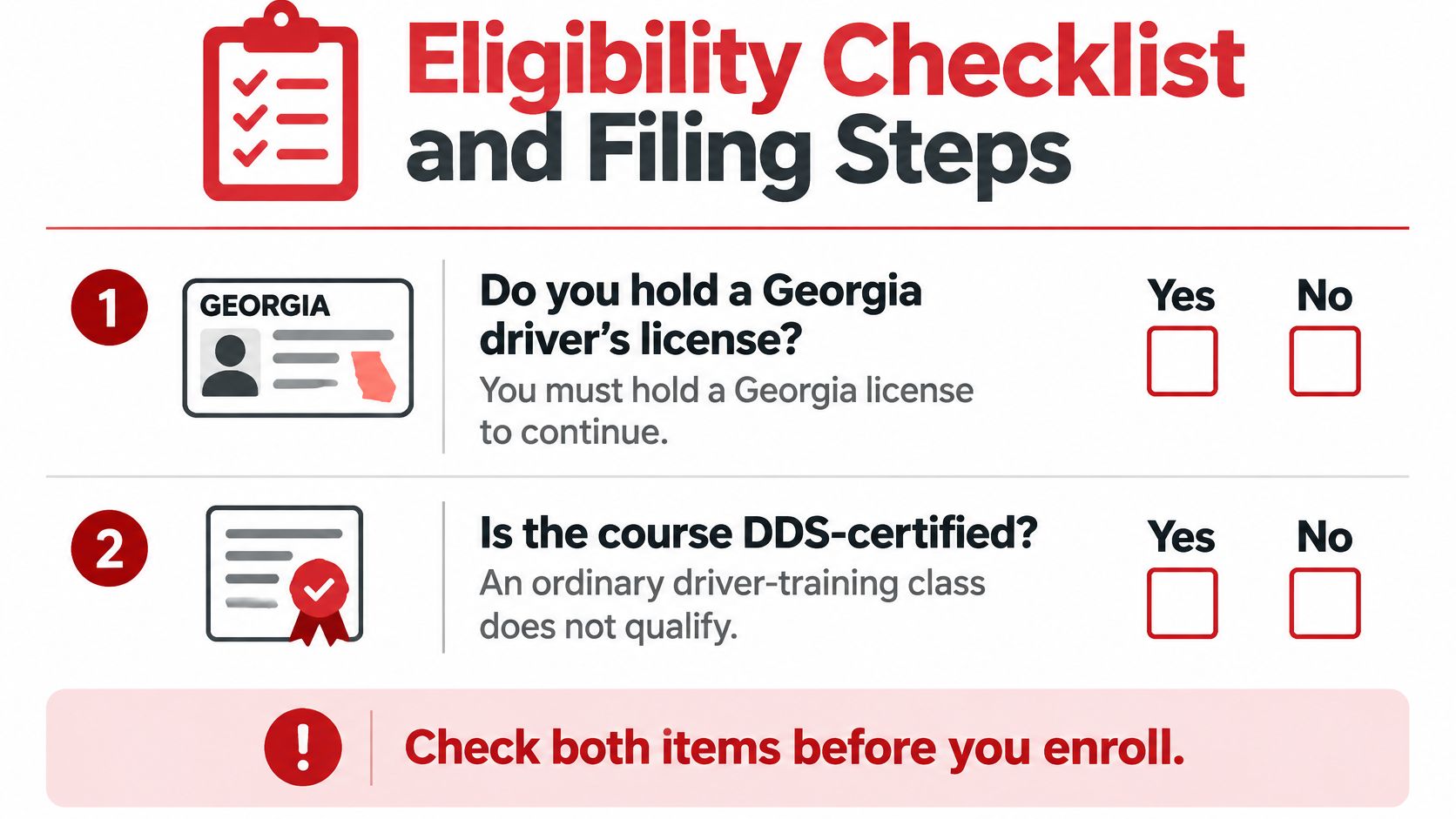
Match the record against four gates before anyone spends the fee. Miss one and the hours will not move the point total.
Run the Checklist Against Your Own Record
- Do you hold a Georgia driver's license? The reduction is a Georgia license benefit, so a permit or license from another state does not qualify. Families miss this when a teen holds an out-of-state permit and still sits in a Georgia classroom.
- Is the course DDS-certified? Only DDS-certified schools are approved for defensive-driving programs. A general driver-training class, even a solid one, is a different product. Lessons train the habits that keep new points off the record. They do not stand in for the certified course that repairs points already posted.
- Have you used a reduction in the last 5 years? The limit is one point reduction in any 5-year period, so check whether you have already used one, since a course taken for another purpose, such as a court order or license reinstatement, is not the same as a reduction.
- Do you have points to remove? The record cannot go below zero, so a clean record gets no benefit from the reduction. A driver still short of suspension range can use a successful reduction to stay clear of it. A driver who already holds a suspension notice needs a separate response to DDS and should confirm eligibility the same week, because a certificate sitting in a drawer is not a record update.
The Filing Sequence That Actually Posts the Reduction
- Pull your driving record and write down the current point total. Everything after this depends on that number.
- Check the 5-year window. If a reduction was used inside it, stop here and deal with DDS directly.
- Enroll in a DDS-certified 6-hour Driver Improvement course, online or in a classroom, and confirm the certification before paying. The common slip is enrolling in a driver-training class instead.
- Complete all six hours. The certificate is issued on completion, not at registration.
- Submit the original certificate to DDS in person or by mail. A photocopy is not the trigger, and neither is the school's internal record of your attendance.
- Recheck the record a few weeks later to confirm the reduction posted.
Common slip: assuming the school reports your completion to DDS on your behalf. The certificate is your paperwork to file.
The administrative trigger is submission, not attendance. The certificate works like a check that has not been deposited: the hours are finished, the points have not moved, and the record still shows the old total. That is why the course feels like it did not work for some drivers.
This walkthrough covers the filing side of the process:
For a second opinion on how a course completion interacts with premiums and court outcomes, how defensive driving affects insurance from Ticket Shield, PLLC is worth reading before you call your carrier.
A-1 Driving School offers a 6-hour Defensive Driving course, available online or in the classroom, which is the format this reduction uses.
Preventing Points With Driving Skill
The 7-point reduction is a repair tool with a five-year cooldown. Driving skill is the prevention tool, and it has no cooldown at all.
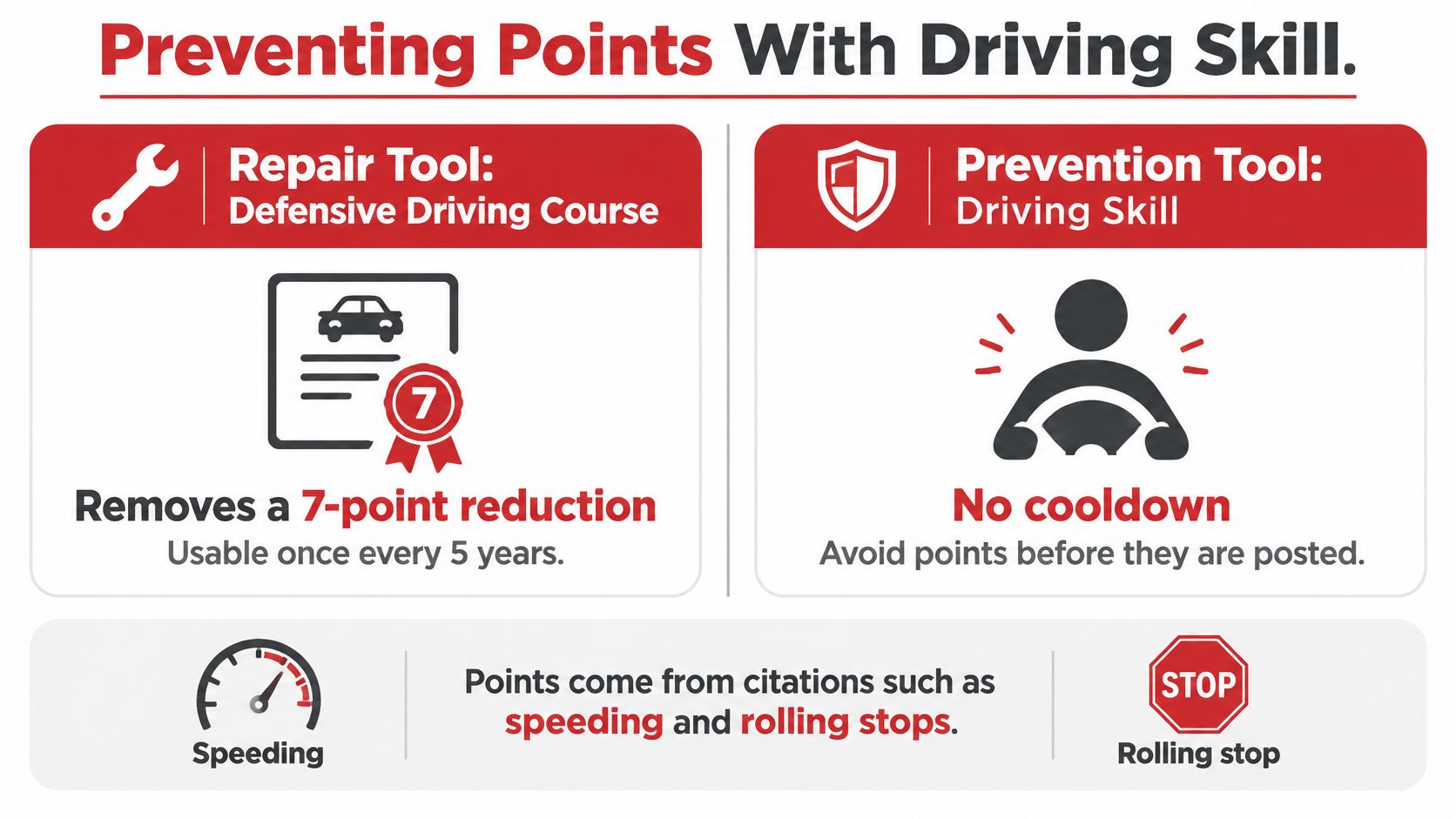
Where Points Come From
Points begin as citations, and citations begin as habits. Rolling through a stop sign at a quiet intersection. Following too closely on the connector. Signaling after the brake instead of before it. Drifting over a limit that dropped from 45 to 35 a mile back. None of those feel dangerous in the moment, and all of them are trainable.
How a Lesson Package Builds the Habit
A driving-lessons package works on the habit rather than the paperwork. The first lesson is an assessment: the instructor watches how you handle speed, stops, lane position and mirrors, then names the two or three habits most likely to earn you a citation.
The middle lessons drill those specific habits on the roads you drive, including the intersections and school zones where enforcement concentrates. The final lessons rehearse the road test route, because the exam measures the same behaviors.
That last piece matters more than most families expect. Applicants under 18 must pass both a vision examination and a road-skills test, as the DDS teen licensing guide sets out, and required driver education splits into at least 30 hours of theory plus 6 hours of behind-the-wheel training. A classroom or online course covers the theory. It doesn't cover the practical skill the examiner scores.
A driver who never earns the first point has nothing to repair.
Georgia's Joshua's Law treats driving lessons as a required part of the licensing process rather than an optional add-on, which the DDS Joshua's Law requirements make explicit. That's a useful frame for parents: the lessons aren't a supplement to the course, they're the half of the training a course can't deliver.
For a comparison of how another state handles course credit, Connecticut DMV point system explained from The Law Offices of Attorney Angel Lugo shows how differently states treat the same idea.
Our Driver's Education and Driving Lessons courses include Georgia DMV-approved Joshua's Law coursework, education and road testing, and we teach driving lessons for both students and adults. On the behaviors instructors coach most, defensive driving practices covers the day-to-day habits that keep points off a record.
Joshua's Law Training Routes
Which set of hours does a 16- or 17-year-old have to finish for a Class D provisional license? Joshua's Law allows more than one route, and the totals are not the same on every route. For the two school routes below, the DDS Joshua's Law course chart sets 30 hours of theory, 6 hours behind the wheel, and 40 hours of supervised driving with 6 of those hours at night.
| Route | Theory instruction | Behind-the-wheel | Supervised driving | Extra requirement |
|---|---|---|---|---|
| Standard school-based | 30 hours classroom | 6 hours at certified school | 40 hours, 6 at night | Vision exam and road-skills test |
| Virtual course | 30 hours online, certified program | 6 hours at school | 40 hours, 6 at night | Vision exam and road-skills test |
Theory Hours Versus Practice Hours
Thirty hours is the theory block, taught in a classroom or through a certified online program. The rest is the car: 6 hours at a school, then 40 supervised hours, 6 of them after dark. Parents often stop once the online login shows complete. The road-skills test scores merging, turns, and night judgment, none of which a screen can log for the teen.
The completion certificate has to come from a DDS-certified training provider. A general tutoring service does not fill either route. Match the enrollment to one row before the hours start, or a finished class can be one DDS will not count.
Those practice hours are also how a new driver stays off a record that a later class can only repair. Supervised night driving and the 6 school hours put the teen on the same kinds of roads an examiner uses. A defensive driving course taken after a citation works on points that already exist. It does not replace the night hours or the school car time this license asked for first.
Choose Your Course and Next Step
Four situations, four different next steps. Match yours before you spend money.

- Open citation with a court date. Follow the court's instructions first, and don't assume the class is a dismissal.
- Points already on the record, no reduction in five years. Enroll in a DDS-certified 6-hour Driver Improvement course and mail the original certificate.
- Teen working through Joshua's Law. Pick one route from the table above, then complete every hour it lists.
- Road test on the calendar. Choose a driving-lessons package built around the Georgia road-skills test.
What We Offer
A-1 Driving School runs an instructor-led Drivers Education Joshua's Law course and an online Drivers Education Joshua's Law course, teen and adult driving lessons and packages, road-test preparation and testing, and the 6-hour Defensive Driving course online or in class. Our Buford location, like our others across metro Atlanta, delivers driver's education in instructor-led and online formats alongside the Scholarship Grant Program, road testing and defensive driving.
Families who need help with cost should ask about the Georgia Driver's Education Scholarship Grant Program, which can offset the price of training for students who qualify. Check eligibility before you compare packages on price alone, because the grant changes the math.
We've helped 100,000 satisfied drivers since 1987, and the front-desk questions are usually the same ones answered here: what does the course take off, when does it apply, and what stops the points from arriving in the first place.
Points are easier to prevent than to repair, and the repair itself has a five-year cooldown. A-1 Driving School offers the 6-hour Defensive Driving course online and in the classroom, Joshua's Law driver's education in instructor-led and online formats, and teen and adult driving-lessons packages with road-test preparation built in. Our instructors will help you confirm which course fits your record or your teen's licensing route before you enroll. Visit A-1 Driving School to see schedules, locations and enrollment options.