You've got vehicles on the road, people with different experience levels behind the wheel, and a lot riding on what happens between the first dispatch and the last stop of the day. In that situation, most companies start with the obvious controls. Insurance paperwork. Vehicle assignments. A policy handbook. Maybe a telematics platform.
That's a start, but it's not a fleet safety program.
A real program connects policy, training, vehicle condition, and coaching into one operating system. It gives managers a consistent way to set expectations, spot risk early, respond to incidents, and improve driver behavior before a claim, injury, or reputation problem forces the issue. It also treats training as a foundation for all drivers, not just a corrective step after someone has already had a bad week.
For Georgia businesses, that matters even more when the driver mix includes younger employees, field staff, new hires, occasional drivers, and people using different vehicle types across different routes. The safest fleets don't rely on one tool. They build a repeatable process and then reinforce it with professional instruction, measurable standards, and regular follow-up.
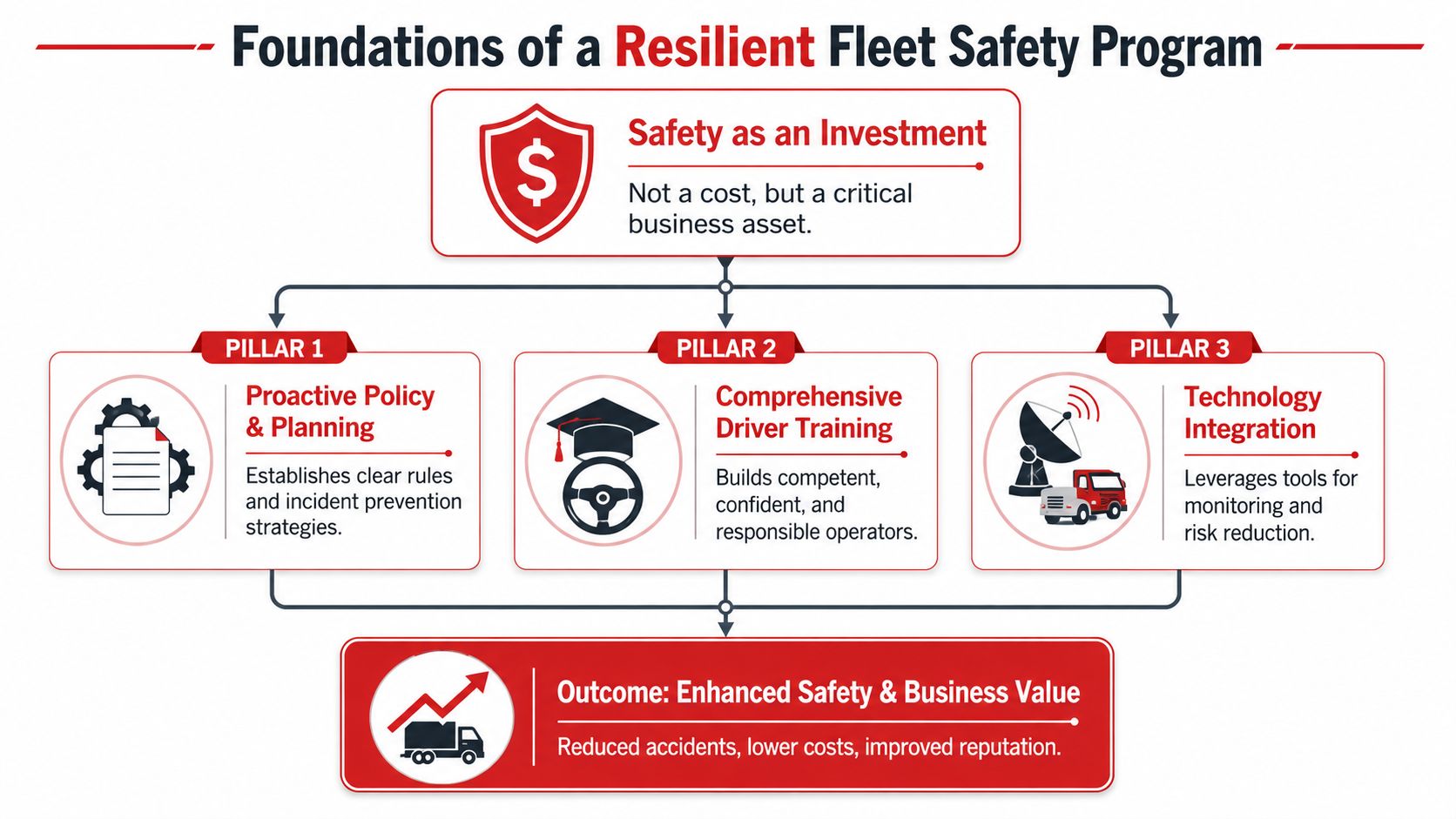
Foundations of a Resilient Fleet Safety Program
Fleet work carries real exposure. U.S. trucking-transportation firms log 3 OSHA-recordable injuries per 100 full-time employees, a rate highlighted in fleet guidance to show why formal oversight matters in vehicle operations, according to Fleetio's fleet safety management guidance.
That number is useful because it broadens the conversation. Fleet safety programs aren't only about crashes. They also address loading and unloading, roadside exposure, fatigue, repetitive driving, and the daily shortcuts that creep in when schedules tighten.
What belongs in the foundation
A resilient program usually rests on four working parts:
- Written standards: Drivers need documented rules for vehicle use, phone use, reporting, inspections, incident response, and qualification requirements.
- Practical instruction: Classroom rules don't fix weak scanning habits, sloppy turns, or poor space management. Drivers need actual skill development.
- Vehicle readiness: A strong safety culture falls apart fast when managers ignore tire condition, lights, mirrors, brakes, or inspection discipline.
- Performance follow-up: If no one reviews patterns, coaching never happens and the policy becomes a binder on a shelf.
A lot of teams overinvest in one pillar and underinvest in the rest. They buy software without changing behavior. Or they write a tough policy and assume drivers will absorb it by memo. Neither approach holds up in the field.
Practical rule: If a supervisor can't explain what drivers are expected to do before a trip, during a trip, after an incident, and during coaching, the program isn't built yet.
Safety has to be operational
The companies that make progress treat safety like dispatch, maintenance, and payroll. It has an owner, a schedule, documentation, and consequences. It also has support. Drivers need to see that the company is trying to help them succeed, not primarily to create a paper trail for discipline.
That changes how you design the program. Instead of asking, “What policy do we need?” ask, “What behavior do we need to see every day?” The answer usually includes clean pre-trip habits, better following distance, lower distraction, smoother braking, proper backing routines, and faster reporting when something goes wrong.
What works in practice
The most durable fleet safety programs usually share a few characteristics:
| Program element | What works | What fails |
|---|---|---|
| Policy | Short, specific, signed, reviewed | Dense manuals nobody reads |
| Training | Repeated, coached, applied on-road | One-time orientation only |
| Maintenance | Inspections tied to action | DVIRs that nobody follows up on |
| Monitoring | Trends reviewed consistently | Event data collected and ignored |
If you're building from scratch, start small but make it real. A simple enforceable program beats a polished document that operations won't use.
Building Your Fleet Safety Policy and Procedures
The best fleet safety policy isn't the longest one. It's the one supervisors can enforce consistently and drivers can understand without interpretation.
A lot of policy documents fail because they try to sound exhaustive instead of usable. They borrow language from an insurer, a handbook template, and an HR packet, then dump everything into one file. Drivers sign it, no one remembers it, and managers start making case-by-case exceptions. That's when credibility slips.
Build the policy in phases
Guidance on program design recommends a phased rollout: define the problem scope and target behaviors, publish written policies with consequences, onboard and train drivers, then deploy telematics and review trends so actions stay consistent, as outlined in Samsara's fleet safety program guide.
That sequence matters. If you install monitoring before drivers know the standards, the technology feels punitive. If you publish standards before you know which risks matter most, the policy becomes generic.
A practical rollout often looks like this:
Scope the exposure
Identify who drives, what they drive, where they drive, and what incidents or risky behaviors keep showing up.Write rules around real behaviors
Focus on seat belts, distraction, speeding, backing, passenger rules, vehicle condition, reporting expectations, and qualification standards.Define consequences and coaching paths
Don't leave discipline to supervisor mood. Set a standard response for repeated issues, preventable incidents, and refusal to follow policy.Train before enforcement ramps up
Give drivers a fair chance to learn the standard before event reviews and formal corrective action begin.
What your procedures should cover
Policies set the standard. Procedures make the standard usable.
Your procedure set should answer a few basic questions:
- Driver qualification: Who is allowed to drive for work, and what documentation must be current?
- Vehicle assignment: Who checks out vehicles, reports defects, and signs off on readiness?
- Incident reporting: Who gets called first, what gets documented, and how fast?
- Post-incident review: Who investigates, who coaches, and who decides preventability?
- Refresher training: What triggers it, and who delivers it?
A policy without a reporting procedure is just a statement of intent.
Georgia realities to plan for
Georgia businesses often have a mixed driver population. Some hires are experienced. Some are new to business driving. Some may be younger employees who still need foundational education tied to licensing requirements. Some use company vehicles every day, while others only drive for work occasionally.
That mix changes the policy design. One standard still applies, but training delivery, qualification review, and documentation often need to vary by role. A sales rep using a personal vehicle for work doesn't present the same exposure as a dedicated route driver in a branded van. Your procedures should recognize that without creating confusion about expectations.
The point is consistency, not rigidity. The strongest policies leave little doubt about the rules, but they still match the way the business operates.
The Cornerstone of Safety Comprehensive Driver Training
Most fleet safety programs put training in the middle of the stack. In practice, it belongs near the top.
Policies tell drivers what the company expects. Technology tells managers where problems may exist. Training is what improves the driver. Without it, you're asking people to perform at a level they may never have been taught to reach.
That's especially true with younger hires, occasional business drivers, and adults who have licenses but weak fundamentals. A license proves legal eligibility to drive. It does not prove professional readiness for company expectations, route pressure, unfamiliar vehicles, customer-facing behavior, or the discipline that fleet work requires.
Why skill-building beats reminder training
Evidence cited in fleet guidance shows that driver training can reduce crash rates by 20% to 30%, but the same guidance warns that training works best when it functions as coaching rather than punishment, according to Automotive Fleet's implementation advice.
That distinction matters. A punishment mindset produces defensive drivers in the wrong sense of the word. They hide mistakes, resent reviews, and treat training as a consequence. A coaching mindset gets better buy-in because it focuses on specific habits, not personal blame.
Here's the practical difference:
| Training style | What drivers hear | Likely result |
|---|---|---|
| Punishment-driven | “You messed up, go take this course” | Resistance and minimal behavior change |
| Coaching-driven | “We need to improve this specific skill” | Better retention and stronger habits |
The training gap most fleets miss
Many organizations assume they only need remedial instruction after an incident. That's backward. Foundational training should happen before drivers prove they need it.
That includes:
- New-hire baseline instruction: Confirm mirror use, lane positioning, backing routine, intersection scanning, and speed discipline before solo operation.
- Role-specific practice: A technician driving a service van needs different emphasis than an office employee who occasionally visits a client site.
- Georgia-specific driver education: If your hiring pipeline includes younger drivers, knowledge of local licensing pathways matters. Joshua's Law coursework, road test preparation, and structured driver's education can all support readiness.
- Flexible delivery: Some employees need in-person instruction. Others benefit from online coursework for scheduling reasons, especially in distributed teams.
For Georgia employers, local training resources are practical, not just convenient. When a workforce includes teens entering the labor pool, adults returning to driving, or employees who need more confidence before operating a company vehicle, professional driver's education and driving lesson packages can close a gap that internal onboarding usually misses.
The safest time to fix a driving habit is before that person becomes your liability.
Some businesses also benefit from assigning foundational reading or supplemental content around vehicle awareness and visibility, especially as newer safety features become more common. Even a consumer-facing resource like this overview of cars that have blind spot features can help frame a conversation about what driver aids can and cannot replace. The key is keeping the focus on judgment, not gadget dependence.
What comprehensive instruction should include
A useful program goes beyond slides and quizzes. It should combine knowledge, observation, practice, and validation. That usually means:
- Classroom or online learning for rules, risk awareness, and licensing-related fundamentals
- Behind-the-wheel lessons for actual vehicle control and hazard management
- Road test preparation or evaluation to confirm a baseline standard
- Lesson packages that allow repetition for drivers who need more than one session
That last point is often the differentiator. Real skill change usually takes more than one exposure. Fleets that treat training as a process get better consistency than fleets that treat it as a checkbox.
Leveraging Technology for Proactive Risk Management
Technology helps most when it supports a coaching conversation that would otherwise be vague.
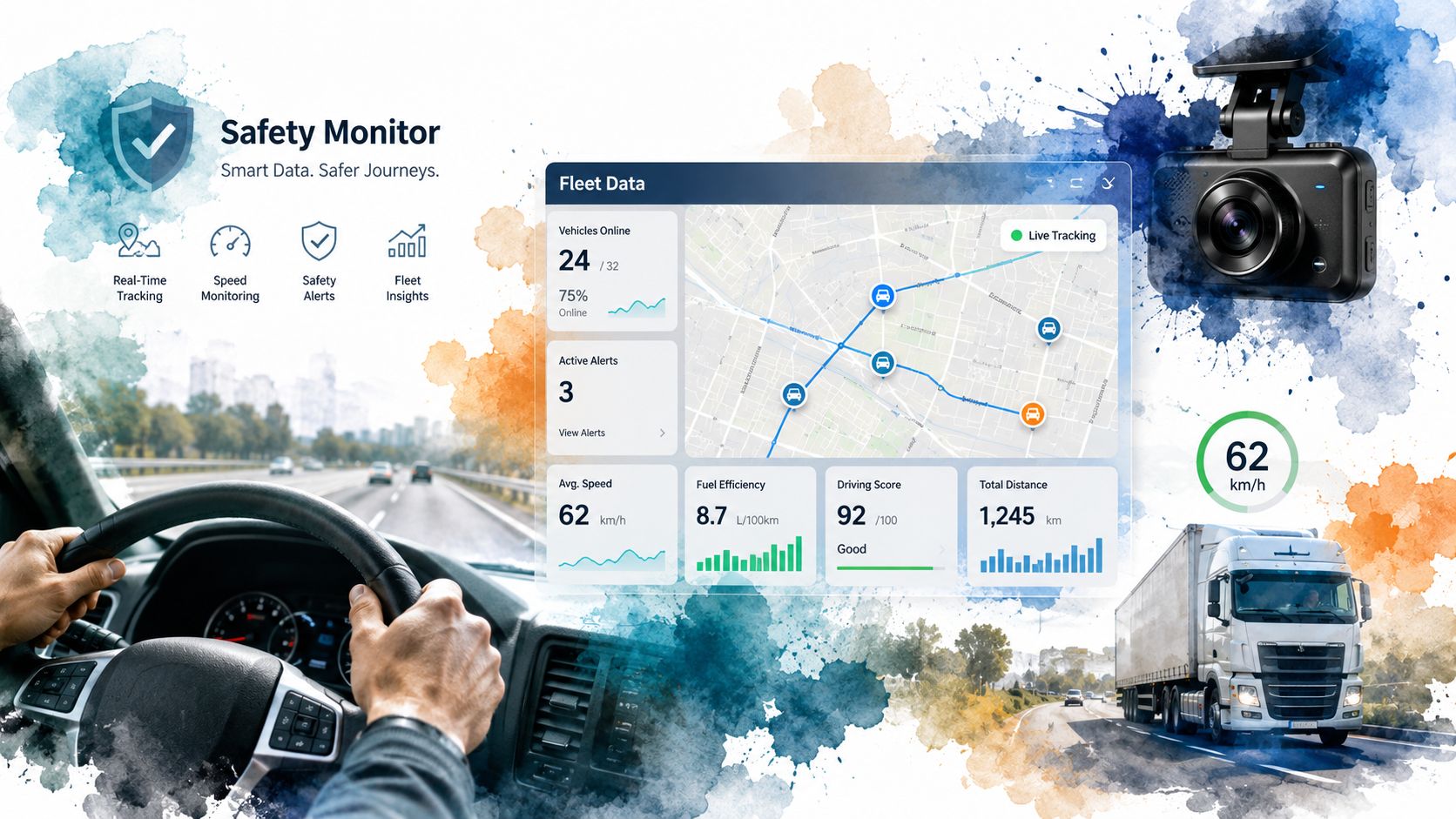
A manager may suspect a driver follows too closely or brakes late, but suspicion doesn't create a fair review. Telematics, dashcams, ELD data, and digital inspection workflows give managers specific events, timestamps, route context, and repeatable standards. Used well, those tools make coaching more objective.
What to monitor first
You don't need every possible alert on day one. Start with behaviors that drivers understand and managers can coach consistently.
Common starting points include:
- Speeding events
- Harsh braking
- Rapid acceleration
- Seat belt compliance
- Idling patterns
- Inspection completion
- Vehicle defect reporting
The mistake is dumping raw event counts on a supervisor and calling it a safety program. Event data needs context. Exposure matters. Route type matters. Vehicle type matters. A driver in dense urban traffic will generate a different event pattern than someone covering long suburban runs.
Why coaching matters more than the device
Industry data shows 91% of businesses reported improved safety after using driver performance coaching, and 96% of fleet managers surveyed said they use coaching as part of their safety approach, according to Teletrac Navman's driver safety program article.
That tracks with what operators see in the field. Technology by itself doesn't improve behavior. The manager who reviews patterns, picks one or two issues to address, and follows up the next month improves behavior.
A simple coaching rhythm works well:
- Review exception trends, not one-off noise.
- Pick the clearest behavior issue.
- Meet with the driver quickly while the event is fresh.
- Tie the event to a driving standard.
- Agree on one corrective habit.
- Recheck the data later.
Field note: If every event becomes a disciplinary meeting, drivers will fight the system. If managers ignore repeated patterns, the system loses credibility. The middle ground is structured coaching with consistent thresholds.
For fleets trying to strengthen those conversations, even supporting materials around visibility and hazard awareness can help drivers connect the data to real-world decisions. For example, discussions about mirrors, lane changes, and sensor limitations can be reinforced with practical reading such as guidance on cars that have blind spot features.
Use digital inspections to support safety, not admin
Vehicle condition often gets less attention than behavior data because maintenance defects feel routine. That's a mistake. If drivers submit DVIRs and no one closes the loop, the system teaches them that inspections don't matter.
Good digital inspection workflows should do three things:
| Tool input | Needed response |
|---|---|
| Driver reports defect | Maintenance reviews and assigns action |
| Safety-critical defect appears | Vehicle status changes immediately |
| Repeat defect pattern emerges | Manager looks for process failure |
A short explainer can help teams see how coaching and monitoring fit together in everyday operations.
Technology earns trust when drivers can see the purpose. Fair review, better coaching, faster incident reconstruction, and cleaner maintenance follow-up all support that trust.
Why Outsourcing Driver Training Is Your Smartest Move
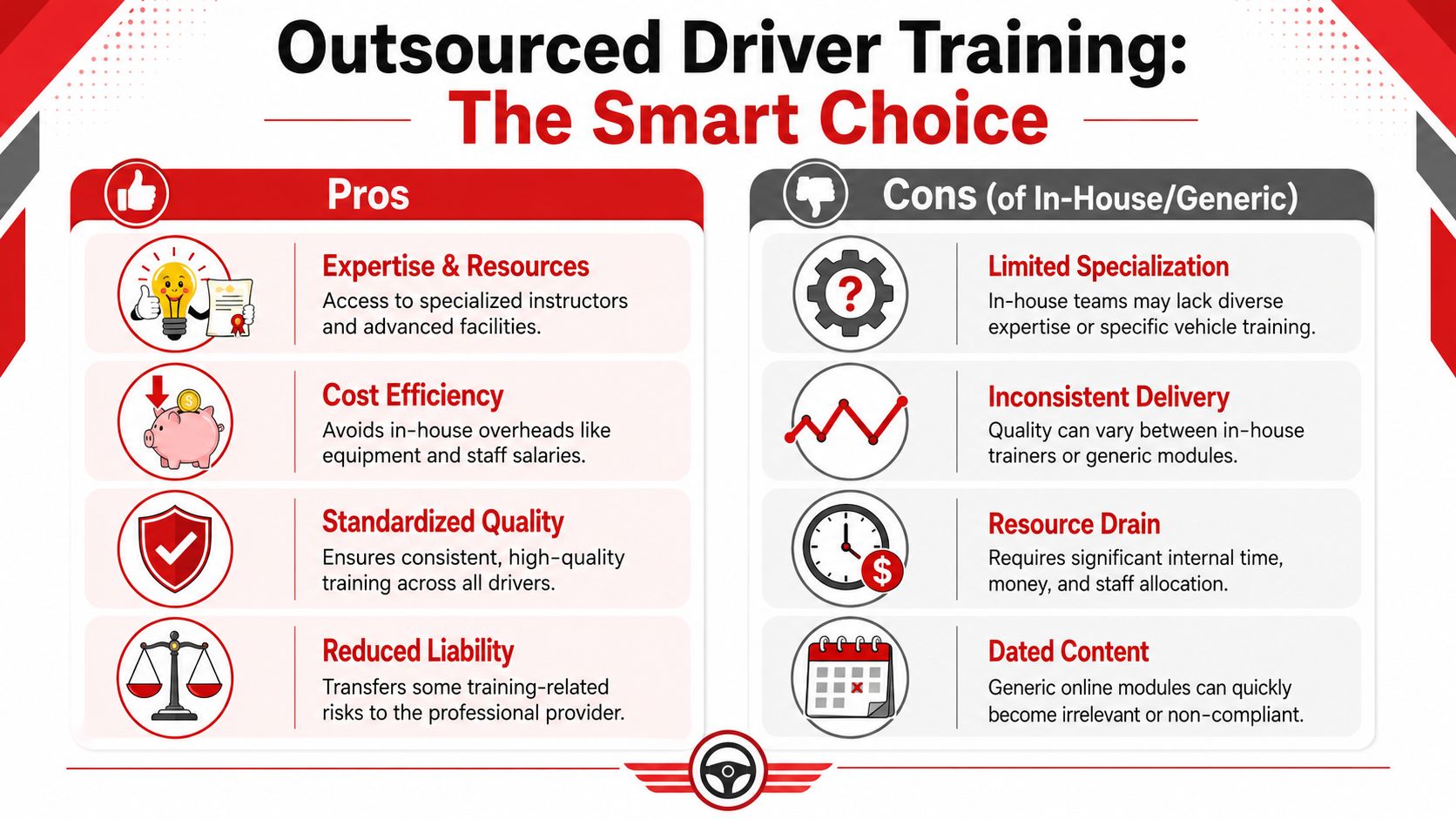
Most businesses aren't built to train drivers at a professional standard. They may have capable supervisors, but that's not the same as having trained instructors, structured lesson plans, evaluation consistency, scheduling capacity, and road test support.
That's why in-house training often drifts into one of two weak formats. Either it becomes a quick ride-along with a senior employee, or it becomes a generic online module that checks a compliance box but doesn't reveal whether the driver can perform.
Where in-house programs break down
The practical limits show up fast:
- Trainer inconsistency: One supervisor coaches mirror use aggressively. Another barely mentions it.
- No neutral evaluator: Drivers may respond differently when assessed by someone outside their daily reporting line.
- Weak behind-the-wheel structure: Most companies can explain policy better than they can deliver actual on-road instruction.
- Scheduling friction: Operations teams often delay training because they're trying to keep vehicles moving.
That's how businesses end up with drivers who are “cleared” internally but still lack confidence in traffic, reversing, lane changes, or test readiness.
What an outside provider does better
A professional school brings process. It can deliver driver's education, behind-the-wheel lessons, road test preparation, and skill validation in a format that's built for learning rather than squeezed around normal operations.
For Georgia employers, that matters in several situations:
- Hiring younger drivers: Joshua's Law-related education and structured entry-level training help establish a cleaner baseline.
- Upskilling adults: Some licensed drivers need instruction, not discipline.
- Supporting distributed teams: Online course options can handle the knowledge side while in-car lessons address the skill side.
- Validating readiness: Road testing and lesson packages provide clearer evidence of competence than informal sign-off.
There's also a credibility benefit. Drivers usually view third-party training as more objective than in-house correction. That reduces some of the defensiveness that comes with supervisor-led remediation.
“Use specialists for specialist work. Your shop handles your vehicles. Your dispatcher handles routes. Professional instructors should handle driver instruction.”
Why local delivery matters in Georgia
National e-learning platforms can help with awareness, but they usually can't provide what many Georgia businesses need. They can't sit in the passenger seat. They can't evaluate a nervous new hire on local roads. They can't prepare a teen employee for state requirements. They can't provide a road test experience tied to performance.
Local providers can also help families and young hires manage practical barriers such as scheduling, online course access, and eligibility for the Georgia Driver's Education Scholarship Grant Program. That's useful when a business hires younger workers and wants a safer, more structured path from learner status to work readiness.
If your company wants fewer surprises, outsource the part that most directly affects how someone operates a vehicle. You'll get more consistent instruction, clearer evaluations, and less internal strain on supervisors who already have enough to manage.
Maintaining Momentum and Measuring Success
The hardest part of fleet safety programs isn't launch. It's month four, month eight, and the point where the policy is written, the platform is live, and people start slipping back into old routines.
That's why mature programs measure behavior change, not just activity. A manager can hold meetings, assign courses, and review videos all month long without improving anything. The question is whether drivers are operating differently over time.
Track a short KPI set that means something
Advanced guidance points to the need for monthly KPIs such as preventable crashes per million miles, speeding events, and maintenance compliance so teams can prove the program is working, not just that it exists, as noted in Motive's guidance on elements of a fleet safety program.
The useful lesson isn't to track everything. It's to track a manageable set and keep the definitions stable.
A practical monthly review might include:
| KPI | Why it matters |
|---|---|
| Preventable crash trend | Shows whether risk control is improving |
| Speeding event pattern | Helps identify repeat behavior and route-specific issues |
| Maintenance compliance | Confirms vehicles are safe to operate |
| Near-miss or coaching follow-up trend | Shows whether intervention is happening |
Look for changes in behavior, not just totals
Raw counts can mislead. If one team drives more miles, handles tighter routes, or operates more frequently in dense traffic, it may produce more alerts even if its safety culture is stronger.
That's why good reviews compare similar work groups, similar routes, and similar vehicle types. They also look for persistence. A single clean month after coaching doesn't prove much. Several months of steadier behavior does.
Some fleets also support driver engagement by helping employees understand the personal side of safer driving. Practical topics like claim avoidance, cleaner records, and vehicle ownership costs can reinforce the message. Consumer-oriented education, such as advice on how to lower car insurance premiums, can complement workplace coaching because drivers often respond when they see how habits affect them outside work too.
Good measurement asks, “Are our drivers getting better at the same work?” Not, “Did the dashboard light up less this week?”
Keep the program alive
A durable safety culture usually includes recurring habits, not heroic efforts. Managers revisit policy during onboarding. Supervisors hold brief coaching sessions instead of waiting for annual reviews. Maintenance and operations share defect information. Drivers know what happens after an incident because the process is consistent.
Recognition helps too. Not because praise replaces accountability, but because drivers should see that the company notices disciplined, professional operation. A team that only hears from safety after something goes wrong will start treating safety as enforcement rather than support.
The strongest long-term programs pair three ideas well. Clear standards. measurable review. ongoing training. Remove any one of those and the system weakens. Keep all three active and the program starts working like part of normal operations instead of an extra initiative.
Georgia businesses that want safer drivers usually don't need more theory. They need a reliable training partner that can help with driver's education, Joshua's Law courses, online learning options, road test support, along with behind-the-wheel driving lessons and lesson packages essential for building real skill before an incident forces the issue. A-1 Driving School serves Georgia drivers with in-person, online, and road-ready training options that fit both new and experienced drivers, including support for the Georgia Driver's Education Scholarship Grant Program.